
 E-Paper



Staff shortages hit governance across Haryana, survey flags gaps
CMGGA review finds major vacancies in DC offices, revenue, education and civic bodies, slowing grievance redressal and routine work statewide.

 Prefer HTon Google


Acute staff shortages across key government departments in Haryana are severely affecting governance and public service delivery, particularly in south Haryana districts such as Gurugram, Faridabad and Palwal, according to a rapid feedback survey conducted by the Chief Minister’s Good Governance Associates (CMGGA), a government initiative where university students are embedded in grassroots governance. The survey, yet to be released to public, found significant vacancies in district administration, revenue, education and urban local bodies, contributing to delays in grievance redressal and routine government work.
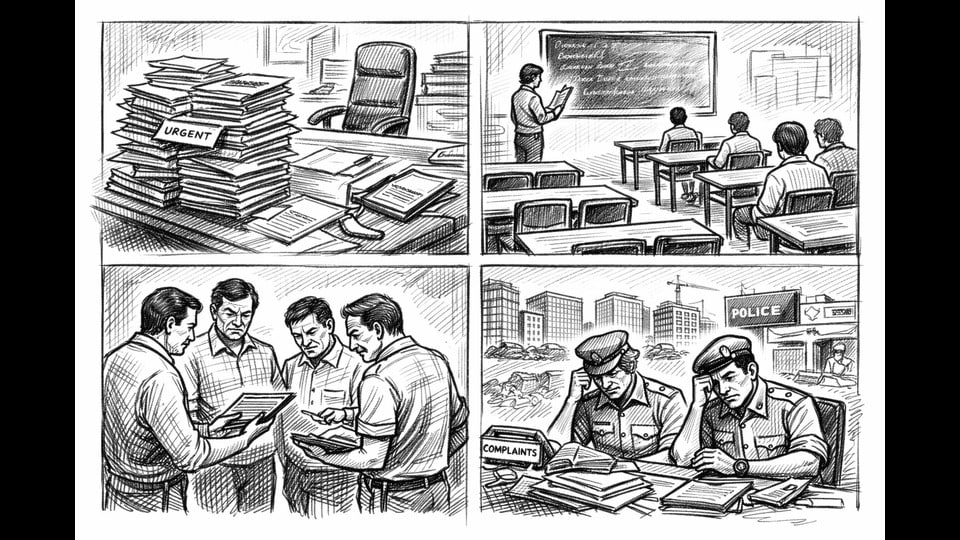
The CMGGA survey, which HT has seen, conducted on February 11 and 12 across all 23 districts of the state, assessed staffing positions across various groups in departments that citizens routinely depend on for day-to-day services, apart from sanitation-related issues. The objective was to understand why public grievances remain unresolved and why routine government work often fails to meet timelines. The findings suggest manpower shortages are a key factor behind administrative delays and growing public frustration.
One of the most concerning findings relates to district deputy commissioners’ offices, which form the backbone of district administration. According to the survey, Gurugram’s DC office is functioning with a 27% staff shortage. Faridabad faces 32.46% vacancies, while Palwal has a 31.61% deficit. Officials said the shortage has directly affected monitoring of law and order, disaster preparedness and review of development projects, with files piling up and complaints not being addressed in a timely manner.
The revenue department is among the worst affected, with 41% posts vacant at the state level. In districts such as Gurugram and Faridabad, where land transactions are high, the absence of tehsildars and naib tehsildars has led to delays in land registration and mutation work. At the Group C level, vacancies have reached 46%, leaving many tehsils struggling to function smoothly.
The education department is also under strain, with 21% posts vacant across the state. In districts like Nuh and Palwal, teacher vacancies range between 44% and 50%, affecting classroom teaching and academic supervision. Urban local bodies are grappling with a 33% staff shortage. In Faridabad and Palwal, more than 80% of Group B posts are vacant, while Panchkula has nearly 98% vacancies in Group D posts, affecting civic services.
The survey warned that unless vacancies are filled urgently, development in key economic hubs such as Gurugram and Faridabad could slow. With existing staff overburdened, efficiency and service quality continue to suffer, raising concerns about governance capacity.
Reacting to the findings, Rao Narbir Singh, Haryana minister of industries and commerce, said the state was aware of the staffing challenges and corrective steps were underway. “The government is committed to strengthening administrative capacity at every level. Recruitment and rationalisation of staff are being taken up in a phased manner so that service delivery improves and public grievances are addressed in a timely and effective way,” he said, adding that priority would be given to districts facing acute shortages.
CMGGA is a Haryana government programme that places 22 to 25 young professionals annually, one in each district, to strengthen last mile delivery. They work across sectors such as education, healthcare and governance, focusing on data driven solutions and grassroots implementation.

Stay updated with all the Breaking News and Latest News from Mumbai. Click here for comprehensive coverage of top Cities including Bengaluru, Delhi, Hyderabad, and more across India along with Stay informed on the latest happenings in World News.


