
 E-Paper



Wetland body seeks report on Masani barrage pollution in Rewari
Tests found BOD above limits, ₹5 crore fine on PHED; ₹258 crore sewage upgrade plan and wetland tag under consideration.

 Prefer HTon Google


The State Wetland Authority of Haryana has sought an action-taken report from the Rewari district administration on wastewater disposal norms at Masani Barrage amid concerns over rising pollution, officials and residents said on Tuesday.
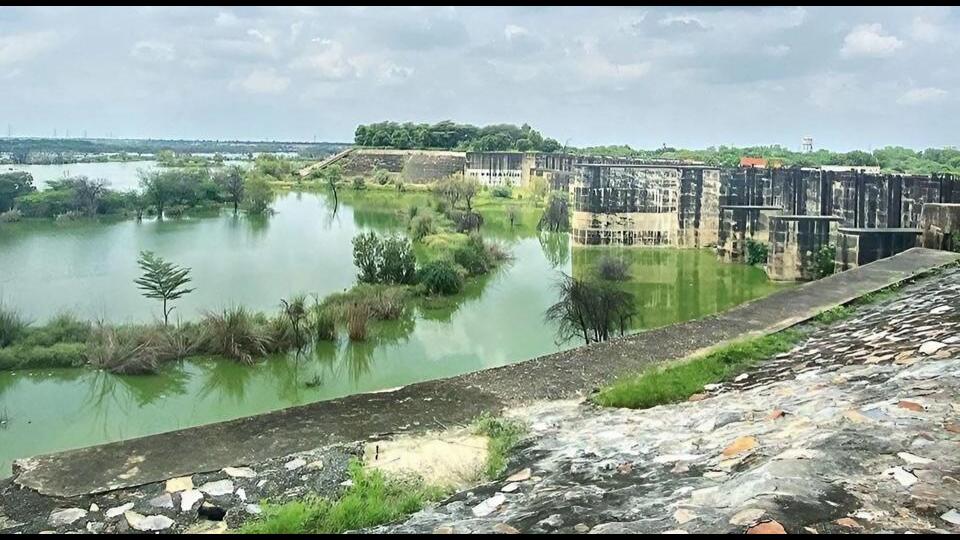
In a letter issued Monday, the authority flagged residents’ complaints about poor disposal practices and wastewater discharge into the hydraulic reservoir along the Delhi-Jaipur expressway. The reservoir, with a catchment of 160–200 hectares during monsoon, is under consideration for notification as a wetland. Residents of at least 15 villages, including Kharkhra, Masani, Titarpur, Khadiyawas, Nikhri, Niganiyawas and Rahliyawas, said they are affected. The barrage lies in the Sahibi River basin linked to the Yamuna River system in Delhi.
“The residents have requested that the Masani barrage be officially declared a wetland, that water be released only through a sewage treatment plant, and that the groundwater be scientifically tested … A detailed report regarding the Masani Barrage be sent to this department,” the letter said.
To be sure, an area meets the definition of a wetland as per the State Wetland Authority, which defines wetlands as areas of marsh, fen, peatland or water, natural or artificial, permanent or temporary, with static or flowing water that is fresh, brackish or saline, including marine areas up to six metres deep at low tide, along with adjacent riparian and coastal zones.
Officials said inspections by the Haryana State Pollution Control Board in February found biochemical oxygen demand (BOD) levels above permissible limits. “Nearly all samples failed to meet the water quality standards. Already an environmental compensation of ₹5 crore has been levied on the Public Health Engineering Department (PHED) for disposing of outdated sewage treatment plants discharging treated water with a BOD of 30 mg/l, exceeding the permissible limit of 10 mg/l,” said Nipun Gupta, HSPCB’s environment engineer in Rewari, adding upgrades are required by 2026.
VP Chauhan, executive engineer at PHED, said the penalty has been challenged before the National Green Tribunal in an ongoing 2022 case. “With three STPs operational for tertiary treatment in 2025 itself, another 3 MLD plant in Bawal complied with the 10 mg/l standard earlier this year. The remaining 6.5–10 MLD STP at Karuwas is scheduled to undergo trial runs at the end of April… The inland surface water quality is currently suitable for sustaining aquatic life,” he said.
Deputy commissioner Abhishek Meena said a ₹258 crore project has been planned for tertiary treatment, segregation tanks and linkage with Jhajjar-Link Drain 8, to be executed in two years. “The wetland status can be granted after the ecological assessment…,” he said.
“Phase I will begin with a tender on April 28 to lay a 56-km pipeline…”, said Vijay Baghotia, irrigation department executive engineer.
Residents, including complainant Prakash Yadav, flagged ecological risks and bird habitats. “The movement of birds here during winter highlights its natural importance. However, in its current state... it is threatening the ecological balance of the area,” he added. Meanwhile, advocate Daya Kishan Khola called for upstream sewage treatment and sludge removal. “Instead of building treatment plants around the reservoir, efforts must go into strengthening sewage treatment upstream,” he said.

Stay updated with all the Breaking News and Latest News from Mumbai. Click here for comprehensive coverage of top Cities including Bengaluru, Delhi, Hyderabad, and more across India along with Stay informed on the latest happenings in World News.


