
 E-Paper



India’s 1st underwater Metro causes panic again after 10 buildings develop cracks
Officials said at least 142 people were evacuated from the buildings that developed cracks in the early hours of Friday, and shifted to five hotels with some of their belongings

 Prefer HTon Google


Dozens of families were rendered homeless overnight in central Kolkata after 10 buildings in Bowbazar area developed cracks from the construction work going on for the East-West Metro corridor, which will include India’s first underwater Metro tunnel across the river Hooghly.
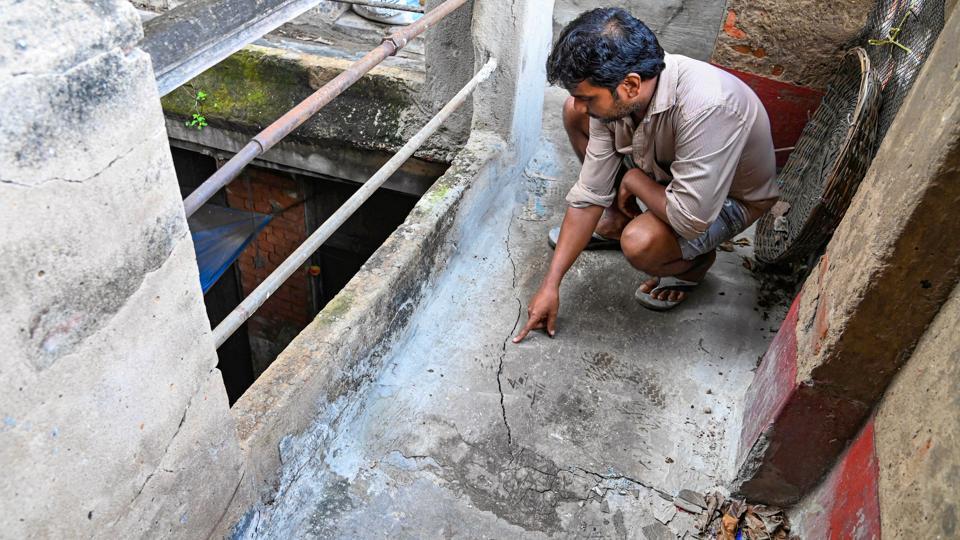
Officials said at least 142 people were evacuated from the buildings that developed cracks in the early hours of Friday, and shifted to five hotels with some of their belongings.
“I lost my husband on September 18. My son couldn’t give the half-yearly examination in his school. He started going to school from Thursday. Today we have been rendered homeless. I don’t know what to do,” Nabanita Baruah, a local resident of Madan Dutta Lane, said teary-eyed.
This is, however, not the first time the work on the Metro corridor caused cracks in buildings in the area. In August 2019, at least 25 buildings in the same locality developed cracks and portions of some buildings caved in after a tunnel boring machine hit an aquifer. Even in May this year, around 14 houses developed cracks, of which two had to be partially demolished.
“The buildings developed cracks on Friday early morning after water seeped in through some leakage and made the soil loose. Work on the project had to be stopped after some buildings developed cracks in May this year. The work had resumed last Friday, and grouting and cross passage work to join the two tunnels were going on,” a senior Metro official said.
Some local residents raised an alarm around 4:30 am after spotting the cracks on the walls, roof and ceilings. They quickly abandoned their houses and rushed to the streets with whatever valuables and belongings they could gather.
“Those who were evacuated in 2019 and May this year are yet to return home. We don’t know when we would be able to return home again. All my books, our furniture, electronic gadgets are there in the house. We can’t keep them in the hotel. The future has suddenly turned bleak,” Aditi Singh, a college student, said.
As they are located in the lanes of central Kolkata, some of the buildings are several decades old and many families live in each house. One of the houses located on 12 Madan Dutta Lane, which developed cracks on Friday, is more than 70 years old.
Also Read:India’s first underwater metro likely to be functional by June 2023 in Kolkata
Senior officials the Kolkata Metro Rail Corporation reached the spot to assess the damage, and said the victims will be compensated within the next 15 days.
The situation took a political turn later in the day when senior leaders of political parties reached the spot. While the ruling Trinamool Congress (TMC) blamed the Railways, the Bharatiya Janata Party (BJP) and the CPIM blamed the government.
“The KMRC didn’t take enough precautions. There were lapses. I will speak to the officials here and then I will speak to the railway board and if necessary, the railway minister. There has to be a time-bound program so that the victims may return home at the earliest and get enough compensation,” Sudip Bandopadhyay, the leader of the TMC legislative party in the Lok Sabha, said.
“Cracks have also developed within the TMC. This was bound to happen as she (referring to West Bengal chief minister Mamata Banerjee) diverted the metro route for her political gains without any planning,” Dilip Ghosh, BJP national vice-president, said.
“She may draw the eyes of Goddess Durga and make some paintings, but she is not an engineer or a town planner. It is for her whims that people are now suffering,” Md Salim, CPM state secretary, said.
A senior official said even though the Union government sanctioned the project in 2008 the route was realigned in 2013 after the TMC government came to power in West Bengal.
Since then, the project missed several deadlines. The East-West Metro would connect Sector V in Salt Lake with Howrah Maidan across river Hooghly through an underwater tunnel, the first of its kind for any metro project in India.
“The problem cropped up after the route alignment was changed a few years ago. The new route necessitated boring of tunnels. The soil is very soft and the water table is high, which is why if there is one leakage, the water fails to recede. We are consulting domain experts and hope to resume work soon,” another official said.


