
 E-Paper



Lockdown impact: 51% report complete loss of income, reveals study
About half the households have lost their whole income. Over two-thirds of the households reported complete loss of income due to lockdown and said their finances were just sufficient for less than a month of survival.

 Prefer HTon Google


It has been two months since Pankaj Kumar (28), a native of Badirabad village in Arwal district, came back along with his family after losing his job at a cloth factory in Surat.

Now, Kumar is barely able to meet his ends, thanks to a small agricultural holding in his village and a roof to live under.
But for Sanjay Das, of Basan Bigha in Arwal district and father of five children, things are getting difficult with each passing day. Das worked in a vegetable mandi in Mumbai. But ever since he returned to his native village, things have gone awry for him.
These are just two examples.
A joint study, titled Qualitative Assessment of Impact of Covid-19 on Migrant Workers and Their Families in Bihar, conducted by Unicef and DMI (Development Management Institute), Patna, reveals that reverse migration of more than 21 lakh migrant workers due to job losses and uncertainty has caused unprecedented hardships and devastating consequences for migrant labourers and their families, according to Dr Urvashi Kaushik, social policy specialist, Unicef in Bihar.
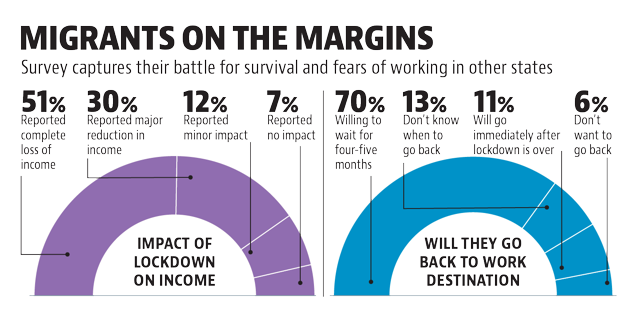
Though the sample size for the study was less than 2,000, the findings are an eye-opener. Nearly 51% of the migrants surveyed reported complete loss of income, while 30% reported major reduction of income. Only 7% of the migrants surveyed said there was no impact on their income.
About half the households have lost their whole income. Over two-thirds of the households reported complete loss of income due to lockdown and said their finances were just sufficient for less than a month of survival.
Job loss was relatively higher among the SC/STs. About one-fifth of them reported that their primary source of income was from government schemes. However, they said they received ration from the public distribution system (PDS), although only 42% reported sufficiency of ration. More than half of the migrant households received financial assistance from the government and the average amount received was Rs 1,320.
Lack of work has compelled them to rethink about their return. A large chunk has already returned to different work places, while about 70% said they would go to destination areas in an average time of 4.4 months while nearly 6% of the migrants want to return quickly.
Nearly 21 lakh people returned to Bihar during the lockdown and the state government, till June-end, had conducted skill mapping of 14 lakh migrants. Of this, 8.40 lakh were engaged in different spheres, like construction of road, bridges, dams, painter, centering mechanic, unskilled workers in construction, mason helpers, etc.
Based on their skills, migrants were broadly categorized into 10 groups -- handicrafts, mechanics, healthcare, general services, electronics and electrical, construction, computer and IT, banking and financial services, agriculture and others.
Construction and related activities seems to be the major source of livelihood for all those who returned from different states, while the second largest chunk of people who came back belonged to other services like cooks, drivers, daily wagers, domestic helps, drivers and tailors.


