
 E-Paper



18th BRICS Academic Forum: Meet ends at LU, council presents recommendations
The recommendations were presented to Shambhu L Hakki, joint secretary (MER), ministry of external affairs and BRICS Sous-Sherpa

 Prefer HTon Google


The BRICS Think Tanks Council on Tuesday presented its recommendations during the concluding session of the 18th BRICS Academic Forum at Lucknow University, recommending practical pathways to build economic and climate resilience, deepen cooperation on innovation and technology, advance sustainable development and support a more inclusive multilateral system.
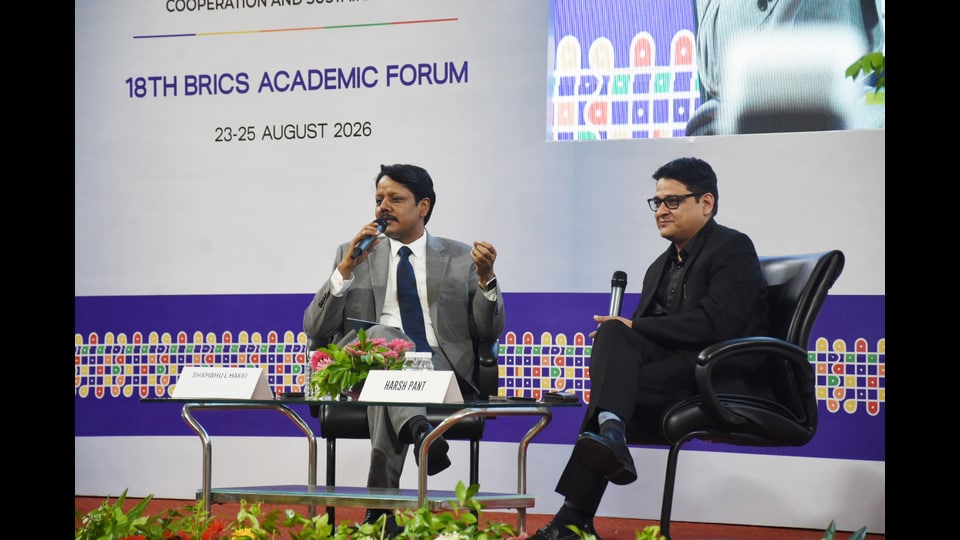
The recommendations were presented to Shambhu L Hakki, joint secretary (MER), ministry of external affairs and BRICS Sous-Sherpa. The Forum, convened by Observer Research Foundation in partnership with Research and Information System for Developing Countries and LU, brought together policymakers, academicians and experts from BRICS nations under the theme ‘Building for Resilience, Innovation, Cooperation and Sustainability’.
A Youth Townhall was held where Hakki said BRICS is not anti-something nor aimed at replacing existing global institutions, but a complementary institution filling gaps in development finance, citing the New Development Bank as an example.
“India as chair has adopted a constructive approach, producing consensus documents across ministerials, with practical outcomes such as cooperation frameworks on agriculture inputs discussed in Indore, a proposed startup innovation fund, supply chain and logistics mechanism, BRICS Connect for skilling, understanding on global value chains and a science and research depository, besides ICT ministerial deliberations on emerging technologies including AI in Pune,” he said.
Emphasising India’s approach of taking diplomacy to cities like Lucknow, Pune and Kochi, he said such meetings include Janbhagidari activities like heritage tours, yoga, walkathons, visits to local industries and Gramin Haat, tasting local cuisine.
“Taking diplomacy to cities like Lucknow, Pune and Kochi is aimed at making people part of diplomatic initiatives. Wherever meetings are held, delegates take cultural heritage tours, do yoga, walkathons, see local artifacts, industries and Gramin Haat products and try local cuisine,” said Hakki.
“The idea is simple: you cannot grow alone. Countries must work together and grow together,” Hakki added, underscoring partnership and collective development guiding BRICS cooperation.
He said that as part of Janbhagidari, a quiz on BRICS is live and students can scan the QR code to participate for an introduction to BRICS.
Citing outcomes, he said work is underway on a startup innovation fund, a supply chain mechanism in logistics, cooperation to protect farmers as discussed by agriculture ministers, BRICS Connect for skilling, understanding on global value chains and a science and research depository.
UN official lauds Family ID initiative
UN resident coordinator in India Stefan Priesner and Unicef India deputy representative Jesper Moller met with UP government officials during their visit to the city for the BRICS Child Futures Forum.
Priesner met chief secretary Shashi Prakash Goyal and proposed periodic review meetings between the chief secretary’s office and UN agencies to accelerate development results. The chief secretary appreciated UN agencies’ support for the state’s priorities.
Moller met additional chief secretary, women and child development, Leena Johari and congratulated UP for reducing stunting from 39.7% to 31.5% and rolling out new Take Home Ration as per NFSA 2023 norms.
The delegation also reviewed UP’s Family ID initiative led by special secretary, IT & electronics and MD Updesco Sameer Verma. The platform has enrolled over 16 crore citizens — 14.7 crore ration card holders and 1.3 crore self-registered — integrating 98 schemes (14 GoI and 84 GoUP). It is supporting the Zero Poverty Mission. With Unicef support, it has added over 748,000 children to ration cards and enrolled nearly 376,000 in basic education.


