E-Paper



Choked Gomti, lost floodplains: Lucknow waterlogging a ‘self-inflicted’ crisis, say environmentalists
Experts blame shrinking floodplains, obstructed waterways and rapid urban expansion for worsening the city’s drainage problems during heavy rain.

 Prefer HTon Google


Following heavy showers that paralysed several parts of the city recently, environmentalists have warned policymakers that Lucknow’s severe waterlogging is a man-made (self-inflicted) crisis.
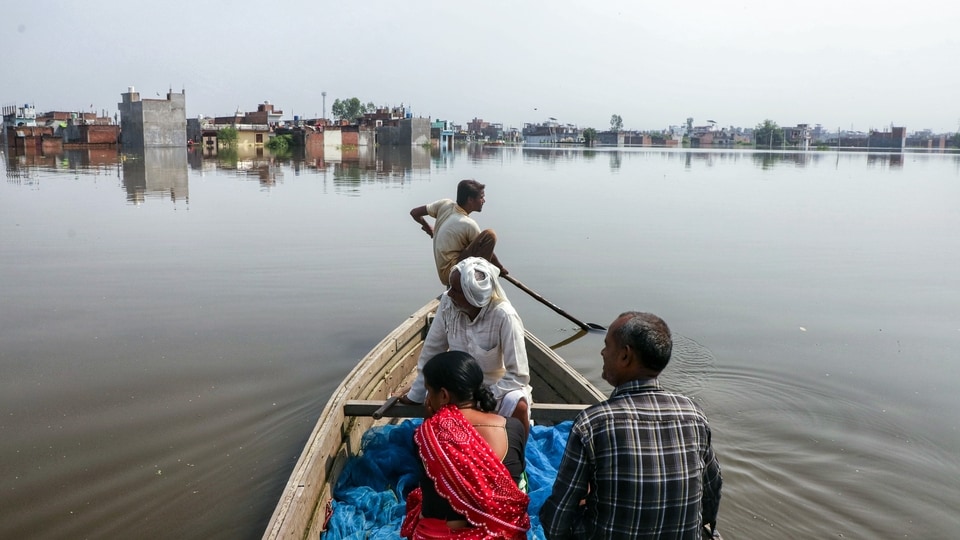
Experts attribute the recurring inundation to a choked Gomti riverbed, toxic road runoff and reckless real estate expansion over ancient floodplains and natural drainage paths.
Biswajeet Thakur, a scientist at the Birbal Sahni Institute of Paleosciences (BSIP), emphasised that rapid, unchecked urban sprawl has drastically degraded the city’s natural drainage dynamics.
Also read: Embankments around Gomti river: CM Yogi Adityanath's 'permanent solution' to flooding
Urban expansion blamed for worsening waterlogging
“Aggressive urban development, particularly expanding towards the south-east direction along Sultanpur road, has virtually left no vacant plots or permeable green spaces to absorb rainwater. A major issue is that heavy road dust mixed with vehicular emissions, metals, oil, and grease spillage churns into a thick, toxic slurry during heavy rainfall. This polluted runoff further clogs drainage pathways, exacerbating waterlogging while increasing environmental toxicity,” he said.
Thakur explained that the reduction in the width of the Gomti riverbed, compounded by a rise of up to 50 cm in silt accumulation as per the Bathymetry survey conducted by department of remote sensing, has severely limited the river’s capacity to absorb excess runoff.
He suggested that retrieving original waterbodies to some extent wherever possible, digging up the river catchment till the sand levels and increasing the porosity and permeability are required for prevention of similar situation in future.
Also read: Gomti River breaches banks, floodwaters invade houses in extension areas
Experts call for restoration of natural water bodies
According to environmental scientist Venkatesh Dutta of department of environmental science, School of Earth and Environmental Sciences (SEES) at Babasaheb Bhimrao Ambedkar University (BBAU), a primary driver of urban flooding is the constriction of natural water channels and the loss of natural floodplains.
“When continuous heavy rain hits, the swollen river causes city drains to flow into residential lowlands. Furthermore, nearly 30 bridges built across the Gomti create major structural obstructions to smooth flow, while historical natural waterways — such as the old flow paths of the Kukrail River near Marine Drive and Ambedkar Park — have been obstructed by commercial and residential projects, leaving low-lying zones highly prone to severe inundation,” said Dutta.
Also read: More of Lucknow comes under Gomti’s rising waters
Nodal agencies must urgently shift towards scientifically backed urban planning
To prevent widespread flooding during continuous heavy rainfall, Ajay Arya, head of geology department at Lucknow University, underscored that policymakers and nodal agencies must urgently shift towards scientifically backed urban planning.
“There is a need to establish an interdisciplinary advisory committee comprising geologists and environmentalists to oversee urban expansion. Authorities must utilise high-resolution satellite data to continuously monitor land use, protect remaining natural depressions, mandate permeable interlocking pavements to restore natural soil infiltration and enforce a minimum 15% green cover on urban plots and prioritise pre-monsoon desilting to preserve the city’s natural drainage arteries,”Ajay Arya said.