E-Paper



2027 polls: Will Cong’s groundwork, SP’s machinery help them pass UP test?
Rahul Gandhi’s increased presence, direct engagement with people and alliance-building have helped Rahul Gandhi rebuild his political connection with Uttar Pradesh

 Prefer HTon Google


As Uttar Pradesh heads towards another high-stakes assembly election, the emerging Congress-Samajwadi Party strategy is shaping up as a test of political chemistry, with Rahul Gandhi’s political makeover and Akhilesh Yadav’s organisational machinery on the ground complementing each other.
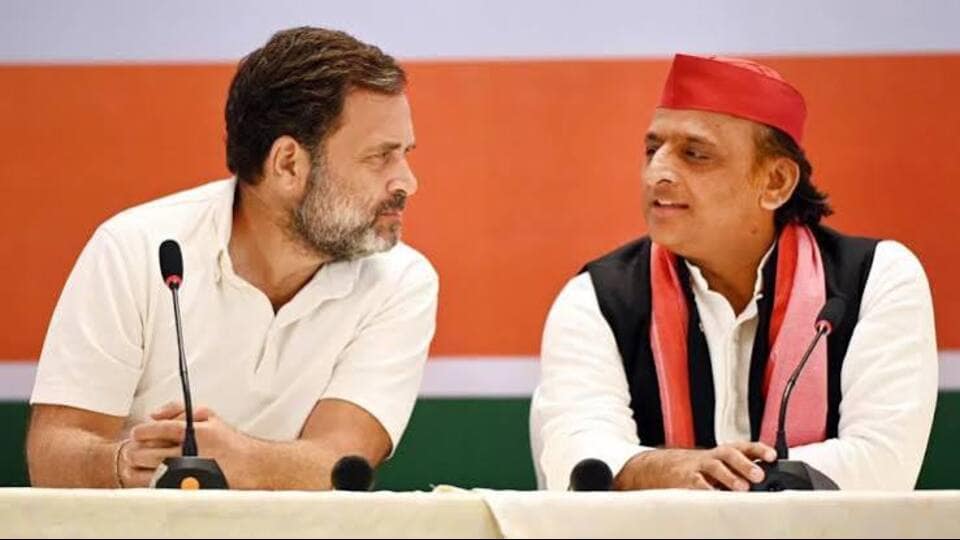
The larger objective is to hold the opposition alliance together to credibly challenge the BJP’s entrenched political dominance.
Rahul Gandhi’s increased presence in UP, particularly the success of the recent ‘Chattron Ki Goonj’ in Prayagraj, has elated the party. Rahul came to Rae Bareli on January 19-21 for a MGNREGA programme, March 13 in Lucknow for the Samvidhan Sammelan, May 19-20 again in Rae Bareli and August 8 in Prayagraj.
His sustained ground action and sharper parliamentary messaging point to a deeper political transformation from a reluctant politician to a more aggressive one. His image in Uttar Pradesh has evolved over the past three years.
During the Bharat Jodo Yatra in January 2023, he travelled through western UP, meeting workers, artisans and citizens and focusing on unemployment, inequality and social polarisation. The Bharat Jodo Nyay Yatra in February 2024 reinforced this image with visits to Bulandshahr, Aligarh, Hathras and Agra.
Congress now wants to indicate that it is not merely a junior partner to the SP but a force staking its own claim to power as new AICC in-charge for UP Rajendra Pal Gautam puts it: “The alliance should be based on equality and mutual respect.”
Overall, his increased presence, direct engagement with people and alliance-building have helped Rahul Gandhi rebuild his political connection with Uttar Pradesh. But does Congress have the organisation across over 17K polling stations or 1.74 lakh polling booths, and strong candidates to take alliance leadership from the SP?
In 2017, the Congress fielded candidates in 114 seats and won 7. In 2022, it contested 399 seats and won only 2. In the 2024 general elections, the Congress fielded candidates in 17 out of 80 seats and managed to win six in alliance with the SP.
SP chief Akhilesh Yadav, meanwhile, is reading the situation carefully: too many seats for Congress hurt SP (2017 is an example), and too few anger its ally. He faces a dual test—electoral arithmetic and coalition dharma.
Congress wants to reclaim the ground it once dominated, till 1989, when it had a CM in Uttar Pradesh. Whether such sharp growth is possible within an alliance. If Congress contests more seats, will SP give up its own? If SP refuses, Congress’s expansion stalls.
The SP in 2024 won 37 of Uttar Pradesh’s 80 Lok Sabha seats, the highest tally among all parties in the state. Together, the SP-Congress alliance won 43 seats, while the BJP was reduced to 33. But translating that Lok Sabha performance into an assembly poll victory will be a very different challenge. In the 2022 assembly election, the BJP won 255 seats, while the SP finished with 111 in the 403-member House. Congress has 2 seats.
While Congress has been out of power in the state since 1989, the Samajwadi Party has held power (1989–1991,1993–1995, 2003–2007 and 2012–2017).
Recently, replying to BSP chief Mayawati’s allegation that the SP had a history of breaking alliances, Yadav said his party “never breaks coalitions” and the existing Uttar Pradesh assembly election partnership remained strong.
Rahul Gandhi is attempting to reshape Congress’s image and rebuild its grassroots relevance, while Akhilesh Yadav is relying on the Samajwadi Party’s organisational network and social coalition.
The challenge for Rahul is that personal popularity and political visibility do not automatically translate into Congress votes. The party remains organisationally weak in much of UP and therefore needs the SP’s machinery.
That is where Akhilesh Yadav becomes crucial. The SP’s 2024 Lok Sabha performance demonstrated that its “PDA” strategy—bringing together backward classes, Dalits and minorities—could significantly weaken the BJP’s traditional coalition.
Akhilesh is now attempting to broaden that coalition. His recent outreach to Brahmins, including his statement that the “P” in PDA can also represent “Pandit,” indicates an effort to move beyond the SP’s traditional social base.