E-Paper



Heart attack resulted in Ansari’s death: Autopsy
A court in Banda district orders judicial inquiry into the death of gangster-politician Mukhtar Ansari; CJM appoints MP-MLA court judge as investigating officer and seeks probe report within a month

 Prefer HTon Google


BANDA A chief judicial magistrate’s court in Banda district of Uttar Pradesh on Friday ordered a judicial inquiry into the death of gangster-politician Mukhtar Ansari, even as the autopsy report prima facie ruled out suspected poisoning and cited heart attack as the cause of death, people familiar with the matter said.
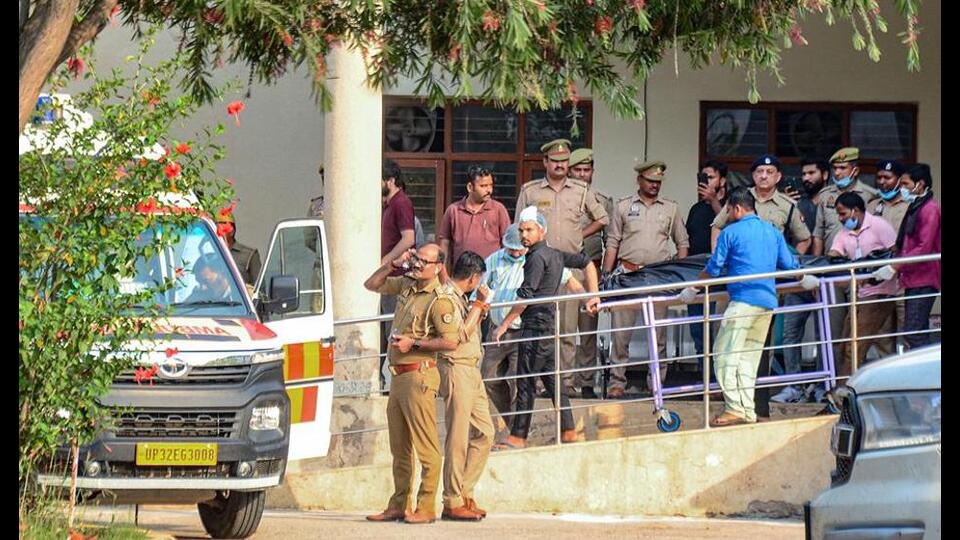
Banda chief judicial magistrate (CJM) Bhagwan Das Gupta appointed district MP-MLA court judge Garima Singh as the investigating officer and sought the probe report on the death of Ansari (60) within a month, a senior official said.
After the completion of the post-mortem examination, which was conducted by a panel of doctors at Rani Durgavati Medical College in Banda, a convoy of 26 vehicles, including an ambulance, carrying Ansari’s body left for Ghazipur, around 400km away, on Friday evening.
“The (autopsy) report negated any suspected poisoning and cited heart attack as the cause of death,” another official said, requesting anonymity.
According to the police, Ansari’s son Umar Ansari along with his two cousins, Ibrahim and Usman, were present inside the ambulance carrying the body. The Uttar Pradesh government had in advance chalked out the route for taking the body amidst tight security, police said.
According to the Ansari family, the former Uttar Pradesh legislator will be buried at the family cemetery at Mohammadabad’s Kali Bagh in Ghazipur. Heavy security arrangements have been put in place around Ansari’s residence and the cemetery.
Station house officer (SHO) of Mohammadabad police station, Pawan Kumar Upadhyay, said Ansari’s family members have said that if the body reaches Ghazipur by 10pm, then the burial will be held on Friday itself, else it will be held on Saturday morning.
Ansari, once among Uttar Pradesh’s most dreaded gang leaders who represented Mau assembly seat between 1997 and 2022, was brought to Rani Durgawati Medical College from Banda prison for a second time in a week shortly before he was declared dead on Thursday. He was admitted for 14 hours on Tuesday after he complained of abdominal pain.
“At approximately 8.25pm, Ansari was brought to the emergency wing in an unconscious state after having complained of vomiting. A team of nine doctors gave urgent medical attention to the patient, but despite efforts, he died of a cardiac arrest,” said a bulletin issued by the hospital.
During the post-mortem examination, Ansari’s family stayed inside the autopsy room with the entire process being video recorded. The panel of doctors preserved the viscera, which would be sent for forensic examination to ascertain whether there was any poisoning or not, officials said.
The post-mortem examination was conducted by ENT specialists Mukesh Kumar, Mahesh Gupta, senior physician SD Tripathi, orthopaedic Dr Vikasdeep Bilatia for an hour. The process began at 2pm. Two senior officials confirmed that there were instructions to strictly adhere to protocols, as the case could face legal scrutiny.
The autopsy report negated the allegation by Umar Ansari that his father was subjected to “slow poisoning” and not given proper treatment, a charge refuted by authorities.
“This is not a natural death, but a murder,” Umar told reporters, adding his family intends to pursue legal avenues for investigation. “I spoke to him on phone at 3.30pm on Thursday. He told me he was feeling too weak. My father instructed me not to come... he seemed to have sensed his demise,” he added.
Earlier, Umar had sent a hand-written application to Banda district magistrate Durga Shakti Nagpal, demanding that the post-mortem examination be conducted at AIIMS, Delhi or by its doctors. Umar Ansari also said he had no hope for justice from the local administration, medical team and the police. “They should either reject or approve the request, we have given them the demand,” he said.
Ansari, who had over 60 heinous crimes registered against him, was brought to Banda jail from a Punjab jail on April 7, 2022 on the order of the Supreme Court.
Uttar Pradesh additional director general of police (law & order) Amitabh Yash said the state police was on high alert since Thursday night and extra deployment was done strategically in sensitive districts in view of the Friday prayers and death of Ansari in Banda. He said extra forces were sent to districts such as Mau, Ghazipur and Banda to ensure peace and maintain law and order. Heavy police force has been deployed from the residence of the Ansari family to the graveyard, and barricades have been put up at various places.With agency inputs