
 E-Paper



Lucknow hotel fire: ‘Woodwork fed flames, iron structures hindered us’
Fire-fighting teams laboured for five hours; 15 fire tenders, 13 ambulances were on stand-by outside the hotel


Rescue teams rushed to the scene as soon as the fire broke out at Levana Suites hotel in Hazratganj, early in the morning, on Monday. Due to the fire, many guests and hotel employees were trapped inside the hotel for hours.
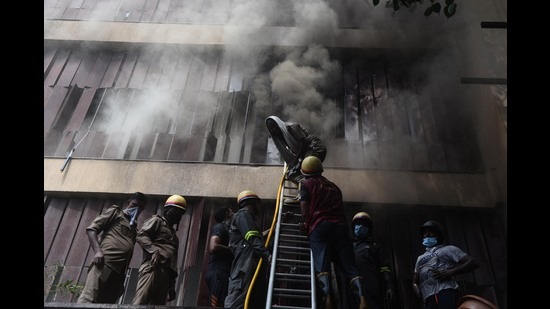
Smoke enveloped not only the hotel but even the surrounding area. A large number of curious residents, passers-by, auto drivers, and rickshaw drivers gathered near the site even after the police blocked the crossing at Madan Mohan Malviya Marg leading to the hotel.
The rescue team included Lucknow police, fire department officials and ambulances. Victims were rushed to Civil Hospital some 3 km from the site of the fire. Fifteen fire tenders and 13 ambulances remained on stand-by outside the hotel with the large rescue team managing the site.
According to a hotel guest staying in room number 210, he rushed to the corridor as soon as he heard people screaming. “The lobby was full of smoke, so we were asked to return to our rooms,” he was quoted as saying. “Firefighters rescued me after breaking a window in the room.”
The firefighting team had a tough time getting inside the hotel to rescue victims and douse the fire due to the thick smoke coming from the lobby area. Ladders were used to access the rooms on the 2nd and 3rd floor. Emergency response teams used iron rods to break the window panes to rescue visitors and guests to the hotel.
In the rescue process, the fire department used smoke ventilation pipes at multiple places to clear the smoke from the building. Due to the severity of the fire, firefighters were forced to drill holes and create openings into walls with the help of JCBs in order to get water inside the first floor. The evacuation took over 5 hours to complete after which the premises was vacated and sealed by the police personnel for forensic investigation.
“The hotel had a lot of wooden embellishment which helped the fire and iron structures all around the building proved very difficult to break down and reach the people stuck inside,” said Piyush Mordiya, joint commissioner of police, law & order, Lucknow.
The four-storeyed hotel had the reception and lobby on the ground floor, a banquet hall on the first floor, while the second and third floor had rooms. According to reports, there were around 35-40 people staying in the hotel. There are 30 rooms in the hotel out of which 18 were occupied at the time when the fire broke out.
Major reasons for fire
There were no or few standards of fire safety followed at Levana Suites hotel. There was no emergency gate and there was no fire extinguisher even in a place like the kitchen. However, these big deficiencies were not seen by the authorities while granting an NOC to the hotel.
Hotel didn’t leave required frontage
According to the rules, there should be a space of six meters around the hotel for movement of fire tenders in case of fire, but this space was not left during the construction of the hotel. The authorities had to bulldoze a wall to enter the hotel. Fire tenders were only able to reach from one or two sides. Had this standard been met, the tenders would have reached from all sides and controlled the fire much earlier.
However, chief fire officer, Lucknow, VK Singh was not ready to speak over the issue. “The forensic team is analysing the incident. We will only be able to comment after the report is out.”
Exhaust not installed to remove smoke
According to rules, it is mandatory to install exhaust fans to remove smoke. But there was no exhaust fan in the hotel. Firemen present on the spot said deaths could have been avoided had the hotel placed exhaust fans at the right places. Four guests who died due to suffocation could have been saved as the smoke could have been blown out.
Not enough fire safety arrangements in the kitchen
It is mandatory to have water hydrants and fire extinguishers inside a hotel kitchen but Levana had none. Incidentally, the fire at Levana Suites began in the kitchen.
Hotel started in an old semi-residential building
The owner did not even build a new building for the hotel. It was a semi-residential building in which a BSNL office used to run. The office shifted and the same building was converted into a hotel without getting the map approved. During that time, all standards of the hotel were not met. For example, just three months ago, a staircase was made from outside without the permission of LDA but LDA officials didn’t bother to act then.
There was no fire escape
There was no fire escape in the hotel. Ujjwal Sharma, a guest who came out of the hotel after the fire, said, “There was no arrangement for exit after the fire. The hotel did not have an emergency exit.”
He said, “The walls were covered with glass to give a luxury look. Iron grills were installed on the facade. Iron plates were installed on these grills. So it was impossible to enter from outside or escape from inside.”
This was also the reason behind the rescue operation which lasted for about eight hours. First these plates and grill were cut then only after breaking the glass, the rescue team was able to enter the rooms inside. It took a long time. This delay could also be one of the causes of the casualties.
CO from flames partly to blame
Carbon monoxide (CO) produced during the fire may have done the damage for those stuck inside the hotel when the fire broke out on Monday.
“Suffocation happens with excess smoke and people tend to panic,” said Dr Anand Ojha, director, Civil Hospital, where the rescued people were admitted.
As some of those rescued had burn injuries doctors said it could be due to panic that they could not escape fast.
“Carbon monoxide creates hallucinations and impairs judgment. An affected person might not be able to sense things happening around,” said Dr Manoj Agrawal, chief medical officer. As a result, people might have fainted first due to reduced oxygen flow to the brain, he said.


