
 E-Paper



Partial solar eclipse: Skygazers in Lucknow watch celestial spectacle
It was witnessed for 53 minutes in Lucknow and 36.93% of the sun was hidden by the shadow of the moon at 5:26pm, said Anil Yadav, director, Indira Gandhi Planetarium


LUCKNOW Lucknow witnessed a partial solar eclipse on Tuesday for over 50 minutes. The celestial event began at 4.36pm when the sun came behind the umbra of the moon, said officials.
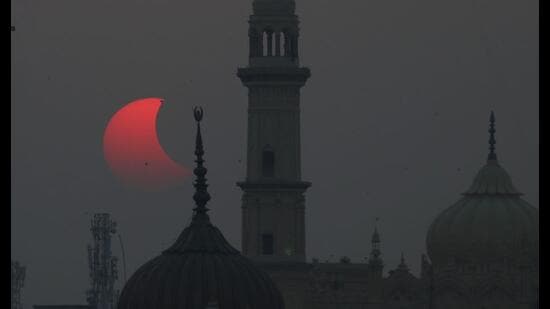
“As the sun set at 5:29 pm, observers couldn’t see the partial eclipse for the full duration. It was witnessed for 53 minutes in Lucknow and 36.93% of the sun was hidden by the shadow of the moon at 5:26pm,” said Anil Yadav, director, Indira Gandhi Planetarium.
In the pre-eclipse phase, visitors observed sun spots, solar flayers, granules and filaments with the help of telescopic instruments, according to a press release by the IGP.
For witnessing this rare celestial event, two Lunt solar telescopes, one Coronado solar telescope, one Dobsonian telescope and two reflector telescopes were installed at the Gomti riverfront for general observers.
Besides, one extra ZWO camera was installed by the Indira Gandhi planetarium for astrophotography of the complete event. A team comprising Utkarsh Mishra, Amritanshu Vajpayee and Swapnil Rastogi was active at the river front to observe and collect the eclipse data.
The Council of Science & Technology, UP, distributed solar goggles to all the observers. Alok Kumar, secretary/director general, DSTUP/CSTUP, Prakash Bindu, special secretary/secretary, DSTUP/CSTUP, directed the entire event and were present at the venue for the entire duration.
The entire programme was organised under the guidance of Anil Yadav, director, CSTUP.
Lucknow would witness the next solar eclipse in 2030.
Regional Science City, Lucknow, also organized a partial solar eclipse observation programme on Tuesday. Special equipment like filter glasses, special spectacles and telescope were arranged for visitors.
About 250 visitors from all sections of society raised queries related to the celestial event, which were answered by M. Ansari, project coordinator and other officers of the RSC.
CM witnesses eclipse from Gorakhpur
Chief minister Yogi Adityanath emphasized on the need for more exploration of the universe, saying the path of human welfare could be further paved by unravelling mysteries of the universe.
On the second day of his visit to Gorakhpur on Tuesday, he witnessed the partial solar eclipse from the Veer Bahadur Singh Planetarium here. Adityanath also took part in a special show organised at the planetarium.
The CM shared his thoughts, exchanged views and learned more about the solar system from scientists. He directed the district magistrate to draw up a proposal to develop a science park in the open area of the planetarium.
“He first saw the solar eclipse with a telescope and then with special glasses (special multicoated glasses) and special binoculars. The chief minister said that necessary equipment should be arranged here to see the celestial events live,” stated a release.


