E-Paper



Rain has stopped, river Gomti hasn’t...Faizullaganj in troubled waters
Over 200 homes remain submerged in water; residents turn night guards to protect their locked homes, forced to ride on boats

 Prefer HTon Google


LUCKNOW While the rest of the city dries out following heavy showers marking the monsoon’s retreat, Gomti River continues to encroach upon the northern outskirts of Lucknow, reclaiming lands that have long been developed into residential areas. Faizullaganj, a lesser-known area of the city, remains submerged as the river’s resurgence has impacted this densely populated neighborhood, particularly along its low-lying banks.
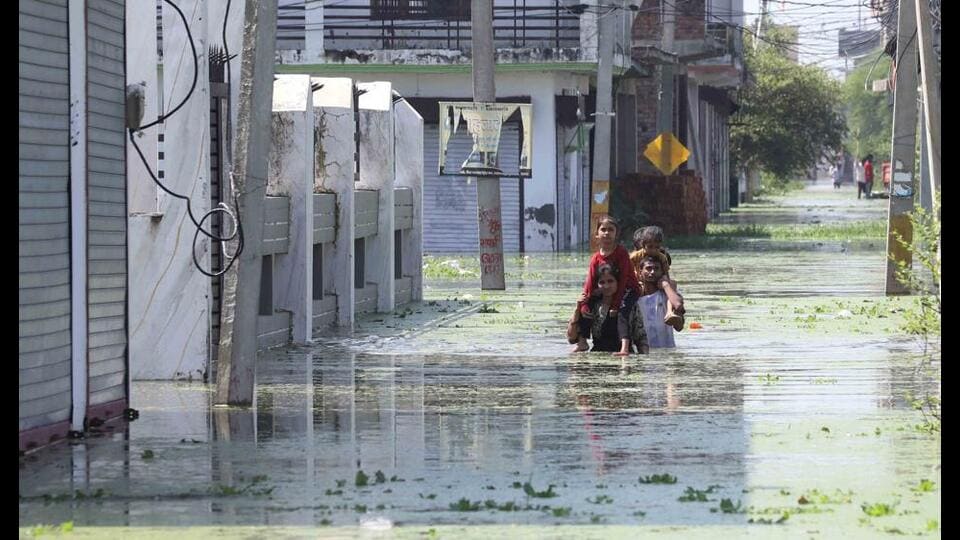
In wake of the situation, a grim new routine has emerged: residents staying behind in flooded lanes to guard their locked houses against theft.
The pocket comprising densely populated colonies is largely inhabited by working class and lower middle class families. Over the years, habitation has expanded into areas vulnerable to flooding, with homes and lanes now occupying spaces close to the river. For residents, these are homes built over years. But the low-lying terrain remains vulnerable to the Gomti’s resurgence. And that is what has left Faizullaganj looking dramatically different from the rest of Lucknow. While roads elsewhere have dried and the rain has already become a disruption of the past, the water here continues to occupy lanes, homes and courtyards.
Officials have attributed the prolonged waterlogging to the rise of the Gomti as well as choked drains, saying the elevated river level is making it difficult for accumulated water to drain out.
In Krishna Lok Colony of Faizullaganj, several houses now remain locked, not because their occupants have gone out, but because floodwater has made staying there impossible.
Families have shifted to relatives’ homes or returned to their villages, carrying whatever belongings they could salvage. But in many houses, one person has stayed behind.
Residents said they fear theft after dark, when the inundated lanes become difficult to access and electricity remains disrupted. Some of those staying behind could be seen carrying sticks as they kept watch through the night.
The irony is not lost on Shaqil, who works as a watchman at Galla Mandi. With his own house partly submerged, he has now taken on another watchman’s job protecting his own home.
Nearby, Abdul Hadi, who sells household materials by moving from street to street, stood guard outside his locked, half-submerged house. He said he had been living there for around a decade.
“We have become guards of our houses as there may be theft at night. No authorities have visited this portion and not a single relief work has been done even though we kept calling on the CUG number of the DM,” he said.
Shanti Devi said she had sent her daughter-in-law to her parental home as the family was left with little choice. “We have no option,” she lamented.
Md Farooq Ansari, an electrician, said he had sent his family to relatives but remained behind. “Even though I have sent my family to our relatives’ place, I am staying here on the street as I have to guard my house,” he said.
The prolonged inundation in Faizullaganj comes against the backdrop of heavy showers during monsoon withdrawal in the state capital. As per Met department data, Lucknow recorded 849.3 mm of rainfall between June 1 and September 30.
Gomti’s water level rose steadily due to Lucknow’s drain water flowing into the river and heavy rains in Pilibhit, Bareilly and Hardoi. The swollen Gomti has since pushed water back into low-lying areas along its banks, leaving 15-16 colonies in Faizullaganj inundated.
Families move out, livelihoods stay behind
Suraj Sahu, a tile fitter, at Subhas colony, said his family was still inside their house even as water had risen to shoulder level.
“My house’s first floor is entirely submerged. My wife and children are on the first floor as there is shoulder level water,” he added.
Sahu said only a few boats were operating in the area and most were privately operated, with residents having to pay hefty amounts to use them.
The disruption has also affected the most basic routines — electricity, movement and access to essential services.
After sunset, residents said, the situation becomes worse. Rani, another resident, said there was no electricity and claimed that snakes and insects were being spotted in the water.
“The situation after dark is worse as there is no electricity. Snakes and insects are seen in the water,” she said.
She also questioned the functioning of relief arrangements while Sahu alleged that residents approaching shelter homes had faced misbehaviour from police personnel deployed there.
Meanwhile, district magistrate Vishak G inspected Faizullahganj and directed officials to provide all medical assistance, food grains and take all measures to ensure citizens get immediate relief.
SDM (Sadar) Sahil Singh said this is not an annual affair and is happening after 10-15 years. He added: “The administration is pro active, from doctors to water, all sorts of assistance is being provided to 500 families living in the affected area.”
No embankment, no permanent relief
The absence of an embankment has emerged as the biggest hurdle to providing a permanent solution to flooding in Faizullaganj, where more than 200 houses remain submerged and residents continue to depend on boats to move through waterlogged streets. The Lucknow Municipal Corporation (LMC) has said the area acts as a natural catchment for river water and that pumping alone cannot provide lasting relief.
According to municipal commissioner Gaurav Kumar, flooding will remain a challenge until an embankment prevents river water from entering the area. He also said the water level could rise further over the next few days, depending on the situation.
Kumar told HT that the construction of an embankment is also part of the Lucknow Development Authority’s (LDA) plan under its Green Corridor project.
“Faizullaganj is a catchment area, where river water comes in naturally. Until an embankment is constructed, the problem cannot be resolved permanently,” he said.
BOATS AND TEMPORARY SHELTERS
*The LMC has established two temporary shelters and made arrangements for food and accommodation. Kumar said around 60 beds were available initially, while an LMC official said arrangements could accommodate around 300 people, if residents agreed to shift.
*However, many families are reluctant to move to the shelters because they fear leaving their houses and belongings unattended.
*To help those who remain in the affected area, the civic body has deployed 15 boats, including for residents who need to reach health centres established by the district administration.
HIGH-MAST LIGHTS
The LMC has also installed high-mast lights and around 45 additional lights to improve visibility in the affected stretches.
ANTI-LARVAL SPRAYING
With residents remaining exposed to stagnant water, the civic body has started anti-larval spraying through drones and intensified fogging to control mosquito breeding.
24X7 ASSISTANCE
An LMC official said teams had been deployed on 24-hour duty to assist residents. He also said several houses had been constructed illegally along the catchment zone, increasing the vulnerability of people living there.