
 E-Paper



Shakti in Khaki: Women officers chart new heights in UP Police
Women now comprise about 36,000 of the nearly four lakh personnel in Uttar Pradesh Police, a force with jurisdiction over more than 24 crore people across 75 districts. The force’s strength exceeds 4.6 lakh personnel, supported by 33 armed battalions and specialised wings handling investigation, intelligence, economic offences and law and order.

 Prefer HTon Google


As Navratri, the annual Hindu festival celebrating the goddess Durga and the Divine Feminine, unfolds, Uttar Pradesh Police is witnessing a parallel institutional transformation where women steadily expand their presence across ranks and command positions, marking a structural shift in the world’s largest single-state police force.
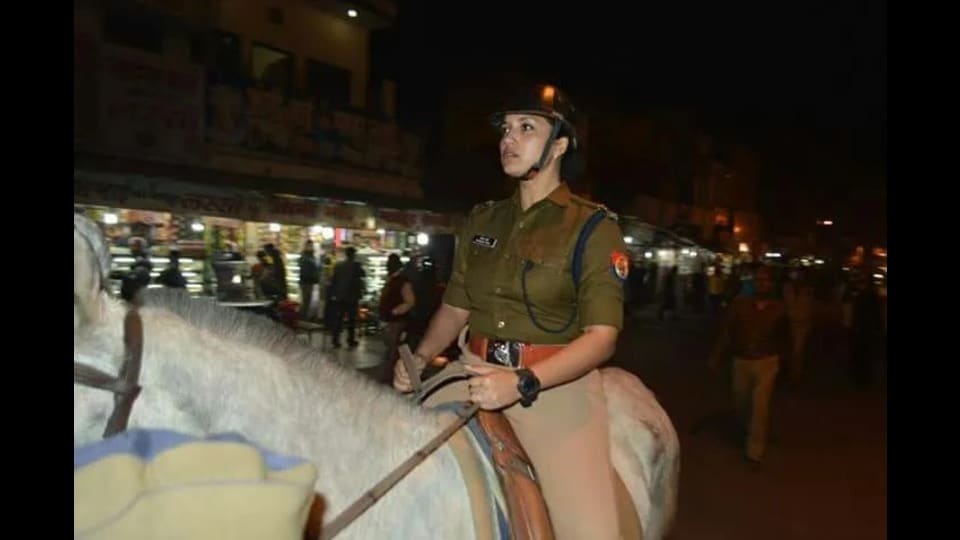
Women now comprise about 36,000 of the nearly four lakh personnel in Uttar Pradesh Police, a force with jurisdiction over more than 24 crore people across 75 districts. The force’s strength exceeds 4.6 lakh personnel, supported by 33 armed battalions and specialised wings handling investigation, intelligence, economic offences and law and order.
In 2024, of the 8,362 sub-inspectors and equivalent ranks recruited, 1,618 were women. The recruitment reflected intensifying competition among female candidates, with nearly 15 lakh women vying for around 12,000 constable posts, roughly 125 applicants per seat.
Women’s representation in the force has reached about 12% since 2017, with further expansion planned.
Rajeev Krishna, director general of police (DGP), said, “On the occasion of Navratri, the Uttar Pradesh Police reaffirms its commitment to empowering women within the force. The increasing representation of women across ranks from police stations to senior command has strengthened our responsiveness, sensitivity and public trust. Women officers are playing a decisive role in investigations, law and order, and community policing. We are systematically expanding their presence to ensure a more inclusive, professional and citizen-centric police force. They are central to its evolving identity where power is not just cultural, but institutional.”
Leadership positions
Uttar Pradesh Police currently has 59 women IPS officers across batches from 1990 to 2024. Several senior women officers head key formations. Neera Rawat, 1992 batch officer, director general (DG), the Economic Offences Wing (EOW) and oversees UP-112 emergency response operations. Padmaja Chauhan, additional DG (ADG), handles Women and Child Security (1090) alongside Fire Services. Laxmi Singh serves as commissioner of police, Gautam Buddh Nagar. Manzil Saini, inspector general (IG), handles vigilance responsibilities. Geeta Singh, IG, heads prosecution.
Neera Rawat said, “In emergency response systems, empathy and communication strengthen public trust. With equal opportunity now a priority, women officers are being assigned roles without bias. Effective time management remains crucial for professional growth.” She also attributed outcomes to structured teamwork and accountability.
From districts to commissionerates
Women officers increasingly lead districts, traditionally considered tough field assignments. Khyati Garg (Lakhimpur Kheri), Charu Nigam (Sultanpur), Aparna Rajat Kaushik (Mirzapur), Deeksha Sharma (Hamirpur), Aarti Singh (Fatehpur) and Shraddha Pandey (Kanpur Dehat) serve as district police chiefs.
Urban policing too reflects the trend. The Gautam Buddh Nagar Police Commissionerate, led by Laxmi Singh, has a strong cohort of additional five women IPS officers of different ranks. Lucknow Commissionerate similarly has significant representation, including Joint CP Aparna Kumar and DCPs Raveena Tyagi and Mamta Rani Chowdhary, alongside two younger officers in key roles.
Institutional support
The Women Power Line 1090, now the Women and Child Safety Organisation, has strengthened mechanisms for addressing crimes against women through improved accessibility, confidentiality and quicker response. The state government has set structural targets requiring deployment of at least three women sub-inspectors and ten women constables in every police station.
Officials said increased participation of women personnel has enhanced sensitivity in handling crimes against women and children, improved community engagement, strengthened trust in policing systems, and contributed to better investigative outcomes and more balanced law-and-order responses.
This Navratri, the image of women officers leading investigations, commanding units and policing the streets reflects more than symbolism—it signals a structural shift.


