
 E-Paper



Taj Mahal disappears under thick blanket of smog
A study of the AQI pattern at Shahjahan Garden station of the UPPCB, near the Taj Mahal, revealed that air quality worsened to 294 (‘poor’ category) on Monday morning

 Prefer HTon Google


AGRA With northern parts of India battling air pollution, a thick layer of smog engulfed Agra and Taj Mahal on Monday. The 17th-century monument, which draws millions of tourists from across the world, was barely visible to the naked eye.
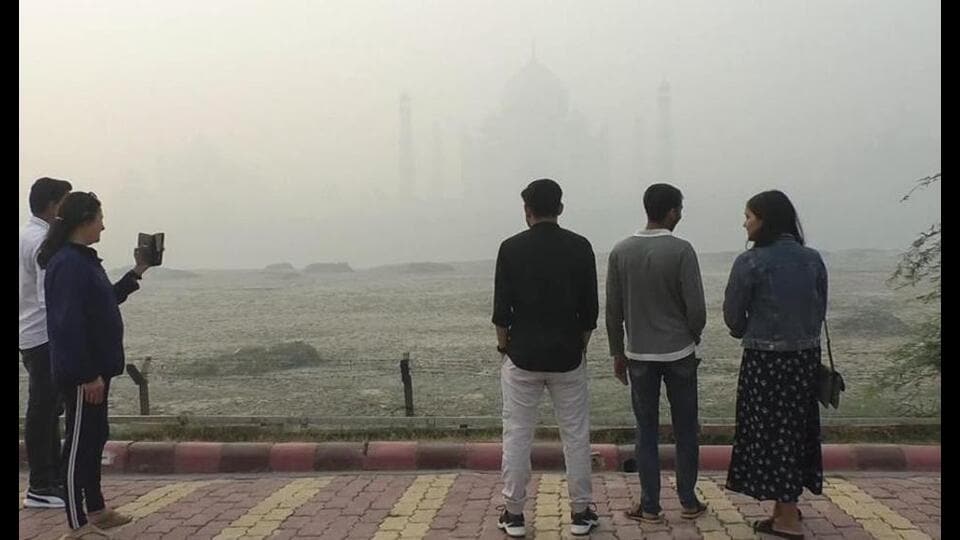
Central Pollution Control Board (CPCB) officials denied that this was solely due to pollution and cited fog and humidity in open area as the reasons.
However, a study of the AQI pattern at Shahjahan Garden station of the UPPCB, near the Taj Mahal, revealed that air quality worsened to 294 (‘poor’ category) on Monday morning around 10am with PM 2.5 being the major pollutant. The smog caused by this lowered the visibility of Taj Mahal. In noon hours, the PM10 level (or dust particles) rose to 229 at this station with traffic in full swing on city roads.
According to a bulletin released by the CPCB, the city’s AQI was 165 on Monday, which is considered ‘moderate’, with five out of six reading stations of UP Pollution Control Board (UPPCB) in the city recording and contributing their figures for final calculation. PM2.5 and PM 10 were found as prominent pollutants.
The ‘hazy view’ of Taj Mahal has been a perennial phenomenon due to air pollution during this part of the year ahead of Diwali, said experts.
“The white mausoleum of Taj Mahal used to appear clear, but for the past one week, it is faint and covered in haze,” said a local in Tajganj area around Taj Mahal.
“The air quality has deteriorated to ‘severe’ level in Delhi and other cities within the National Capital Region (NCR). But things are not so bad in Agra where AQI was ‘moderate’ (165) on Monday,” said Kamal Kumar, Scientist and in-charge of CPCB project office in Agra.
“In this part of the year, the fog adds to the humidity and creates haze and this hinders the view of Taj Mahal too,” stated Kumar.
Environmentalist and secretary of Braj Mandal Heritage Conservation Society, Brij Khandelwal opined that increased vehicular pollution was to blame for the situation.
“Industries were closed by virtue of Supreme Court order in 1996 but the pollution level never came down. Vehicular movement and emissions have gone up,” he said.
Prof Ajay Taneja, pro vice-chancellor and dean (science faculty) at Dr Bhimrao Ambedkar University of Agra, attributed the thick blanket of smog to the “fall in wind speed” during this part of the year.
“In October-November, the wind speed falls and thus dust particles and pollutants take longer for dispersal. The previous day’s smog is carried forward to the next day, and it adds to the new addition of pollutants and dust particles,” said Prof Taneja.


