E-Paper



Turning agri waste into strong, fireproof building material: IIT-K unveils eco hut
Eco-bricks and sandwich panels were made from crop residue, lime, jaggery and lentils; material is resistant to termites, moisture and weather effects and its load-bearing capacity supports up to 1300 kg — ideal for 2-3 storey structures, say researchers

 Prefer HTon Google


LUCKNOW As part of efforts to redefine sustainable infrastructure, researchers at the Indian Institute of Technology, Kanpur (IIT-K), on Friday showcased an innovative eco hut built entirely with local wild cane grass and agricultural waste. Named as HaritArohi Kutir, the product has superior compressive strength, fire resistance (tested up to 1100°C) and is a major step towards greener, resilient infrastructure for India and beyond, the reaserchers said.
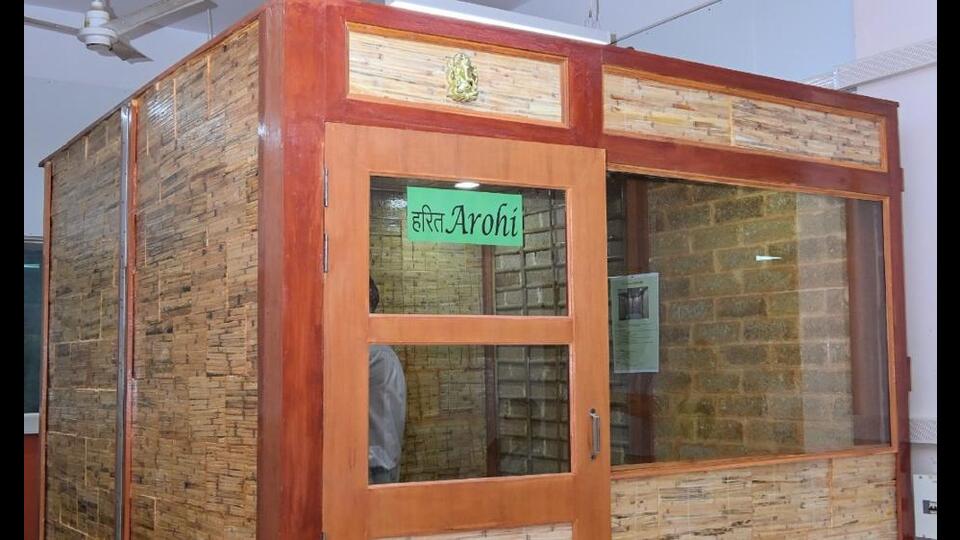
The team led by Deepak Kumar Maurya (who completed PhD from IIT-K) and guided by Prof CS Upadhyay envisions applications in low-rise buildings, toilets, resorts, and disaster-relief shelters, paving the way for a new paradigm in green construction.
“The genesis of this research work is rooted in a project of DRDO where researchers were working on low cost, light weight, blast and ballistic resistance sheets. And it was from there, we were searching for materials that are low cost, light weight, energy absorbing and carry load also,” said Maurya.
“We initially shifted to normal wood. From there, we saw cane grass growing abundantly in the surrounding Kanpur city, including IIT-K premises. It was then the team decided to work with cane grass,” he said.
Innovative eco-bricks and sandwich panels were made from crop residue, lime, jaggery and lentils. The material is resistant to termites, moisture and weather effects and its load-bearing capacity supports up to 1300 kg — ideal for 2-3 storey structures, added Maurya.
This project redefines sustainable construction, turning agricultural waste into strong, fireproof, eco-friendly building materials that can benefit rural housing, disaster shelters, and eco-resorts, said Prof Upadhyay.
“This is one of the final prototypes. We have done many other experiments on this including screw-holding strength, moisture absorption test, fire and burning test, termite resistance. Now, we have to work out to make it viable in the long term with different weather conditions. One of the most important benefits of this is thermal insulated material,” he said.
The project has been funded by the Kotak school of sustainability within the IIT-K, and as of now, it has not attracted government funding. “Currently, ae are making tables, chairs, almirahs, body for drones...the next plan is to make a body for EVs besides wall panels, roof ceilings, household chores,” he said.
How practical is it? Maurya explained: “It is very practical as we are providing 4x1 feet panels and so that it is easy to assemble and there is no external man power. Now that research work has come to an end, we will go towards production where it will become cost effective.”