
 E-Paper



Uttar Pradesh’s second elephant reserve to come up in Kheri soon
Union ministry of environment, forest and climate change gives nod to proposal; state govt to issue notification soon


The Union ministry of environment, forest and climate change (MoEFCC) has given its nod to set up Terai Elephant Reserve (TER) in Lakhimpur Kheri district of Uttar Pradesh.
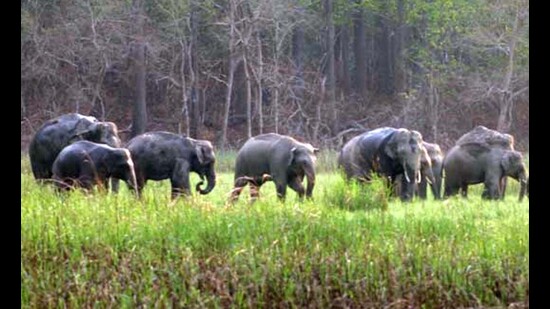
The proposal for it was drafted by Dudhwa Tiger Reserve (DTR) authorities in April this year and forwarded to the Union ministry on October 11. The ministry gave its nod to the proposal on Friday (October 21).
Confirming it, director, Project Elephant and inspector general, forests in MoEFCC, Ramesh Pandey said, “The TER would be the 33rd in the country and second in Uttar Pradesh.” The first elephant reserve in Uttar Pradesh was notified in Shivalik in Saharanpur and Bijnor districts in 2009.
“The TER would be set up in an area of 3,049.39 square kilometre comprising forest areas of Pilibhit Tiger Reserve (PTR), Dudhwa Nation Park (DNP), Kishanpur Wildlife Sanctuary (KWS), Katarniaghat Wildlife Sanctuary (KGWS), Dudhwa buffer zone and parts of south Kheri forest division,” Pandey added. “The new TER will start functioning after the Uttar Pradesh government issues notification in this regard soon,” he said.
In a tweet, Union forest and environment minister Bhupendra Yadav said, “Happy to inform creation of Terai Elephant Reserve at Dudhwa-Pilibhit in U.P. has been approved. This will be India’s 33rd elephant reserve and will help in conserving trans-boundary migratory elephant population. Govt remains steadfastly on the path of protecting all wildlife.”
With the TER coming into existence, Dudhwa Tiger Reserve (DTR) will earn the credit of protecting and conserving four iconic wild species- tigers, one-horned rhinos, Asian elephants and swamp deer.
Elated over the nod to establish TER following his months’ long efforts, Dudhwa field director Sanjay Kumar Pathak said, “Establishment of elephant reserve in Dudhwa will not only boost the eco-tourism but will also help adopt elephant-centric approach towards their conservation under the Project Elephant besides managing camp or captive Dudhwa elephants.” “It would also help effectively handle man-elephant conflicts which are presently state-dependent,” Pathak added.
Elaborating upon the TER, Project Elephant director Ramesh Pandey said, “The need for an elephant reserve in Dudhwa area was felt after a study on wild tuskers revealed that migrant elephants which earlier visited Dudhwa, Katarniaghat, Pilibhit and other Terai areas from neighbouring areas, including Nepal, and returned to their original destinations have tended to stay here permanently.”
“Whether be it the impact of habitat disturbances or disturbance in their migration corridors, the fact remains that number of wild tuskers in DTR has risen to more than 150 and their status has changed from migratory to resident,” Pandey said adding, “this urgently required conservation of these tuskers and their corridors and this could be ensured through establishment of Terai Elephant Reserve.”
“After the establishment of TER, all financial and technical aid and assistance would be available for the reserve which would give impetus to the conservation of wild lives in general and wild elephants in particular,” he said.
Pandey added, “Elephant reserve in Terai region assumed much more significance as it was located on India-Nepal border where trans-national migration of wild tuskers was a routine, giving rise to man-elephant conflicts.”
Dudhwa field director Sanjay Pathak said, “With financial and technical assistance under the Project Elephant, the TER would enable to effectively handle the man-elephant conflicts.”
“Besides, more and more locals would be engaged in elephant conservation and eco-development,” Pathak added. The DTR has always been an ideal destination for migratory wild elephants since decades through various domestic and trans-border corridors.
The DTR has attracted wild elephants for decades through various domestic and trans-border corridors, including Basanta-Dudhwa, Laljhadi (Nepal)-Sathiyana and the Shuklafanta (Nepal)-Dhaka-Pilibhit-Dudhwa buffer zone corridor. ‘’The Terai Elephant Reserve under the Project Elephant would help revive or restore these corridors, which have been left disturbed,’’ Pathak said
Project Elephant director Ramesh Pandey said, “Migratory elephants have always been visiting Dudhwa owing to its enriched habitat conditions.” “Among them, Shuklafanta-Dudhwa corridor was discovered in 2003,” Pandey added.
“At present, some of these corridors have been left disturbed due to human interference and needed to be restored so as to avoid man-animal conflicts,” he said. “Terai Elephant Reserve will help revive or restore these corridors,” Pandey added.


