
 E-Paper



17-year-old Iraqi’s heart failure cured in India with LVAD implant
In October, Hadan came to Mumbai with an extremely weak heart. “He had lost close to 10 to15 kg and was wheelchair-bound. After extensive work-up failed to reveal a treatable cause of his dilated cardiomyopathy, he was listed for a heart transplant,” said his father

 Prefer HTon Google


A 17-year-old Iraqi patient with end-stage heart failure got a second lease of life after a permanent Left Ventricular Assist Device (LVAD) was implanted in him at Fortis Hospital, Mulund. The boy is one of the youngest patients to have undergone this procedure in India.
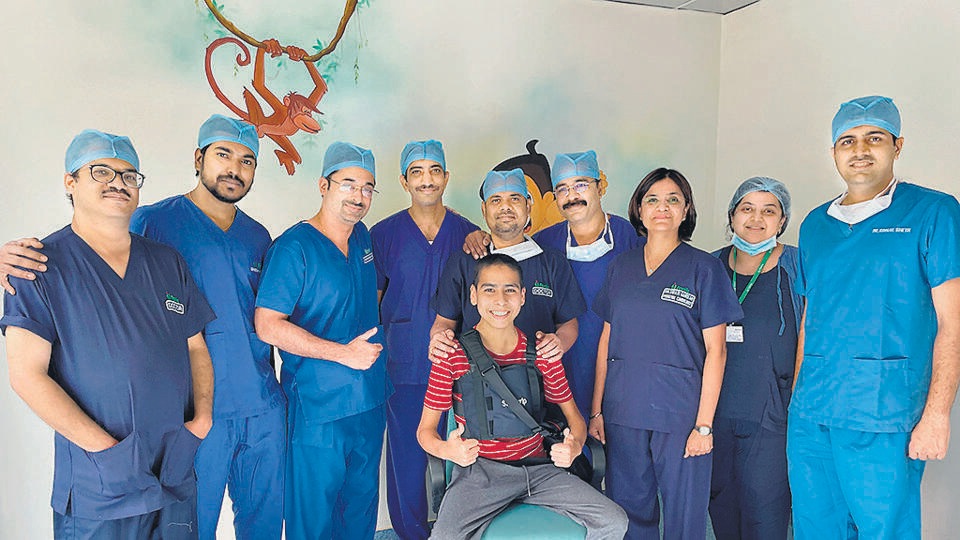
Hadan Falah was diagnosed with dilated cardiomyopathy in May this year. In this condition, the heart fails to pump blood due to muscle weakness, and its chambers consequently enlarge.
According to the doctors, Hadan experienced fatigue late last year while playing football, which later deteriorated to weakness even while walking. “After multiple tests, he was told that his heart was weak and pumping at only 10 percent. He was put on anti-heart failure medication and asked to take rest,” said Falah Hasan, his father.
In October, Hadan came to Mumbai with an extremely weak heart. “He had lost close to 10 to15 kg and was wheelchair-bound. After extensive work-up failed to reveal a treatable cause of his dilated cardiomyopathy, he was listed for a heart transplant,” said his father.
However, being a foreign national and due to the scarcity of donor hearts, Hadan’s chances of getting a suitable heart in time were miniscule, as the first preference is given to Indian waitlisted recipients as per national guidelines. Despite optimising his medicines, Hadan’s condition worsened over the next two weeks, and he was admitted to the ICU for intravenous medicines and support. The team of doctors was able to stabilise him and suggested that his family consider implantation of a permanent LVAD.
“His heart muscles were very weak,” said Dr Swati Garekar, Hadan’s paediatric cardiologist. “Despite being on intravenous BP-increasing medicines for over three weeks, there was no improvement. He could crash at any moment and revival would be very difficult. We had a choice of a temporary or permanent LVAD.”
Dr Garekar said the temporary LVAD would mean that Hadan would be ICU-bound, with the LVAD on a trolley by his bed and connected to him by tubes. “But with an implanted permanent LVAD inside his chest, he could go home, be with his family and even attend school. A permanent LVAD seemed like the ideal solution for his unique problem,” she said.
Hadan was operated on November 18 by paediatric cardiothoracic surgeon Dr Dhananjay Malankar. Explaining the procedure, Dr Malankar said that one end of the LVAD pump was inserted inside the left ventricle (the main pumping chamber of the heart) while the other end was connected by a tube to the aorta (the main artery that supplies blood to the body).
“The LVAD sucks the blood from the left ventricle and pumps it to the entire body through the aorta,” he said. “This advanced machine fits inside the patient’s chest, and only the power cable that is connected to the power source comes out of the skin. The cable is either an AC plug-in kind when the patient is at home or a battery pack worn around the waist if he wants to venture out.”
Hadan’s surgery took close to nine hours. In India, an average of 15 to 20 LVAD surgeries are performed every year. “In the past year itself, 17 patients have received a permanent LVAD implant,” said Dr Malankar.
Hadan was discharged on December 15. After his first follow-up, the family left for Iraq on Saturday. “Post the procedure, we are happy to see him getting back to his life,” said Hadan’s father. “He is excited about going to school as soon as we get back to Iraq.”


