
 E-Paper



3 petitions in SHRC say azaan breaching their human rights
The complaints also state that in 2005, the Supreme Court prohibited the use of loudspeakers between 10 pm and 6 am. In addition, the complaints state, the Bombay High Court (HC) has set the ambient day and night-time noise levels in residential areas at 45 decibels and 55 decibels respectively

 Prefer HTon Google


MUMBAI: Aggrieved at the volume at which mosques in their neighbourhoods amplify the call to prayer, a few people in Mumbai have petitioned the State Human Rights Commission saying the breach of noise restrictions is a violation of their human rights. The 3 petitioners have a common advocate who is also a Hindutva activist.
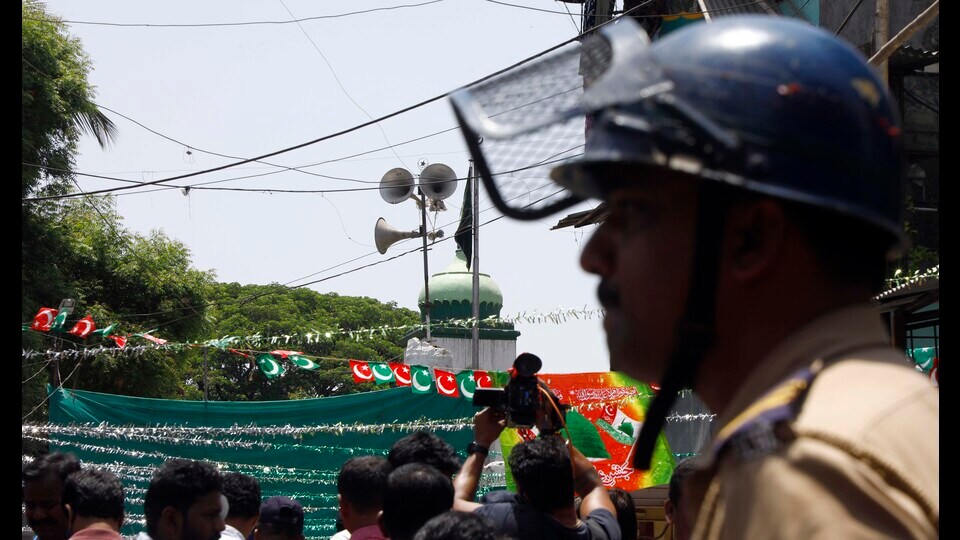
Central to each complaint is the plea that freedom from noise pollution is part of the right to life and liberty guaranteed under the Article 21 of the Constitution of India. Another individual’s constitutional right to freely profess, practice and propagate their religion, they argue, cannot infringe upon their inalienable right to life.
The complaints also state that in 2005, the Supreme Court prohibited the use of loudspeakers between 10 pm and 6 am. In addition, the complaints state, the Bombay High Court (HC) has set the ambient day and night-time noise levels in residential areas at 45 decibels and 55 decibels respectively. This degree of quiet is however impossible to achieve in Mumbai.
Their complaints also quote from a 2016 judgment of the Bombay HC which ruled that no religion or sect could claim the use of a loudspeaker as a fundamental right under the Constitution, and a 2020 judgment of the Allahabad HC which observed that while azaan was an integral part of Islam, its amplification through loudspeakers and public address systems was not.
One of the petitioners, 34-year-old civil engineer Sameer Patil had left the tranquillity of Five Gardens at Dadar for a newly-constructed tower in Bhandup looking out to the lush green hills of the Sanjay Gandhi National Park. What he did not realise then, he says, is that the building is in the vicinity of five mosques. “Our sleep pattern has changed. All you want at the end of the day is 5 to 6 hours of sound sleep,” he says. “Being woken up by a loud noise ruins your day and puts you in a bad mood. And that bad mood persists throughout the day.” When complaints to the police went unheeded, Patil met the lawyer Kaushik Mhatre who advised him to go to the state human rights commission. Mhatre’s day job is that of a lawyer—he practices in the Bombay HC but the advocate representing the families of the deceased sadhus and driver in the 2020 Palghar mob lynching case is a full time Hindutva activist and a proponent of the bogus idea of zameen jihad.
Patil had come across videos where Mhatre spoke about how blaring prayers on loudspeakers is the modus operandi of Muslims to drive away people of other communities and eventually buy their homes and which then emboldened him to seek Mhatre’s counsel. At a hearing at the commission last week, Purushottam Karad, Deputy Commissioner of Police, Zone VII, stated in an affidavit that he had deployed a police inspector to patrol all five mosques that Patil had complained about, between 5 am and 8 am. None of them, Karad said, had used loudspeakers before 6 am.
In the same affidavit, Karad also said that the police had filed cases in court against two mosques which had violated the noise rules in May and September this year. The court had fined the management of both the mosques and after which they were adhering to the timings.
DCP Karad also pointed out that as Patil lived in a noisy locality dotted with numerous small noise-emitting industrial units and workshops, all of that as well as the traffic added to the overall noise and not just the azaan. The next hearing in the matter is slated for December.
This week, the commission heard another case in which Mhatre again is representing the applicant, 42-year-old Rahul Pawar, who lives next to a mosque at Chembur. “The loudspeakers of the mosque face my windows. Even after we asked the mosque to turn the loudspeakers the other way, the noise was unbearable,” he said.
Pawar said he reached the commission after his Right To Information applications, filed at the behest of Mhatre, revealed that Deonar police had not given the mosque permission to use loudspeakers. At the hearing, an inspector from Deonar police station informed the commission that the mosque had since removed the loudspeakers. However, the police had allowed the mosque to use a box speaker inside its premises. But Pawar is not satisfied with this response. “What prevents the police from granting the mosque permission at a later date again to use loudspeakers?” he argues.
In July, the human rights commission had dismissed a complaint by another Mhatre client after hearing it for six months. The applicant, 32-year-old college professor Abhijit Kulkarni, had approached the commission after filing a writ petition in the Bombay HC. His complaint was directed at three mosques in Nehru Nagar, Kurla.
“Every time I complained to the police, the mosques would keep the sound down for 3-4 days, before it would resume,” he said. Kulkarni who also found Mhatre through his incendiary Youtube videos formed a community organisation, the Jaago Nehru Nagar Association, to pursue legal recourse as a group. The association has 300 members from 140 buildings which claim to be affected by loudspeakers. The HC is yet to dispose of his petition. Following the dismissal of his case, a fellow resident has now filed a second complaint with the human rights commission.
Hemrajsingh Rajput, Deputy Commissioner of Police, Zone VI, where both Pawar and Kulkarni stay, and who is also a party to the proceedings at the commission, declined to comment on the case.
Noise pollution activist Sumaira Abdulali acknowledged that there is a genuine issue at stake here. Multiple research studies have linked long-term exposure to loud noise with increased levels of stress and blood pressure and headaches, not to mention hearing loss and tinnitus. Constant exposure can have debilitating physiological and psychological effects.
Abdulali, who, armed with a decibel meter, is a familiar sight at political rallies and festival celebrations, has observed noisier festival celebrations since the Covid-19 pandemic. “Though the Ganpati immersion festivities this year were quieter compared to last year,” she says, she has received several complaints from citizens this Navratri. Abdulali’s Awaaz Foundation was one of the petitioners in the Bombay HC in its 2016 ruling on the strict implementation of the Noise Pollution (Regulation and Control) Rules, 2000. “During the hearings the police had argued that acting against religious establishments would cause a breach of peace,” she said explaining why the police sometimes don’t act against the mosques or Ganpati or Garba pandals.
Last year, the Juma Masjid of Bombay Trust had introduced a mobile application, Al-Salah, to alert devotees of namaz timings five times a day and also livestream azaan, thus eliminating the need for using loudspeakers. “That was a template for other mosques to follow,” Abdulali says.
Moin Ajmeri, a trustee on the boards of four mosques in Santacruz East, says that in mixed community neighbourhoods, early morning azaan is bound to cause disturbance. “The purpose of azaan is to call members of the Muslim community to prayers. While Muslims may like to hear the name of Allah first thing in the morning, others may not. The intention should not be to wake anyone up,” he adds.
The mosques he runs do not use loudspeakers before 6 am. “The rest of the day is generally so noisy, I do not think anyone should have a problem with loudspeakers being used for a few minutes. Even then, I constantly advise the management of other mosques to use loudspeakers at a low volume, especially early in the morning and to point them in the direction of the homes of Muslims,” he says.
Reached for his response, chairperson of the state human rights commission, retired Bombay HC Justice K. K. Tated, said that the commission has been regularly receiving complaints against the use of loudspeakers by mosques. It has also taken up some cases suo motu on the basis of newspaper reports.
“There are restrictions against the practice of any religion. They have to be practiced within the law. Whether it is mosques or Ganpati and Navratri, you cannot use loudspeakers 24 hours a day. Being disturbed by loud noise is indeed a human rights issue.”
However, cautions Sanjay Hedge, senior advocate at the Supreme Court, the right to life under Article 21 of the Constitution cannot be extended to require that only one source of noise be shut down, while ignoring other equally persistent sources. “The police may be required to shut noise beyond a particular decibel at a particular time, from all sources. This would include a bhagwati jagran as much as an azaan, or a temple puja,” he says.


