E-Paper



69-year-old dies outside Bandra station as ambulance driver refuses hospital run
A 69-year-old man died at Bandra station, waiting for an ambulance, highlighting failures in emergency response despite a 2014 HC order for services

 Prefer HTon Google


Fifteen years after Bombay high court ordered that ambulance services be made available at all suburban railway stations across the Mumbai Metropolitan Region (MMR) for a quick response to any traveller’s health emergency, on Tuesday a 69-year-old Bandra-based textile businessman, died outside the station waiting for an ‘108’ ambulance to rush him to the hospital.
The businessman Rama Shankar Singh had boarded a Borivali-bound local from Marine Lines at 5pm. Between Grant Road and Mumbai Central stations he collapsed, complaining of uneasiness in the chest. Seeing this, his co-passenger Mehul Sanghrajka called the Railway Protection Force (RPF) helpline ‘1512’ asking for assistance. A few RPF personnel arrived at the next station – Mahalaxmi – to check on Singh, but as he told them he was feeling better and would be able to complete the commute to Bandra, they exited the coach. However, at Prabhadevi station, when he collapsed again, Sanghrajka called Singh’s son, Hari Mohan, and the ‘108’ helpline for an ambulance.
Hari Mohan told Sanghrajka to alight at Bandra station so that they could take him to Hinduja Hospital, where Singh had undergone a bypass surgery in 2021.
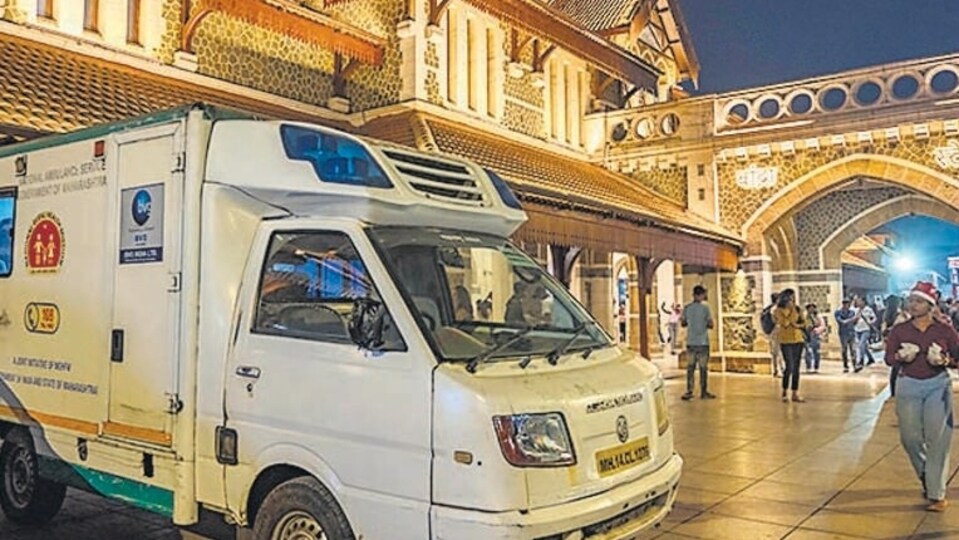
“When I alighted from the train at Bandra with Singh at around 5:40 pm, and took him to the ambulance deployed outside the station, despite the station master insisting that he was having a heart attack and hence must be rushed to a nearby hospital, the driver argued citing protocols and lack of approvals from seniors,” said Sanghrajka, adding there was no doctor near the ambulance either, flouting the HC order of 2014.
Hari Mohan, who was waiting to receive his father at the station, said, “The ‘108’ ambulance driver said he could ferry a patient only when he receives a call from the doctor. My father was standing in front of a locked ambulance door, feeling dizzy, I made him lie down on a stretcher; minutes later he collapsed in my arms.”
Dr Harris Sheikh, who was deputed to be in the ambulance, claimed Singh’s health worsened as “people had forcefully made him lie down in the ambulance”.
He said, when the driver called him, he was at one of the platforms of the station, and had instructed him to “rush the patient to Bhabha Hospital, two kilometers away, as this was a case of emergency”.
“As per protocol, the doctor receives a call first, following which we take a patient to the nearest government hospital. I got a call quite late. Before I could do anything, the patient was already lying inside the ambulance,” Sheikh said.
Sanghrajka added, “After losing 20 to 25 minutes arguing with us, the driver finally drove us to Hinduja Hospital at around 6:45 pm, without a doctor.”
“Had there been a doctor present in the ambulance at the time, as is the rule, my father could have been saved,” said Hari Mohan.
Singh’s death certificate, issued by Hinduja Hospital, states: “He was unresponsive with his central pulse absent at the time he was wheeled into the hospital.”
After HC had ruled that ambulances be made available outside all suburban railway stations, on February 28, 2014, the state government instructed Pune-based BVG India Limited to run the ‘108’ service across the state, which included stationing a fully functional ambulance with a doctor outside each railway station premises, to transfer a patient to the nearest hospital.
The agreement between the service provider of ‘108’ service states that the response time of an ambulance should be four minutes, and if a delay of 20-30 minutes in a month is logged, the service provider would be fined ₹1 lakh for every minute’s delay.
Medical aid to persons involved in train accidents or when complaining of a sudden illness within the ‘Golden Hour’— the first one hour after the accident is crucial— is among the recommendations ordered by HC. Years later, it remains on paper.
HT’s calls to BVG India Limited, remained unanswered.