
 E-Paper



A simple flat purchase that turned into a 10-year-long nightmare
As a journalist, Anjana Vaswani has covered many a public interest issue, but it wasn’t until she bought a flat in an under-construction project that she became the subject of a cautionary tale herself. This is an account of how she and other buyers in Orbit Terraces waged a 10-year battle to wrest their homes


Mumbai: July 13 was one of those slow, rainy days in Mumbai best suited to hunkering down at home when mid-afternoon a WhatsApp group that I am part of suddenly buzzed to life. Saifuddin Hajee, a Mazgaon businessman, dropped a voice note on the group to announce the successful completion of the conveyance and registration of Orbit Terraces in the name of the society – meaning, the flat purchasers’ group.
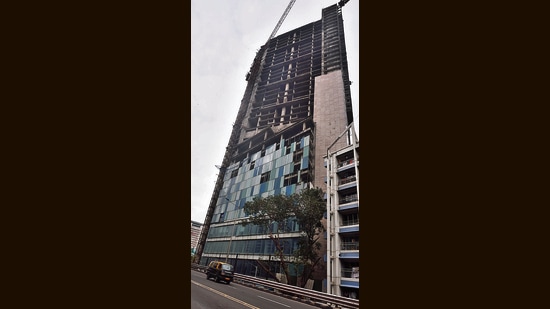
The 50 of us on the group are spread across the city, but our phones chimed almost collectively in one hurrah. Hajee’s voice note marked the end to 10 years of litigation, lobbying, meetings with the builder, with bankers, with government officials and other flat buyers, so that finally we could claim a contested building as our own.
Our small victory has come at a huge price, both personal and financial – we’ve had to dig into our pockets to pay for the builder’s greed and for the negligence of officers, some of the members of our group have passed away over the years, marriages have broken up, some suffered illnesses brought on by the financial strain, relationships soured within families over whose decision it was to trust the builder in the first place. But for all that, we’ve been luckier than some 4.8 lakh home buyers in India (A May 2022 report from property consultant Anarock points out that 4,79,940 units, estimated to be worth some ₹4.48 lakh crore or roughly $56 billion, remain stuck in various stages of construction across Mumbai, Pune, Delhi, Kolkata, Chennai, Bangalore and Hyderabad; MMR and Delhi-NCR account for 77% of the total). Their projects may never see the light of day, unless, like us, other buyers come together to take on the system.
When I booked a 2.5 bedroom flat in the under-construction Orbit Terraces at Lower Parel in-2010, I based my decision on the glamorous advertisements that promised a spacious home and luxurious amenities. Orbit, owned by Pujit Agarwal, was building many projects and it all seemed hunky dory. The alarm bell rang two years later in the form of a hand-written note that arrived at my doorstep in 2012. “Don’t you care about the money you’ve invested? What are you doing about it?’ it read, and it was signed by a certain Pravin Gandhi, who had tracked me to the new home I had just moved into with my parents and children, then 9 and 14.
Until then I had not heard of Gandhi who I later realised had started Hinditron Computers, one of India’s earliest technology companies in 1972. I had been promised delivery of the Orbit Terraces apartment by the end of 2013 so I had no reason to panic. Still, jolted, I dialled the phone number on the note immediately – as did, I would later learn, four others whose whereabouts Pravin Gandhi had also painstakingly traced through RTI.
Gandhi, who was 69 when he set that ball rolling, had realised something was amiss because the builder kept dodging his queries about the progress of the construction. ‘Work had come to a halt and there was speculation in the media about the builder facing financial difficulties. Each time I would visit the builder’s office, I would get vague promises. Since individual pressure was not yielding results, I felt collective action was needed,’ recalls Pravin Gandhi, general partner at Seedfund, a venture capital firm.
He had booked a 2 BHK in Orbit Terraces in 2010, hoping a flat in Mumbai would encourage his daughter, who lives overseas, to move to India. After 12 years, this is no longer likely. “So, for me, it is an investment that has no useful value”, he now says.
Once a few of us had decided to take legal action we reached out to Vivek Shiralkar, an unassuming solicitor whose quiet manner belies his acuity. Unsurprisingly, some in our group wanted ‘bigger names’; we visited large, swanky offices with glass cabins and shiny wooden floors. Every legal eagle we met said filing the case would cost us ₹3 lakh per flat purchaser – on paper, there were close to a hundred purchasers, and at the time many were not reachable, many others were already struggling to pay EMIs towards a flat they weren’t sure they would ever see completed. How would we ever get over ₹3 crore together to file the case?
In 2017, Shiralkar, aided every step of the way by solicitor Yashoda Desai, filed our case against Orbit Corp. It was as a ‘representative suit,’ the equivalent of what the Americans call a class-action suit, a lawsuit filed by a group of persons on behalf of a larger body with similar interests, rights and claims (remember the film, Erin Brokovich?). Nine of us buyers thus represented the other flat purchasers in the lawsuit that sought to allow us to step into the shoes of the developer – this remedy which exists in law, yet which has rarely been used against builders, slashed our cost of litigation and allowed us to sidestep the first of many hurdles that would follow.
By this time Pujit Aggarwal, the builder, was in jail on allegations of duping investors in a case filed by Capri Global Capital Ltd. His father, Ravikiran Aggarwal, would attend court instead. On one occasion, this writer watched, incredulous, as Ravikiran – dressed in designer suit and glasses – tried to play the, ‘I’m old and in dire straits,’ card before Justice Shahrukh Kathawalla. It irked. After all, seniority and adverse circumstances had not afforded anyone on our side of the battle lines any concessions.
One senior citizen in our group, who has requested anonymity, watched her son’s marriage prospect disappear as the match was hinged on the fact that the couple would have their own home to live in. In fact, almost every time our group met over the years – we are practically family now – someone spent the evening crying over someone else’s shoulders about the toll this project was taking on them. At every meeting, one of the buyers, Eruch Engineer, who was 76 when our case went to trial, would ask. “Will I see this building completed in my lifetime?”
He didn’t. When he passed away in 2019, our group had just arrived at consent terms with the banks. The banks agreed to sell the property to us for ₹60-odd crore. But as another buyer Saifuddin Hajee, who has led our buyers’ group through the entire process, recalls of that time, “We would take one step forward and two steps backward.” When Pujit Aggarwal was declared bankrupt for instance, it was a big setback for us buyers.
The banks – SBI and the Union Bank of India – took an aggressive stand and filed an application to declare the promoters of Orbit Corp as insolvent before the National Company Law Tribunal. Our solicitor Shiralkar recounts, ‘This was a big blow to us because once an application is admitted in NCLT, there is a moratorium on all other legal proceedings; an Interim Resolution Professional is appointed. We would, essentially, have been put in a queue with all of Pujit Aggarwal’s other creditors.”
In 2017 itself we filed a writ petition in the Supreme Court challenging the provisions of the insolvency code. We claimed it discriminates against flat purchasers – this position has been modified since then, and flat purchasers are now on par with secured creditors in insolvency proceedings.
In 2018, just as we were getting around the NCLT issue with directions from the SC, based on the orders it had passed in the matter of Jaypee Infratech, Orbit Corp was wound up by the High Court. Another nightmare had begun. The matter was now out of NCLT’s jurisdiction – an official liquidator was appointed. Shiralkar filed an application in company court to say that as flat purchasers we have a statutory charge [on the property] and that we are entitled to that property under the provisions of Maharashtra Ownership of Flats Act (MOFA). To do this, we had to form a cooperative society (until then, we were operating as an AOP or Association of Persons), which had to be registered. More meetings, more expenses, more delays, more disappointment and self-doubt.
In the meantime, the banks accepted our offer of a one-time settlement – and we used this to appeal to the company court. ‘We claimed that banks are secured creditors and they have a right to stand out of liquidation -- that they can sell that property to us by way of a private treaty under the SARFAESI Act (Securitisation and Reconstruction of Financial Assets and Enforcement of Security Interest Act),’ recalls Shiralkar.
This is how we’ve spent the last ten years: we’ve put our lives and careers on hold to file applications, attend court, to meet lawyers and bank and government officials, to rent halls and conference rooms to apprise our group of buyers about the status of the project and to brainstorm about next steps. We’ve had to coax flat purchasers into putting in more money towards all of this considering all that they’d already suffered through; we’ve had to rally together through the pandemic to get the funds together to pay off Pujit and Ravikiran Aggarwal’s debt. What should have cost me ₹22,175 per sq.ft in Orbit Terraces now costs me ₹27,175 per sq.ft. (It works out to an additional burden of over ₹70 lakh for even a 2 BHK ).
The conveyance in our society’s name is no doubt a milestone for us buyers but another uphill task has begun. Having been abandoned for so long, the building – the 40 floors that have been constructed – will now have to be assessed for quality of construction. One of our options is to hire a contractor who will complete the building, another option is to sell the whole building as is and to distribute the funds proportionally to all purchasers – but, in a tight financial market, we’d be lucky if we broke even. We will meet as a group once again and decide how to proceed.
Stay updated with all the Breaking News and Latest News from Mumbai. Click here for comprehensive coverage of top Cities including Bengaluru, Delhi, Hyderabad, and more across India along with Stay informed on the latest happenings in World News.


