
 E-Paper



Covid: Mumbai’s Dharavi fights a virus
Dharavi’s population density is 17 times that of the rest of Mumbai, and over 80% of its population uses community toilets. Yet, by the middle of the pandemic, the World Health Organisation chief Tedros Ghebreyesus praised slum residents and city authorities for the way in which they had curbed the spread of the coronavirus in this neighbourhood. Here’s how they did it.


“Video calling really saved me. There were times when I felt that I would never see my children again,” said Prabhavati Jaiswar, 53, as she busies herself at the stove making coffee in her 10 x 10 ft home in Rajiv Gandhi Nagar, one of localities in densely-populated Dharavi. Her youngest, nine-year-old Ganesh sits on the doorstep with his friends, their legs dangling close to the narrow open drain outside.
There are six people in that room, some on chairs, others crouched on the floor, and everyone is talking about the third phase of the vaccination drive that will begin in a few days. No one has a mask on. Jaiswar hands over a cup of too-sweet coffee to each, including her school-going daughter, Shilpa (16). Jaiswar’s older daughter, 18-year-old Sheetal is on a mezzanine floor above us. She surfaces after Jaiswar calls out – earphones plugged in, eyes planted on the phone screen – to receive her cup. Her college class is going on, but no one below is bothering to lower their volume. Jaiswar’s oldest, 22-year-old Durgesh, is out at work.
On March 25, 2020, Jaiswar was visiting her husband’s family in Uttar Pradesh as her mother-in-law had recently died. Her husband could not attend his mother’s cremation as he lives and works in Kuwait. Prabhavati was stuck in the village as all transport was stopped during the lockdown, enforced to curb the spread of the virus. She spent the next three months away from her children. “The whole chawl was amazed at how my youngest was brave enough to stay without his mother for such a long time,” Jaiswar said.
In mid May, the lane outside the Jaiswars’ house was sealed after a person was found to be Covid positive. This meant that even stepping out to use the community toilet complex – located on the main road, close to the Rajiv Gandhi Sports Complex -- was disallowed during the day. Volunteers who came to deliver packets of food – organized by the Brihamumbai Municipal Corporation, the area’s legislator Varsha Gaikwad, the local corporators like Vasant Nakashe and Harshala More, and citizen groups like Dharavi Boys made up of Durgesh and his friends who pooled their earnings to help neighbours – couldn’t enter the lane either.
“I was so afraid – we all were so fearful in the initial days. I thought, any of us could die at any point and we wouldn’t even be together,” Jaiswar said. “The real virus of the pandemic was fear.”
A year after Mumbai recorded its first Covid-19 patient, Dharavi -- a slum spread over 2.4 sq km in the heart of Mumbai with at least 850,000 residents and a population density of 354,167 people per sq km, or 17 times that of Mumbai -- has seen a spike in daily cases reported in the past month.
Kiran Dighavkar, assistant commissioner of the G/North ward with jurisdiction over Dharavi, recently announced that the BMC was going to resume screening people for symptoms as Dharavi recorded 12 cases on March 10. So far, Dharavi has recorded 5195 cases and 316 deaths. There are 99 active covid-19 cases in Dharavi as of March 10.
Experts, government officials and residents agree on one thing: while the pandemic tore through Mumbai, which was one of the worst-hit cities in the country, in Dharavi, a looming health crisis was largely averted.
Dharavi is home to migrants, who work in the construction industry, or as domestic helps in neighbouring tony localities, as well as different communities practicing trades like pottery or leather manufacturing. Nearly 283,000 people use the 450 community toilets in the slum and each hutment, the same size as Jaiswar’s home, houses on an average 8-10 people. Most localities have narrow lanes with two or three-storied houses where often, top floors double as factories for the several cottage industries that Dharavi is known for, such as plastic recycling and garment manufacturing. Where then was the space to quarantine at home, or practice social distancing? After the first case was detected on April 1, 2020, it took 17 days to record the first 100 cases, six days to record the next 100, and only five days to record another 100.
Yet, on July 11, World Health Organization director general Tedros Adhanom Ghebreyesus praised Dharavi as an example of an intense Covid-19 outbreak that was brought under control. A sero-surveillance survey released that month revealed that 57% of slum-dwellers, taken from a random sample of 7000 residents, had antibodies for the coronavirus; compared to that, only 16% of the population that did not live in slums, had antibodies.
On April 1, Dharavi’s first case was detected, posthumously. The 56-year-old man was a resident of Dr Baliga Nagar, a set of nine multi-storied buildings. His family refused to speak: “It has been traumatic for us. We are trying to move on and don’t want to relive what happened,” one of his daughters who refused to give her name, said.
The man had no travel history, but he developed symptoms on March 23 following which he visited his local doctor who gave cough medication. Six days later, the man began to face difficulty breathing and he was admitted to Sion hospital, where he was tested for Covid. His positive result came on April 1 shortly after he passed away.
The gated colony where he lived was sealed by the Brihanmumbai Municipal Corporation (BMC) on April 1. Within a week, four other hotspots were sealed in Dharavi; Baliga Nagar remained a containment zone till April 21. For the first two weeks, cases were concentrated in five areas: Kalyanwadi, Mukund Nagar, Social Nagar, Muslim Nagar, and Madina Nagar. Within a month the number of hotspots increased to 10. By the end of April, Dharavi had over 180 containment zones.
“We lived through so many misconceptions about the infection, and rumors. Everyone believed life was over now that they have contracted the virus. We did not step out of our homes even after April 21, because we didn’t want to be a containment zone again,” said Saida Khan, a 48, a resident of Dr Baliga Nagar, who tuition classes came to stop due to the pandemic. Her husband, who runs a contract business in the construction industry, also lost business and the family had to dip into their savings of ₹23,000 to sustain through the lockdown.
Though the lockdown is long over, Khan is not keen to resume tuitions despite requests from parents. “I am afraid to allow so many people into my home, or take on responsibility of so many children during a pandemic,” she said.
“We had a three-pronged strategy to stop virus transmission in the community: High number of tests, contact tracing, and shifting as many people as possible to institutional quarantine facilities. Without this in place, the situation would have become difficult to manage,” said Dighavkar.
Dharavi traced up to 24 contacts for every Covid-positive person, in contrast with the city’s average of 10 to 15 contacts. The BMC acquired three private hospitals in Dharavi, and set up 22 Covid Care Centres with 4,447 beds in April and May.
Four large quarantine centres for high risk contacts were set up, the first came up at the Rajiv Gandhi Sports complex with 300 beds. Others came up in the Mahim Nature Park (1200 beds), Dharavi municipal school (700 beds) and Manohar Joshi Vidyalaya (also 700 beds). High risk contacts were also moved to the quarantine centres in Dadar and Mahim. After initially starting a door-to-door screening system, the BMC set up fever camps and roped in private doctors. Fever camps were temporarily set up at various locations across Dharavi. Residents living nearby would walk-in to get a Covid-19 test done, or get checked by a doctor.
On June 23, Dharavi recorded only five cases, the lowest since April 5. BMC data from that month shows that by then, 548,270 people had been screened.
“Dharavi is a success story. It managed to minimise the infection rate and outbreak very effectively and very quickly. What changed is not just in terms of transmissibility of the virus. Genetic factors, actual genotype of the virus, socio-economic factors could have contributed to high case fatality rate (CFR), though it is difficult to say for sure. Uncontrolled co-mordidity contributes to high CFR, but how much uncontrolled co-morbidity is or was there in Dharavi’s population is difficult to derive without data. Having hypertension in itself is not a problem, it is a problem only if your metabolism is in a state of inflammation, in which case co-morbidity can cause a problem in recovery,” Dr Om Shrivastav, a consultant for infectious diseases, said.
According to Dighavkar, strict measures put in place by the municipal body helped curb the spread of the disease.
Within the first fortnight of the lockdown, the BMC stopped sale of fruits and vegetables in Dharavi. BMC staff and volunteers helped deliver groceries door-to-door, and community volunteers stepped in to ensure that no household lacked essential goods.
The BMC sealed the borders of slum and set up 24 check-posts at all entry/exit points to monitor movement control. Strict containment measures were deployed in virus hotspots. All forms of transportation services and movement of vehicles were stopped; all small industries, shops, and markets across the slum area were shut down. Within weeks, the bustling locality had turned into a ghost town.
“We did a drone survey of Dharavi in the middle of the lockdown in May and saw that not a single person was out on the street. Citizens cooperated with the authorities very well,” Dighavkar said.
But that’s not how some residents remember it. Satish Dubey, a resident of Rajiv Gandhi nagar and one of the people sitting in Jaiswar’s one-room home volunteered with the BMC to distribute food and ration kits to residents of his locality.
“The police would hit people with their lathis if they found anyone on the street, even if the person had to go out to buy some medicine or use the community toilet. We even complained to the police station to get the local cops to stop their high handedness,” Dubey, 22, said. “All that did was add to our fear.”
At least 100,000 migrants living in Dharavi left for their hometowns on foot in April before the Centre started special trains for them.
“We were already out of jobs and out of money. In the initial months, we thought that if we get the virus, we would die,” Dubey said.
In a recent Ease of Living Survey released by the Centre, Greater Mumbai ranked high on resilience, or the ability to deal with natural disasters. This was in full display in Dharavi, as volunteer groups kicked into action.
Labour contractor Avirath Shinde, 36, recalls how he and the labourers who remained in Dharavi after the lockdown went door to door distributing essential food items, hand sanitizers, or helping the sick and elderly commute to the nearest fever camp. Avirath tested positive for Covid on May 8, along with three other members of his family.
“When I was discharged from the hospital, all my neighbours helped with sanitizing my house, providing my family and children with cooked food, and doing grocery runs for us. Dharavi also managed to deal with the pandemic largely because of its community spirit,” Shinde said.
In another part of Dharavi, Nawneet Ranjan who runs Dharavi Diary, an innovation project run with company’s CSR funds to train the area’s school-going students in technology and digital tools, began to work on a database. With the help of motley band of students, he began to record the needs of the residents in that area. Then, he began to raise funds over social media platforms and also helped distribute food and ration kits. “Between July and September, we raised around ₹25 lakh, and supplied ration kits to over 10,000 families,” Ranjan said.
By July, Dharavi’s small and medium scale businesses were permitted to resume operations. Dharavi has 5000 GST registered businesses, and over 15,000 single room factories, with a turnover of one billion US dollars annually, according to BMC data. But recovery has been slow.
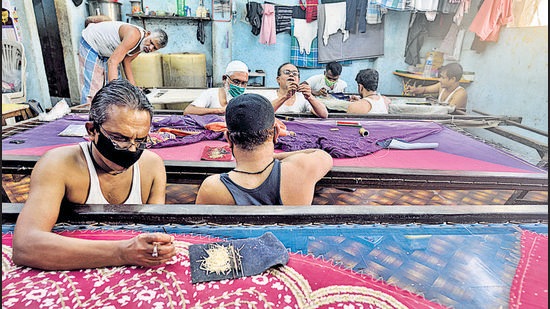
Mohammad Shamshad Sher, 41, who owns an embroidery business in Dharavi and operates from a small 20X20 ft room on the second floor of a tin-roofed hutment, used to own three shops and employed over 60 people. Now, however, he can only operate one of them.
Mohammad pays ₹15,000 rent for his workshop, and though the landlord had waived off the rent for the lockdown months, that is not the case any longer.
“I have employed only 10 labourers right now, because there is no work. If we do not get orders, then I cannot pay everyone. Most of the labourers I work with went home after the lockdown. Not everyone has returned. Even if they return, where is the work?”
Stay updated with all the Breaking News and Latest News from Mumbai. Click here for comprehensive coverage of top Cities including Bengaluru, Delhi, Hyderabad, and more across India along with Stay informed on the latest happenings in World News.


