
 E-Paper



Air quality dips to very poor in pockets as winter approaches
Analysts said the rising concentrations of particulate matter reflected both seasonal patterns and the city’s persistent emission sources

 Prefer HTon Google


Mumbai: The city’s air quality deteriorated sharply on Friday on the back of a surge in concentrations of the pollutants PM2.5 and PM10 from Thursday night through Friday morning. Several monitoring stations across the city recorded ‘poor’ and ‘very poor’ air quality on Friday and the worst affected areas were Bandra Kurla Complex (BKC), Siddharth Nagar (Worli), Mazgaon, Sion, Navy Nagar–Colaba, and Deonar, where concentration of particulate matter rose to dangerous levels.
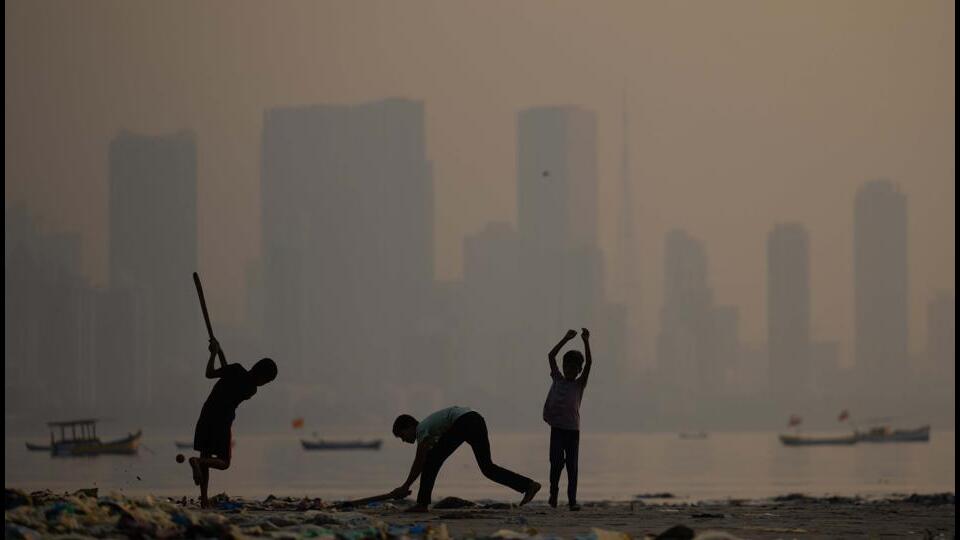
As per the Central Pollution Control Board’s (CPCB) 4pm bulletin, the city’s overall air quality index (AQI) stood at 164, significantly higher than the 138 recorded on the same day last year. At several locations, levels of PM2.5 – which comes from combustion sources, vehicles, industries, generators and waste-burning – exceeded levels of PM10, which comprises construction and road dust.
As per CPCB norms, the permissible 24-hour average for PM10 is 100 micrograms per cubic metre (µg/m³), while PM2.5 should remain below 60 µg/m³.
Among the worst hit areas was BKC, where the AQI reached 307 by 5pm on Friday after peaking at 341 around noon; the 24-hour PM2.5 average here stood at 304µg/m³, while PM10 averaged 270 µg/m³. Sion witnessed one of the sharpest spikes in particulate matter concentrations, with PM2.5 soaring to 425 µg/m³ and PM10 touching 454 µg/m³ overnight; by Friday evening, the AQI in Sion stood was poor, at 242.
At Siddharth Nagar in Worli, the AQI on Friday was 304, or ‘very poor’. Ozone was the prominent pollutant here, signalling a mix of traffic emissions and stagnant wind conditions.
At Navy Nagar in Colaba, PM2.5 remained consistently higher than PM10 and peaked on Friday at 308 µg/m³; on Thursday evening, PM10 had touched 500 µg/m³ .
Analysts said the rising concentrations of particulate matter reflected both seasonal patterns and the city’s persistent emission sources.
“Pollution levels go up once winter sets in because cooler temperatures trap pollutants closer to the ground,” said Sunil Dahiya, air quality expert and founder, Envirocatalysts. “Sharp spikes in pollution will continue in locations where emissions are high, such as in dense traffic corridors, industrial clusters and waste-burning hotspots.”
The Brihanmumbai Municipal Corporation (BMC) has intensified enforcement in response to deteriorating air in the city, a senior BMC official told HT.
“There are 4-5 pollution hotspots, mainly due to traffic and construction activities. We have formed squads in every ward to check violations, and notices are being issued wherever necessary,” the official said. “Deep-cleaning drives are also underway to control dust.”
Gufran Beig, chair professor at the National Institute of Advanced Studies (NIAS), said the coming weeks would see further decline in air quality.
“La Niña is already setting in, earlier this time. This may intensify further in November, which will create a phenomenon of cooler temperatures mixed with slower wind speeds. Therefore, it is very likely that Mumbai’s overall AQI may worsen further due to low dispersion of particles as the winter season progresses,” Beig said.
Pollution peaks may arrive earlier in December this year though the trends so far are similar to last year, he noted.
Maharashtra Pollution Control Board officials did not respond to texts or calls from HT.

Stay updated with all the Breaking News and Latest News from Mumbai. Click here for comprehensive coverage of top Cities including Bengaluru, Delhi, Hyderabad, and more across India along with Stay informed on the latest happenings in World News.


