
 E-Paper



At 245, Mumbai records season’s worst AQI
The city’s air quality index (AQI) touched a season high of 245 on Monday, settling in the ‘poor’ quality of the AQI, season’s worst, as per the System of Air Quality and Weather Forecasting And Research’s (SAFAR)


The city’s air quality index (AQI) touched a season high of 245 on Monday, settling in the ‘poor’ quality of the AQI, as per the System of Air Quality and Weather Forecasting And Research’s (SAFAR) network of 10 continuous ambient air quality monitoring stations (CAAQMS) across the city. As per the Central Pollution Control Board’s classification, ‘poor’ air quality can cause “breathing discomfort to most people on prolonged exposure.”
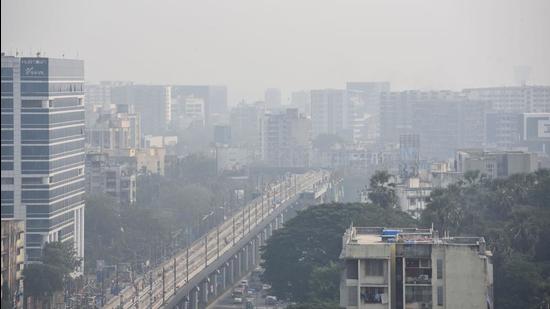
Air quality had previously dipped to the ‘poor’ category this month on November 5, a day after Diwali, when AQI touched 215. However, the overall AQI is an average of a network of individual monitors across the city, which shows wide geographic variation in the concentration of pollutants.
Of the 10 monitoring locations operated by SAFAR across Mumbai, four of them showed significantly worse air quality than the city’s average on Monday. Colaba registered the city’s most polluted air with an AQI of 345. This was in the ‘very poor’ category, which, as per the Central Pollution Control Board, can cause “respiratory illness on prolonged exposure.” Other locations with ‘very poor’ air on Monday included Mazagaon (325), Bandra-Kurla Complex (314) and Malad (306).
Experts attributed the spike in pollution, particularly particulate matter (PM) pollutants, to an incursion of moisture after the formation of a low-pressure area (LPA) in the Arabian Sea off Maharashtra’s coast.
“Because of the low-pressure area, moisture laden winds have started blowing over the city, pushing up humidity levels,” said Gufran Beig, meteorologist and project director, SAFAR. “When this happens, the air becomes heavier and is able to hold pollutants, especially PM2.5 and PM10, to a greater capacity. This is why one might notice a haze accumulating over some parts. At the moment, winds are not strong enough to disperse this haze but there may be some relief on Tuesday because rains have been forecast.”
An AQI of 100 to 199 is considered ‘moderate’, while 50 to 99 is considered ‘satisfactory’ and below 50 is considered ‘good’. AQI in excess of 200 is considered ‘poor’, above 300 ‘very poor’, above 400 ‘severe’ and above 500 is considered ‘severe+’.
Andheri registered ‘poor’ air quality, with an AQI of 259, while Chembur (149), Borivali (149), Worli (115), Bhandup (111) and Navi Mumbai (130) all recorded ‘moderate’ air, which can cause “breathing discomfort to people with lung disease such as asthma, and discomfort to people with heart disease, children and older adults,” as per the CPCB’s health advisory.
Dr Lancelot Pinto, consultant pulmonologist at Mahim’s PD Hinduja Hospital, said he has seen, over the past month, an uptick in patients coming in with exacerbation of chronic respiratory illnesses. “It’s something all chest physicians are used to at this time of the year. I’d advise people suffering from respiratory issues to check the air quality before leaving their homes, and to remain regular with their medical regimen. Most masks that are used for protection against Covid can also help stave off air pollutants, but during this season they should be regularly replaced as they tend to collect more dust.”
Mumbai has also witnessed an uptick in temperature over the past four days, with Monday’s daytime maximum settling at 35.2 degrees Celsius (which is two degrees above normal). This was after maximum daytime temperature dropped to a monthly low of 32.8 degrees Celsius on November 7.
“The increasing heat and humidity both are due to a fluctuation in wind directions due to the formation of the LPA over the Arabian Sea. Why the LPA has formed is not clear. It is a very unusual phenomenon in November. It will cause rain bearing winds to strengthen over Mumbai in next 48 hours, and light to moderate showers are very likely over Mumbai and also Thane,” said a meteorologist with the India Meteorological Department’s (IMD) regional forecasting centre in Mumbai.
The highest daytime maximum temperature recorded this month in Mumbai was on November 14, when the mercury touched 36.6 degrees Celsius. Last year, the highest temperature recorded in November was 36 degrees Celsius (on November 15 and 18).
Stay updated with all the Breaking News and Latest News from Mumbai. Click here for comprehensive coverage of top Cities including Bengaluru, Delhi, Hyderabad, and more across India along with Stay informed on the latest happenings in World News.


