
 E-Paper



At 502, city records its worst-ever air quality
This is the worst AQI recorded since the launch of this monitoring system in 2015, confirmed Gufran Beig, project director, SAFAR, who also described the pollution level as unprecedented

 Prefer HTon Google


MUMBAI The city’s air quality index (AQI) on Monday morning plunged to an unprecedented 502 – indicating ‘Severe +’ air quality – as per the System of Air Quality and Weather Forecasting and Research’s (SAFAR) network of nine monitors in the city. This is the worst AQI recorded since the launch of this monitoring system in Mumbai in 2015, confirmed Gufran Beig, project director, SAFAR, who also described the pollution level as unprecedented. The corresponding 24-hour average AQI according to the Central Pollution Control Board was 381.
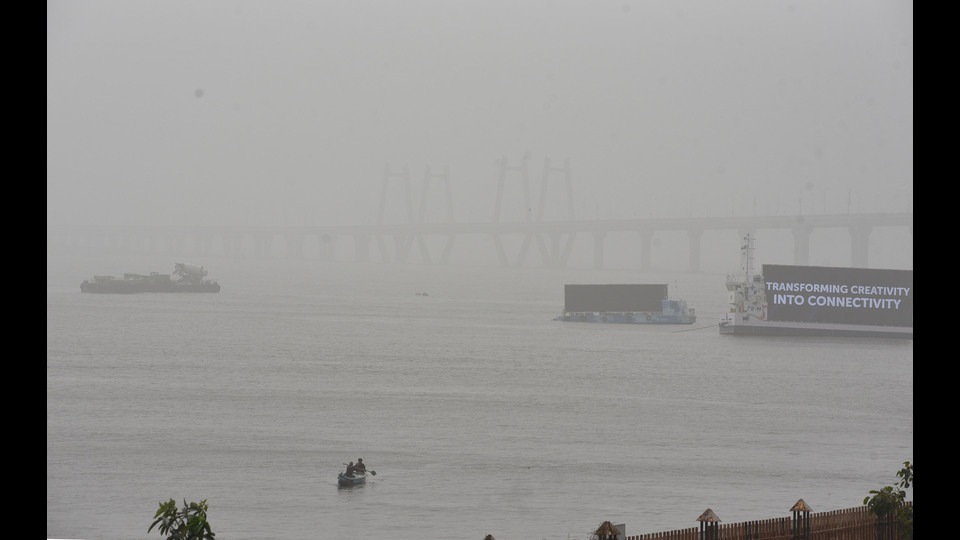
Beig attributed the pollution spike to a recent western disturbance which passed over the region, bringing unseasonal rains to parts of the city on Saturday, followed by a large dust plume which rode in on prevailing westerly winds during the early hours on Sunday. Experts said that this dust originated from Pakistan and the Middle East.
Western disturbances are storm systems that form in the Middle East and travel eastward, bringing sporadic and sudden winter rain to the northern parts of India, with their influence sometimes extending along the western coast and in central India.
“The western disturbance induced a low-pressure zone near Rajasthan and adjoining parts of Pakistan on the night of January 21,” Beig said.
“This caused an increase in the surface wind speed over Pakistan and adjoining eastern Iran, which started blowing the dust over these regions from the early morning hours of January 22. Within a few hours, the dust was visible over the Gulf of Oman and northern Arabian Sea, following which it entered Gujarat on the same day, and Maharashtra the following day,” added Akshay Deoras, an independent meteorologist at the University of Reading, UK.
Beig described this event as “unprecedented” for Mumbai. “On Monday morning, the city’s air quality index touched ‘severe’ classification for the first time on record. This number, of 502, is an average of hourly AQI data over 24 hours, so on Monday morning it indicated that there was a high amount of dust in the air during the night and the previous day. During the day on Monday however, clearer skies and strong winds marginally improved air quality,” Beig explained.
Despite the improvement, however, Mumbai continued to record ‘severe’ air on Monday evening, with SAFAR showing an AQI of 453. Data from individual monitors, however, accessible through the CPCB’s website, show uniform improvements across the city with PM2.5 and PM10 levels dropping consistently starting around 7am Monday. The CPCB’s daily air quality bulletin, released at 4pm each day, showed Mumbai as having ‘very poor’ air on Monday.
The discrepancy between the SAFAR and CPCB numbers, experts explained, is due to the number of air quality monitors used by each. While SAFAR relies on data from nine monitoring stations in Mumbai, CPCB uses data from 17, spread over a larger geographic area, producing a lower geographic and diurnal average.
Beig added that Mumbai had last witnessed such a high levels of air pollution owing to similar dust event in late 2016, but was unable to pinpoint the exact AQI value at the time. An AQI of 100 to 199 is considered ‘moderate’, while 50 to 99 is considered ‘satisfactory’ and below 50 is considered ‘good’. AQI in excess of 200 is considered ‘poor’, above 300 ‘very poor’, above 400 ‘severe’ and above 500 is considered ‘severe+’.
On Sunday evening, immediately after the dust plume entered the Konkan and north Madhya Maharashtra regions, SAFAR recorded an AQI of 333, which climbed to 502 by the next morning.
“Since AQIs, at both state level and in the CPCB’s daily air quality index bulletin are presented as an average of the past 24 hours, the previous day’s conditions are actually better reflected in the following day’s average,” explained Sachin Panwar, an independent air quality expert certified by the Quality Council of India. “There must have been an accumulation of dust during the night, owing to lower temperatures and slower wind speeds, and this likely pushed the AQI numbers past the 500-mark in the morning. For a coastal city like Mumbai, it is surprising to see such a high AQI,” he added.
Other experts were also surprised. “I have never seen uniformly high pollution load across so many of the city’s air quality monitors before,” said Ronak Sutaria, founder of Respirer Living Sciences. “The nature of the pollution, however, is very different from a city like Delhi, which records such high AQIs more routinely. There, the sources of pollution tend to be local, whereas the event witnessed in Mumbai is clearly a regional event in that the pollutants were transported in a very large quantity from outside the region over a short period of time.”
Mumbai had also witnessed a similar dust event in March 2012. The source of dust has always been the arid regions of the Middle East and Pakistan, experts said. However, such events over the Middle East are generally more frequent during spring and summer season when factors such as high temperature, atmospheric instability, strong northwesterly winds and thunderstorms create ideal conditions for the triggering of dust storms. Dust storms observed in June and July are not able to impact Mumbai due to the monsoon conditions.
LOW TEMPERATURES CONTINUE
As a result of the western disturbance and accompanying unseasonal rains, Mumbai continued to experience cooler than usual temperatures on Monday. The day’s daytime maximum settled six degrees below normal at 24.8 degrees Celsius (up from 23.8 degrees Celsius the day prior, which marked the lowest in January in at least a decade) while the minimum settled two notches below normal at 15 degrees Celsius, down from 21 degrees Celsius on Sunday. January’s highest maximum as per historical records stands at 37.4 degrees Celsius (in 2006) while the lowest minimum stands at 7.4 degrees Celsius (in 1962). With temperatures expected to rise from Tuesday, warmer conditions will further aid in the dispersal of accumulated dust.
HEALTH IMPACT
Chest physician Dr Prashant Chhajed from Santacruz based Lung Care and Sleep Centre said that nearly 20% of his daily consultations over the past few days have been people complaining of runny nose, burning of eyes, sneezing and cough triggered by the condition of the air. “Some patients mistake these as Covid-19 symptoms and end doing RT-PCR tests,” said Dr Chhajed. “Patients who already have underlying conditions such as asthma and chronic obstructive pulmonary disorders (COPD) are highly sensitive. We make sure that their existing treatment is on track and enhance the level of treatment temporarily if needed. In patients with no such underlying conditions, we give symptomatic treatment and advise them not to step out early in the morning to avoid inhaling the smog particles,” he said.
City-based physician Dr Hemant Gupta said that the high concentration of smog mainly impacts early morning walkers, senior citizens, and those with already existing lung ailments. “When such people inhale these particles, respiratory allergies are triggered or aggravated,” said Gupta.


