E-Paper



BMC clears encroachments from Banganga steps, revives 11 deep stambhs
The architects working on Banganga’s restoration have revived the historic 11 deep stambhs at the Grade 1 heritage precinct

 Prefer HTon Google


MUMBAI: The ₹12-crore Banganga Tank restoration project is well on its way. While the BMC last month removed 14 huts, which were encroaching on the historic steps for 45 years, the architects working on Banganga’s restoration have revived the historic 11 deep stambhs (pillars of light) at the Grade 1 heritage precinct. Work on restoring the walls and steps is currently underway.
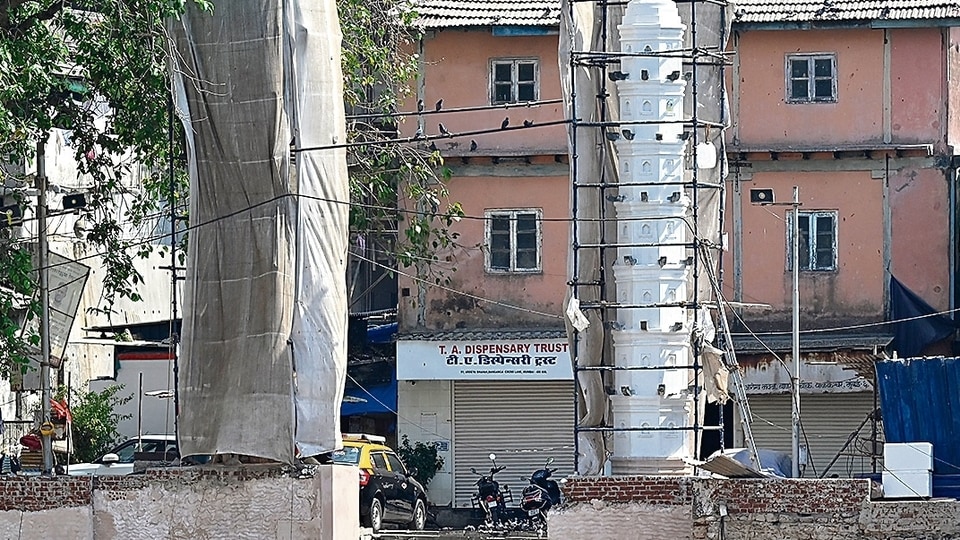
Architect Vikas Dilawari and architectural firm Shashi Prabhu & Associates have been appointed as consultants for the project. Banganga Tank is privately owned by the Gaud Saraswat Brahmin Temple Trust (GSBTT) and maintained by the state archaeology department.
Explaining the significance of the deep stambhs, Rutwik Aurangabadkar, CEO (projects), GSBTT, said they were donated by devotees in the past. “Constructing a deep stambh was considered auspicious,” he said. “The belief is that below every stambh is a samadhi (memorial) of a saint, and the devotee who built the stambh over it received many blessings. There are around 40 samadhis in the Banganga precinct, and it is considered a teerth shetra (holy place).”
The chief objective of the project is to revive an 11th-century Ram Kund (the place from where Banganga water flows outwards and merges with the sea) and restore it to its former glory. Now buried under debris, the Ram Kund is located 400 metres away from Banganga Tank. The restoration of the Ram Kund poses challenges, particularly due to the accumulation of debris allegedly caused by 300 hutments. It will be addressed in Phase 2.
While ₹6 crore is being spent in Phase 1, GSBTT is paying the architects’ fees in order to retain control over the designs and aesthetics. GSBTT, founded in 1879, is spending ₹60 lakh to ₹70 lakh to maintain the sanctity of Banganga Tank.
Enakshi Bhatia, architect from Shashi Prabhu & Associates, said the Ram Kund was not being restored at present because it was out in the sea, which threw back a lot of debris with plastic. “We are going to try and resolve that issue first before we restore the Ram Kund,” she said. “The challenge is that it is an open sea. The Ram Kund was desilted a few months ago by the BMC but it filled up with silt again and so we are first ensuring that debris doesn’t accumulate there.” Bhatia added that part of the Ram Kund was under the Maritime Board’s jurisdiction and so they were still exploring how it could be restored.
The desilting work of the tank has begun. A lot of flora and fauna will not be disturbed since it is a living site and not an archaeological ruin. Bhatia said the focus would be on restoring the steps, walls and deep sthambs, all of it being done under Dilawari’s guidance. “The objective is to repair and restore to their original form all 11 deep stambhs, which currently have layers of plaster and paint over them,” she said. “The deep sthambs have been lit up by the community by putting diyas in the niches.”
The Banganga Tank is roughly 110x70 metres and the walls at many places are in a state of disrepair because some parts have fallen off and some rebuilt incorrectly. The tank will be repaired from the safety point of view as well to take it back as close as possible to its original form.