
 E-Paper



Cheaper, faster learning accelerates commerce-first product launches
MUMBAI: The future of product launches in India is decisively commerce-first, believes Sairam Ranganathan, head of e-commerce at WPP Media India

 Prefer HTon Google


MUMBAI: The future of product launches in India is decisively commerce-first, believes Sairam Ranganathan, head of e-commerce at WPP Media India. Product launches are no longer just campaign driven. Thanks to the emergence of e-commerce and quick-commerce, the landscape is dynamic, with these platforms becoming more than just points of transaction and turning into influential environments for product discovery, trials, conversion and other learnings on buying habits, Ranganathan said recently, while releasing a framework for new product launches in a digital world.
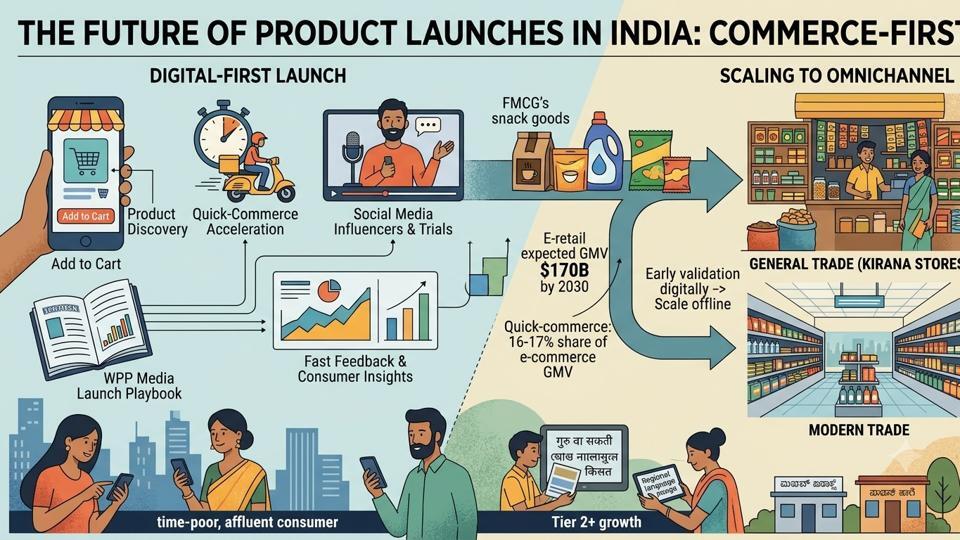
The commerce-first launch playbook has been compiled in view of the unmistakable shift in consumer behaviour where shoppers are increasingly discovering and ordering products online. E-retail is expected to touch a Gross Merchandise Value (GMV) of $170 billion by 2030, up from $65 billion in 2025, the WPP Media playbook noted, adding that quick-commerce is already a mainline channel with 16-17% share of the e-commerce GMV.
The advantage of commerce-first launches is that it helps identify and validate the opportunities early on as brands can test their propositions and learn from actual shopper behaviour, the playbook noted. Ranganathan said quick-commerce is the new sales touch point which further compresses the trial and learning cycle. Little surprise then that many companies, both in the direct-to-consumer segment as well as large, traditional FMCG firms are launching products only for quick-commerce platforms, he said.
Content creators or social media influencers, retail media and quick-commerce are accelerating discovery, product trial and generating faster market feedback, he said. Once the learnings are in place, companies can scale whatever is working for them. With 90% of Indian retail still being offline, early analysis on the basis of digital demand and consumer endorsement of products segues into expanding them into general trade (neighbourhood kiranas) and modern trade (big box retail), he added.
Adarsh Menon, partner at Fireside Ventures, an early-stage venture capital fund with sizeable investments in a portfolio of digital-first consumer brands, said that even legacy brands have re-sequenced their launches from general trade to digital first. “And these are traditional FMCG companies that are seeing and accepting it as a legitimate way to introduce new products,” said Menon. Several big companies have launched Modern Trade and e-commerce exclusive brand extensions in fabric conditioners, coffees and liquid detergents, for instance.
The WPP Media playbook says that the time-poor, affluent, urban consumers are looking for convenience, premiumization and product relevance. For them, availability of a product at the point of need beats brand recall. But the next phase of e-retail growth is coming from well beyond the metros. What works for the tier 2 plus markets are the affordable entry packs, trust-first messaging through credible reviews and reach through local creator eco system and regional language content.
Fireside’s Menon said the difference between old-school and new-age launches is that in the old school ways, product launch used to be an “enormous, almost irreversible, bet”. It required months of research, loads of inventory, distributor and retailer negotiations to stock products, building media etc with a commitment of huge capital. “Now a product launch is more of an experiment where a brand can list in a few 100 pin codes and then within a week can know if there is any traction,” he said.
Besides, brands have more information that they can work with as digital platforms sit on real time shopping signals. But do platforms share the data? “It may not be complete data but it is still way better than what they ever got from their traditional distribution networks,” Menon said.
“Online platforms definitely share more though I still call them walled gardens. Also, the platforms have realised the value of the data and they are now monetizing it through their analytics products for consumer brands to use,” Menon said.
Clearly, digital product launches are not a quick-fix to all the problems “but there is a fundamental improvement in the cost and speed of learning which is good,” Menon said.
Yet he warns of the pitfalls of blindly following sampling. “A sample size of 50,000 online consumers, for instance, doesn’t represent the whole country,” he said. So, this requires being mindful of that fact before scaling up operations. Secondly, a trial may be faster online but “trial isn’t traction”, Menon said. Brands still need to build repeat purchases for the long term. “No doubt it has become cheaper to discover whether you have a winner or not. But the platform or the discovery doesn’t convert a product into a winner. You still need a great product, great proposition, and all the other traditional blocks required to build a great brand such as good pricing and distribution as well,” Menon said.
While the initial brand lessons can be learnt digitally, for scale, the product must go offline into general trade and modern trade outlets. “I like to repeat that today, the digital world is where brands are being born, but omnichannel (digital plus physical retail) is where they will grow up,” he said.
Besides, brands born online should not be built keeping only a two- or five-year horizon in mind. “To create a lasting brand, you have to live in a consumer’s mind and not just on a shelf or a phone,” Menon said.
Stay updated with all the Breaking News and Latest News from Mumbai. Click here for comprehensive coverage of top Cities including Bengaluru, Delhi, Hyderabad, and more across India along with Stay informed on the latest happenings in World News.


