
 E-Paper



Mumbai's open spaces under threat as development plans shift parks for utilities
With public spaces shrinking, civic activists argue the changes violate commitments made by the BJP to protect urban open areas ahead of the 2026 elections.

 Prefer HTon Google


The reimagining of Mumbai has come at a cost of its civic infra – since 2023, 12 plots originally marked for parks, playgrounds and recreation grounds have been diverted for utilities and alternate developments, putting pressure on the city’s already scarce stock of public open spaces, while three others are on the precipice of similar changes, having been placed before the Brihanmumbai Municipal Corporation’s (BMC) Improvements Committee’s since June.
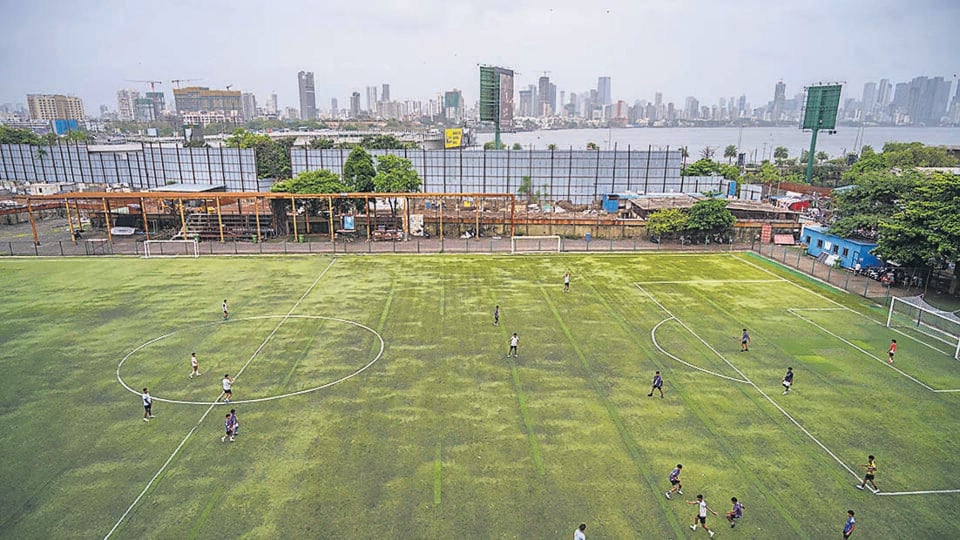
Seven proposals were tabled just four months after the BJP-led Mahayuti promised to protect the city’s open spaces from private interests ahead of the civic body elections in 2026 – some of them pushed by BJP legislators Ameet Satam and Mihir Kotecha, putting to test the party’s manifesto pledge.
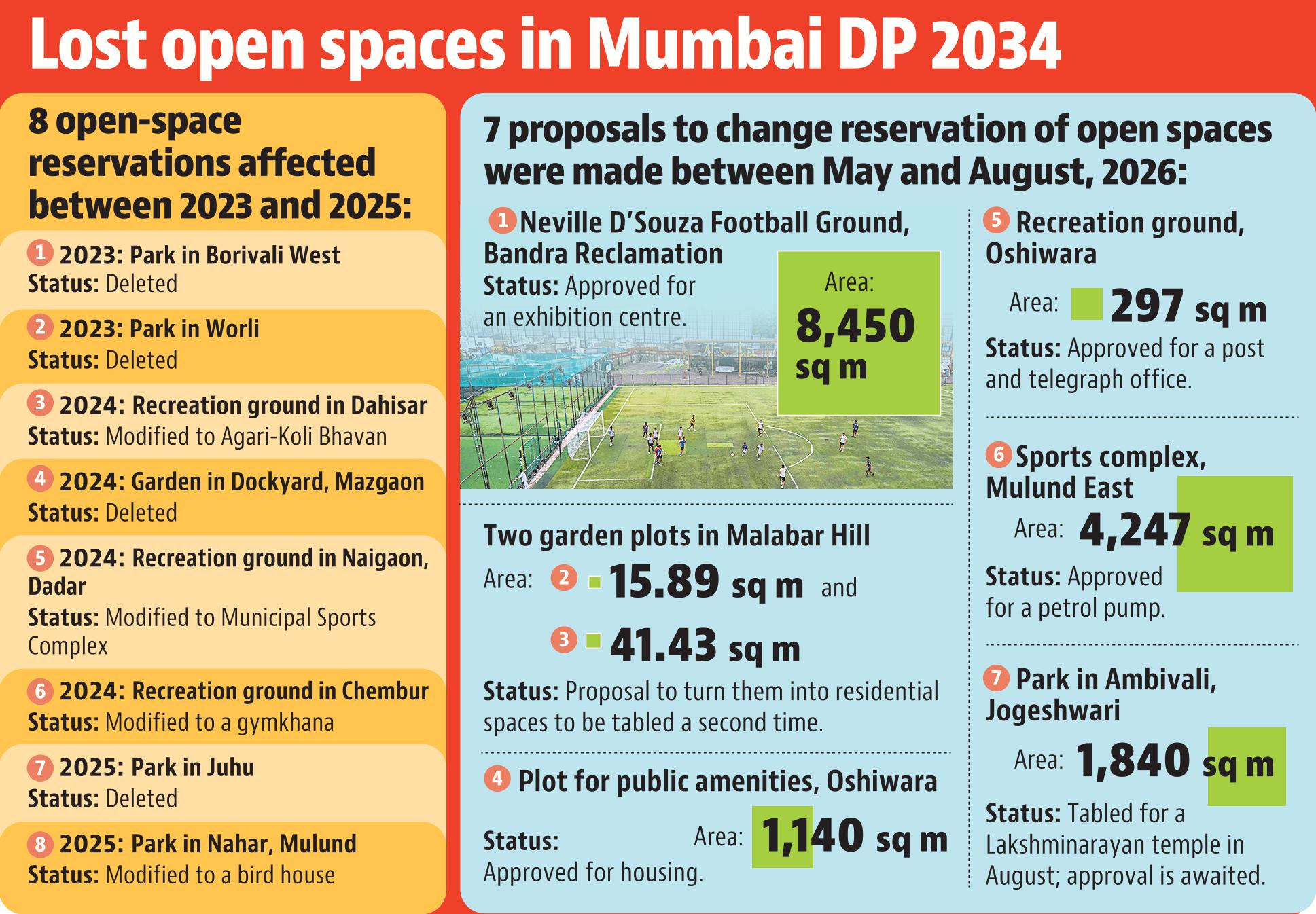
Data obtained from BMC’s DP department shows a range of deletions and modifications made to reserved open spaces in the Development Plan (DP) 2034 – two were changed in 2023, four in 2024 and two more in 2025.
Against this backdrop, the latest stack of proposals before the Improvements Committee has renewed scrutiny over the protection of Mumbai’s open spaces – the most prominent one being the Neville D’Souza Football Ground at Bandra Reclamation, which is scheduled to facilitate an exhibition and convention centre. HT was the first to report on this on May 20 even before the proposal was tabled in the committee in June.
Also Read | Mumbai's BMC to implement OC amnesty scheme for housing societies; 5 things to know
In defence
Defending the proposals, Satam said while the BJP is committed to an open-space policy in its vision document, several existing reservations represented anomalies that needed to be resolved. “We were clear about our stance in our vision document. The open space policy has not been finalised and has been pending for a long time. We will ensure that it is finalised in the current year and all anomalies are cleared,” said Satam, putting forth the example of the space in Jogeshwari zoned as a park, where a temple’s reconstruction has been planned. “The temple had existed for around 150 years and stood on privately owned trust land, but its reservation as an open space prevented reconstruction.”
He added: “That temple is dilapidated and any reconstruction can be done only by changing the reservation of the open space. To facilitate the construction of the temple we had to alter the reservation.” Satam also pointed to cases where he had opposed the transfer of open spaces to private entities, such as handing over two plots in Andheri and Juhu to a private trust, adding that the proposals for the Malabar Hill gardens have not been cleared.
Also Read | BMC to amalgamate Lower Parel municipal plots with SRA scheme for integrated redevelopment
What critics say
The clarifications have done little to allay concerns among civic activists and urban planners, who argue that every deletion or alteration reduces the stock of land available for public use in an already space-starved city. In a representation dated August 19, Urban Centre Mumbai planners Pankaj Joshi and Urmi Kenia expressed concern over the proposed conversion of the Bandra Reclamation playground into an exhibition or convention centre. BMC’s DP 2034 assessment shows Mumbai has only 1.20 sq m of public open space per capita, far below the recommended norm of 4 sq m mentioned in the DP, which fails to meet the WHO’s global livability standard of 9 sq m per capita.
Both Joshi and Kenia questioned whether a planning study had established the need for such a facility and warned that altering the reservation would undermine open-space protection. They also invoked constitutional rights, the Public Trust Doctrine and sought ward-level assessment of open-space deficiencies before any reservation change.
Questioning the rationale of changes in the DP, Congress leader in the BMC Ashraf Azmi said: “It defeats the purpose of formulating the development plan in 2018 – it means they don’t value the opinions of citizens. The Malabar Hill gardens proposals have been referred back but that doesn’t mean they won’t be cleared.”
He also pointed to the open space policy that could address the reconstruction of religious structures without deleting garden reservations. “We are not going against people’s faith, but there are no reassurances that the land will not be misused for other gains. The entire land cannot belong to a temple trust. They are opposing MHADA plots in Vile Parle being given to a trust; why can’t they oppose this open space?”
He alleged that changing the reservation status of the football ground in Bandra Reclamation “could benefit a developer.”
Nayana Kathpalia, founder trustee of NAGAR, said the repeated changes in the DP undermined assurances made by political parties. “The deletion of open space reservations is disgraceful. What is the point of political parties in power offering assurances when their intent is just the opposite,” she said.
Also Read | Mumbai civic body clears plan to redevelop 22 BEST depots
Green disparity
The debate comes against the larger reality that Mumbai’s green appearance does not necessarily translate into accessible public open space. Much of the greenery visible from above, particularly in the northern and eastern parts of the city, comprises mangroves, forests and other areas that are environmentally protected or inaccessible to the public.
DP 2034 has set a target of at least 4 sq m of public open space per capita by 2034. Yet provision remains sharply uneven across Mumbai’s 26 wards.
An analysis by the Urban Design Research Institute (UDRI) and NAGAR, in their report ‘Public Open Space, Mapping Existing and Reserved Open Spaces’, highlights this disparity. The island city has an average existing public open-space provision of 2.94 sq m per capita. A-ward in Colaba has around 9.4 sq m, while B-ward in Dongri has only 0.5 sq m. Higher figures in some wards are influenced by large government and institutional campuses, naval and dock areas, heritage spaces and relatively lower population density.
The suburbs face a different challenge. Rapid development post-Independence and the introduction of transferable development rights in the 1990s accelerated construction without a corresponding expansion of accessible public open spaces. Despite the existence of Sanjay Gandhi National Park, mangroves and other natural areas, average existing open space is only around 1.05 sq m per capita.
The data therefore points to a problem that goes beyond the overall quantity of greenery. Mumbai’s challenge is also one of distribution, accessibility and protection. A plot marked as an open-space reservation on a planning map does not automatically mean residents have access to a functioning playground, garden or recreation ground.
UDRI-NAGAR’s strategy suggests moving beyond merely mapping open spaces toward a city-wide framework for their protection, investment and management. It proposes a publicly accessible and continuously updated open-space database, stronger coordination between government, experts, communities and civil society, and improved mechanisms for policy and funding.
This can be achieved, the report suggests, by formally engaging registered Advanced Locality Management (ALM) groups in each ward in open-space management through quarterly, agenda-driven consultations under Ward Committees and Area Sabhas, with representation proportional to ward size.
For Mumbai, the question is increasingly not whether it needs more open spaces – the deficit is well-established -- but whether the spaces it already has, and those reserved for public use, will remain protected.

Stay updated with all the Breaking News and Latest News from Mumbai. Click here for comprehensive coverage of top Cities including Bengaluru, Delhi, Hyderabad, and more across India along with Stay informed on the latest happenings in World News.


