
 E-Paper



Dhiruben Patel, the Gujarati doyenne of letters, leaves behind a pathbreaking trail at the age of 96
Born in 1926 in Dharmaj village, Gujarat, in “a very shrimant parivar”, Patel lived in Santacruz for most of her nine decades. A BA-MA in English literature, who also taught English at Bharatiya Vidya Bhavan for a few years, she wrote more than 50 books in Gujarati, including novels, short stories, poems, translations, and books for children

 Prefer HTon Google


Mumbai: Only Dhiruben Patel would be up to the task of writing her 96-year-long story within a newspaper deadline. While recounting her life, her closest associate of 55 years, a Sahitya Akademi awardee in Gujarati herself, Varsha Adalja, says, “Dhiruben played in Gandhiji’s lap. Sarojini Naidu knew her.” Ushaben Mehta, who was imprisoned by the British in 1942 for running an underground radio station, was a close mutual friend. Patel’s mother Gangaben was also a freedom fighter, who was jailed six times. “That inheritance of her childhood stayed with her throughout her life,” says Adalja. “She wore only khadi saris, that too, in the Gujarati manner.”
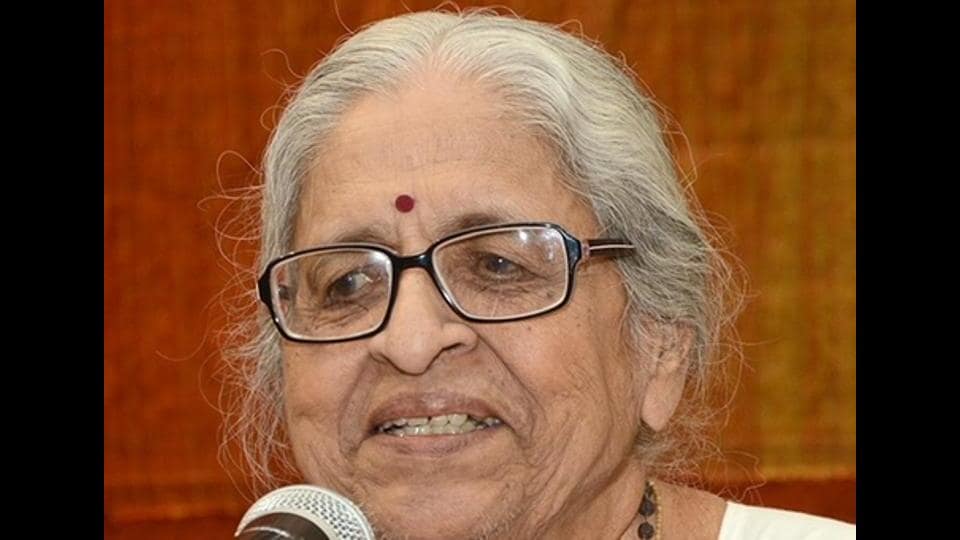
Born in 1926 in Dharmaj village, Gujarat, in “a very shrimant parivar”, Patel lived in Santacruz for most of her nine decades. A BA-MA in English literature, who also taught English at Bharatiya Vidya Bhavan for a few years, she wrote more than 50 books in Gujarati, including novels, short stories, poems, translations, and books for children. “She worked in all literary forms, including film, drama, and TV shows,” says prolific Gujarati author Kumarpal Desai, who was awarded the Padma Shri in 2004. “There isn’t another personality in Gujarati who has worked in so many different formats.” On the national stage, two of her works received the most attention: ‘Bhavni Bhavai’ (1980), Ketan Mehta’s cult film which won a National Award, and a novel called ‘Agantuk’ (2002), for which she won the Sahitya Akademi Award in Gujarati.
“Her plus point as a writer was that she would frame her words in her mind,” says Adalja. “When her pen was in her hand, in one sitting, without rewriting, without editing, without reading it again, she would write. Whatever was written was final.” Patel would also contribute to Desai’s magazine, ‘Vishwa Vihar’. “She used to refer to herself as an 11th-hour writer,” he says. “She was that kind of a genius. In simple language, she could make a big point. I would ask her to write an article, then leave the office and reach home in 25 minutes. In that time, she would call me and say, ‘I’ve left the article on your desk.’”
She worked with the same speed for theatre as well. Manoj Shah, who has directed over 90 plays, two of which were written by Patel, wanted to do a children’s play in the manner of a Greek production. “I asked her, ‘Dhiruben, will you write for me?’ She was so excited. Within a month, I got her script.” ‘Mummy, Tu Aavi Kevi?’ was a big hit on the Gujarati circuit, with 60-plus shows. Shah made her acquaintance in 2002, when she was well into her seventies. “We became more than colleagues, we became family,” he says. “She created that bond. She would always keep tabs on my work. She even made it to my latest play ‘Adbhut’ in a scrapyard. She would meet us for coffee in Starbucks. That used to be an ajooba, this old woman in there.”
Beyond the home
Patel, who never married herself, was also passionate about getting housewives out of their comfort zones and in contact with the outside world. As the editor of ‘Sudha’, a women’s weekly in Gujarati, she called on all women to contribute. This is where Adalja met her in 1967. “I would put my two daughters to sleep and run in the afternoons for interviews. The encouragement she gave me started my literary journey. It gave me the identity of a writer.”
Later on, she started two organisations with the same purpose: Lekhini in Mumbai, and Vishwa in Ahmedabad, where she spent her final years with her niece. “Dhiruben would ruminate, ‘There are so many women who want to write. If they write something amateurish, no one will publish it. So, how will they get a platform?’” says Adalja. “Lekhini has lasted 40 years. How many women became writers like that? How many women have received management training from her? She never took credit for it.”
Adalja continues, “My journey was always behind her.” Ranjitram Suvarna Chandrak is the highest literary award in Gujarati literature. “In its 50-year history, only two women had received it: Miraben Pathak and Dhiruben Patel. After them, I received it. Darshak Award, first Dhiruben received, then I received. But, in 1996, I received the Sahitya Akademi Award before her. So, I felt really bad. But, Dhiruben said, ‘You deserve it, Varsha.’ She would say that I’m no longer her student, but have gone ahead of her.” She breaks down on the phone when she says, “I have lost my guru. You know, when a shooting star falls, there’s a long tail behind it. So, Dhiruben might be gone, but she’s left a long arc behind her.”
Pull quote
There isn’t another personality in Gujarati who has worked in so many different formats.
Kumarpal Desai, author, critic, and Padma Shri
Caption:
Dhiruben Patel wrote more than 50 books in Gujarati, but author Kumarpal Desai says, “She never behaved like a big-shot writer among us.”


