
 E-Paper



How the city got ready after May’s wake up call
While the unusually early start to the monsoon exposed the Brihanmumbai Municipal Corporation’s (BMC) lack of preparedness on May 26, the civic administration was ready for the triple-digit downpour this weekend, helped by a high tide that was not particularly intense


MUMBAI: Torrential rain that did not let up from Sunday night through Monday left many parts of Mumbai marooned but the impact was contained, thanks largely to a proactive civic administration that had learnt some hard lessons from three months earlier.
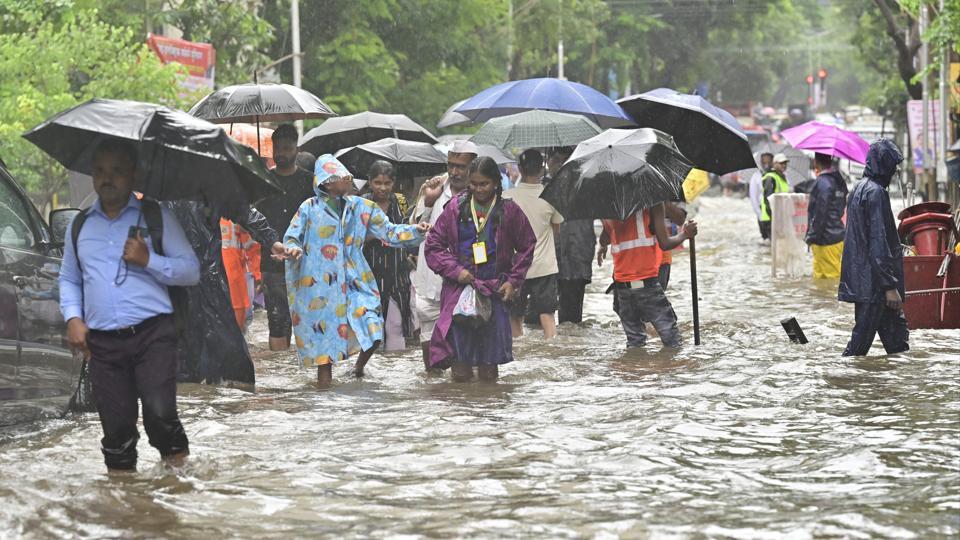
While the unusually early start to the monsoon exposed the Brihanmumbai Municipal Corporation’s (BMC) lack of preparedness on May 26, the civic administration was ready for the triple-digit downpour this weekend, helped by a high tide that was not particularly intense.
In May, when the monsoon arrived 16 days early, the BMC had reduced the number of dewatering pumps from 482 to 41, citing underutilisation in previous seasons. The cutback proved ill-timed and costly for citizens. This time, the civic body increased the number of pumps it pressed into service, from 417 to 514, exceeding previous years.
Also, following the May 26 disaster, the BMC had imposed a penalty of ₹10 lakh each on four pumping station operators, for lapses in their operations.
Dewatering pumps and desilting
Desilting operations, which had lagged in May, were fast-tracked, with 77% of key drains cleared by early June. Three months earlier, road concreting work across the city had further clogged drains with soil and debris, and places like Breach Candy, which usually don’t flood, experienced unusual flooding. At Hindmata and King’s Circle in Matunga, both low-lying, flood-prone areas, dewatering pumps had either malfunctioned or were not connected to discharge points. This time around, the civic staff made sure they were fully operational.
Additional municipal commissioner (projects), Abhijit Bangar, told HT, “One key difference compared to May 26 was that all pumps, both at mini-pumping stations and main pumping stations were fully operational. There were no reports of mechanical failures or lack of preparedness. We also knew that heavy rainfall was expected from August 16, for five consecutive days. This gave us time to prepare.”
Internally, disaster response protocols were reviewed and improved. Coordination between departments was sharpened, and the importance of early warnings became central to the BMC’s strategy.
Another factor that helped was the relatively low intensity of the high tide, which was at 3 metres, peaking at 7.46am. However, the downpour did not let up. Between 6 am and 2 pm on Monday, the eastern suburbs recorded 177 mm of rainfall, the western suburbs 149 mm, and the island city 173 mm.
“It rained heavily across all three zones, but our field teams were working to address any issues promptly. While waterlogging was reported at two locations, it began receding quickly,” said Bangar.
“We have received an even more serious warning for Tuesday, with rainfall expected to exceed 200 mm. Fortunately, the high tide is not expected to be intense, which is a relief,” Bangar said.
The BMC’s renewed focus was evident on Monday, when the IMD first issued a red alert (extremely heavy rain, likely to cause disruption and damage) for Mumbai and surrounding districts.
The civic body announced that schools and colleges would be shut for the afternoon session, with morning sessions released early. The city’s emergency helpline, 1916, was actively publicised. Updates and advisories were issued in real-time, asking citizens to avoid unnecessary travel and stay indoors.
Flooding hot spots
But the situation on the ground was still challenging. Streets flooded in low-lying areas such as the Andheri subway, Elphinstone flyover, which was shut for a couple of hours, Lokhandwala, Matunga, Grant Road and Dadar.
Rainfall between 8am and 12 pm on Monday was intense. Chembur recorded over 140mm, while Dadar, Wadala and Worli saw upwards of 130 mm. “Unlike in May, when the BMC was caught off-guard, the response this time reflected a civic body more in control, one that had adapted and learned,” said a civic official from the storm water drains department.
Ground floor residents in Kurla, who usually take shelter on higher floors every monsoon, were not stranded this year. Bait Khan, a local resident, said, “This year, a new storm water drainage system was installed and widened along CST Road, which gave us relief. The persistent waterlogging issue at Kismat Nagar has finally been resolved. Apart from three spots near Kalpana theatre, Sheetal theatre, Kurla Depot, and Al Barqat School, where major issues still remain, we are hopeful those will be fixed by the next monsoon.”
Another resident, Mushtaq Batla, shared a similar experience. “For over two decades, Pipe Road near Kurla Nursing Home would flood every monsoon. This time, however, the roads remained clear. The drains were properly cleaned, and while we expected knee-deep water, we were pleasantly surprised by the big improvement.”
Other chronic flood-prone areas, such as Gandhi Market in Sion, did not go completely under this time. For instance, all seven dewatering pumps at Hindmata were fully operational. At Gandhi Market in Sion, Hardeep Singh, a shop owner said, “There was no flooding and our shops remained safe. Although the roads were briefly inundated, the water receded quickly.”
Amid continuous rainfall, the entire BMC machinery was deployed on the ground. Engineers, pump operators, health workers, and emergency response teams fanned out to manage the challenges.
An official from D Ward, Malabar Hill, said they had brought an extra set of clothes to stay overnight in the ward, as a red alert had been issued for the next 24 hours.
“The staff has been deployed at key locations such as Cadbury Junction and Bhulabhai Desai Road, which was flood-prone. We are working around the clock,” the official added.

Stay updated with all the Breaking News and Latest News from Mumbai. Click here for comprehensive coverage of top Cities including Bengaluru, Delhi, Hyderabad, and more across India along with Stay informed on the latest happenings in World News.


