
 E-Paper



IMD issues heat warning as state sizzles
Twenty-three out of 26 monitoring locations in interior Maharashtra clock temperatures over 40 degrees Celsius on Thursday


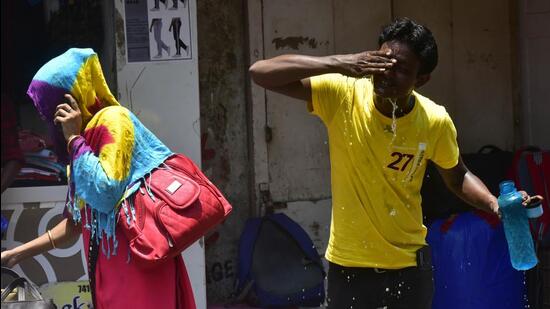
MUMBAI/DELHI The India Meteorological Department (IMD) on Thursday issued an ‘orange’ category heatwave warning – indicating “increased likelihood of heat illness symptoms” on prolonged exposure and “high health concern for vulnerable people e.g. infants, elderly and people with chronic illness” – for four districts in Maharashtra till May 2, including Wardha, Akola, Chandrapur, and Yavatmal, while a ‘yellow’ category alert indicating less severe heatwave conditions has been issued for Nagpur district.
An orange alert is a warning to administrators to be prepared for imminent heatwaves; a yellow alert is to warn them to be watchful.
There is no such warning for Mumbai; however, the city has seen higher-than-normal maximum daytime temperatures for 10 straight days starting April 19.
With the exception of the Konkan region, Maharashtra’s interior districts all recorded alarming levels of heat on Thursday, with 23 out of 26 monitoring stations across Marathwada, Madhya Maharashtra and Vidarbha meteorological subdivisions recording daytime maximum temperatures in excess of 40 degrees Celsius. Chandrapur in Vidarbha recorded the highest daytime maximum in the state at 45.8 degrees Celsius, followed by Jalgaon in Madhya Maharashtra where the mercury touched 45.6 degrees Celsius.
Other locations with searing temperatures on Thursday included Amravati at 44.4 degrees Celsius, Bramhapuri at 45.2 degrees Celsius, Wardha at 45.1 degrees Celsius, Nagpur at 44.3 degrees Celsius, Akola at 45.4 degrees Celsius, and Ahmednagar at 44.5 degrees Celsius.
“Other than Kolhapur, Sangli and Mahabaleshwar, every other IMD station across Marathwada, Madhya Maharashtra and Vidarbha meteorological subdivisions today (Thursday) recorded t. max. temperature above 40 degrees Celsius, so the extent of the heatwave is widespread. Even in the Konkan region, where Mumbai recorded the highest daily temperature of 37 degrees on Thursday, it is important to exercise caution because humidity will cause a lot of discomfort to people,” said KS Hosalikar, head of the IMD’s surface instrument division in Pune.
IMD has warned that the heatwave could lead to moderate health concerns for vulnerable people including infants, the elderly, and people with chronic diseases. There is also an increased likelihood of heat illness symptoms in people who are either exposed to sun for a prolonged period or doing heavy work, it added. IMD has also recommended that people should avoid heat exposure– keep cool; avoid dehydration by drinking sufficient water even if not thirsty; avoid heat exposure, wear lightweight, light-coloured, loose, cotton clothes and cover the head; and drink oral rehydration salts, and home-made drinks.
Kripan Ghosh, head of the IMD’s agricultural meteorology division in Pune, said the ongoing heatwave will also impact the production of crops across interior Maharashtra, particularly wheat.
“We are issuing alerts at a district level based on local observations. It is not just that heat will bake the unharvested crop, there is also a possibility that available sources of irrigation will dry up. In the coastal region, fruit crops like mango may also be affected even though there is no heatwave warning for the region,” Ghosh said.
North India, too, reeled under extreme temperatures on Thursday, with Delhi recording a maximum temperature of 43.5 degrees Celsius, the highest April temperature in 12 years as a heatwave continued to rage across vast swathes of India. Prayagraj, in Uttar Pradesh was the hottest city in the country on Thursday, with a maximum of 45.9 degrees Celsius.
The India Meteorological Department (IMD) warned that the heatwave will become more intense over the next five days, with temperatures likely to touch 45 degrees Celsius (°C) in some parts of the country.
Behind the heatwave is a so-called anti-cyclone, which is expected to last till early next week. “The heatwave is mainly because of a strong anti-cyclone over the north Arabian Sea which is bringing hot, westerly winds. There is likely to be relief from May 2 because we are expecting a strong western disturbance (a cyclonic movement). Maximum temperatures will drop to 37-38°C over parts of northweat India,” said R K Jenamani , senior scientist, national weather forecasting centre, IMD.
But until then, many parts of the country will continue to swelter under hot and dry conditions.
According to IMD’s gridded dataset, the average maximum temperature till April 27 was 35.7 degrees Celsius, the highest in five years for this month. However, this headline number hides just how hot northwest India has been. In four states – Madhya Pradesh, Rajasthan, Punjab, and Gujarat – the average maximum temperature in April 2022 so far has been the highest since 1951; while it has been the second highest in Delhi (including neighbouring districts), Uttar Pradesh, and Haryana.
And many parts of the country have seen no rain in April. Rainfall in April so far in states like Punjab, Haryana, Madhya Pradesh, Uttar Pradesh, Uttarakhand, Jharkhand, and Telangana is in the bottom 20 since 1901, according to IMD’s gridded dataset. However, average rainfall till April 27 across India was 44.23mm, 19th highest since 1901, largely due to rainfall in north-eastern and some southern states.
Things will only get worse between Friday and Monday. Delhi, for instance, may see the mercury cross 44 on Friday.
IMD has issued an orange alert for Rajasthan on April 28 and 29 and a yellow alert for almost the entire country except parts of peninsular and east India. For April 30, May 1 and 2, IMD has issued an orange alert for Madhya Pradesh, Maharashtra and Chhattisgarh and a yellow alert for the rest of the country except the peninsular region.
During an anti-cyclone, air pressure is high on the surface, causing the air above it to come down. This air warms up as it comes down on account of high pressure. The outward hot winds caused by this are ranging as far as Odisha and West Bengal.
But early next week, the western disturbance (a cyclonic movement originating in the Mediterranean) will put an end to the anti-cyclone, cause moisture laden winds to come in from both the Arabian Sea and the Bay of Bengal. These easterly winds will reduce temperatures to 37-38 degree C over parts of northwest India, Jenamani explained.
Extreme heat stress over large parts of India has triggered a discussion on heatwave spells.
Several research papers in the past have flagged India’s vulnerability to heat extremes. A 2016 paper by the Indian Institute of Tropical Meteorology and IMD said the frequency, total duration and maximum duration of heatwaves are increasing over central and northwestern parts of the country, The warming of the tropical Indian Ocean and more frequent El Nino events in future may further lead to more frequent and longer lasting heatwaves over India, it added.
“The anti-cyclone is leading to incursion of hot, dry winds over a very large area up to east India. The soil is also very dry. There has been no rain. So, the conditions are extreme. A very interesting and concerning thing to note is that the heatwaves have impacted West Bengal this time. Again, we didn’t expect that. That’s not a text-book heatwave prone region. Coastal Odisha and Andhra are heatwave prone because of local factors. This shows that the area impacted by extreme heat is increasing,” said M Rajeevan, former secretary, ministry of earth sciences.
“We need to create awareness and take action. Heatwaves are deadly. They will kill people working outdoors like farm labourers, construction workers. In most cases they just collapse. Heatwave intensity and duration will only increase in coming years,” added Rajeevan.
Stay updated with all the Breaking News and Latest News from Mumbai. Click here for comprehensive coverage of top Cities including Bengaluru, Delhi, Hyderabad, and more across India along with Stay informed on the latest happenings in World News.


