
 E-Paper



It’s a noisy Ganeshotsav this year
After a lockdown-driven lull during festive seasons over the last couple of years, five days since Ganesh chaturthi this year, sound levels breached established norms at many prominent places


Mumbai After a lockdown-driven lull during festive seasons over the last couple of years, five days since Ganesh chaturthi this year, sound levels breached established norms at many prominent places.
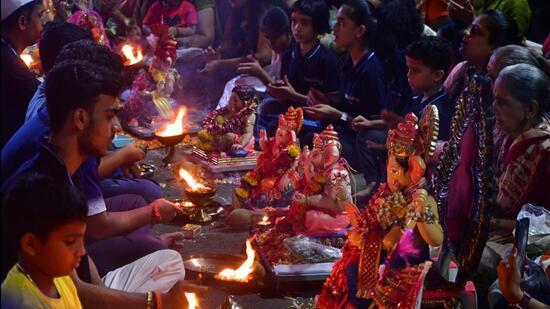
An observational study carried out by the city-based Awaaz Foundation on the evening of September 4 proved this point. The highest decibel (dB) level recorded on Sunday evening at the corner of Babulnath Road, Marine Drive, touched 115.6dB, as opposed to 93.1 dB in 2021 and 100.7dB in 2020.
The most elevated noise levels recorded over the past 18 years touched 123.7dB in 2015, followed by 123.2dB in 2013. Awaaz Foundation has been monitoring noise pollution in the city during key festivals. It has been observed that Ganesh chaturthi celebrations have registered the highest decibel levels since 2003.
“After two years of very low noise levels, use of drums, conical loudspeakers and banjos increased noise levels on the fifth day of Ganpati visarjan. The combination of these musical instruments created the highest noise levels -- 115.6dB -- at the Babulnath Road, corner of Marine Drive, followed by 112.1dB at Bandra. An equally escalated level was recorded when a metal cylinder was beaten by a metal hammer to produce 109.4dB at Linking Road; and by drums when sound reflected off metal barriers erected for Metro construction at SV Road, Khira Nagar,” said Sumaira Abdulali, convener, Awaaz Foundation.
When he was made abreast of this reality, Ramakant Biradar, deputy municipal commissioner, BMC, said, “This year the celebrations are louder, but there are no egregious violations unlike in the pre-pandemic time. The BMC control room has not received a single complaint from any citizen about loud noises from processions or pandals.”
Biradar also clarified that the civic body is not carrying out any independent noise monitoring survey of its own. “That is being done as usual by the Maharashtra Pollution Control Board (MPCB) with a little help from us. The data is collated by them. It will be shared after the festivities have concluded,” he said.
VM Motghare, joint director, MPCB, could not be reached for comment despite our efforts.
The sound of ambient traffic ranges between 70dB and 80dB which is considered to be “loud”, while 120dB is closer to the sound a commercial airliner makes while taking off and is considered to be “very loud”. The human threshold for pain is marked at 130dB, over and above which even incidental exposure to loud noises can cause lasting damage to hearing. Prolonged exposure to noise levels around 120dB can also cause lasting hearing damage, in addition to increasing blood pressure and triggering headaches.
Stay updated with all the Breaking News and Latest News from Mumbai. Click here for comprehensive coverage of top Cities including Bengaluru, Delhi, Hyderabad, and more across India along with Stay informed on the latest happenings in World News.


