E-Paper



Maharashtra’s districts of concern in Covid fight: In Sangli, monitoring system vs lockdown fatigue
Sangli, which lies south of Pune and shares a border with Karnataka, recorded its highest daily caseload of 2,328 cases on May 6.

 Prefer HTon Google


At 10 am, the Sangli fruit and vegetable market run by the Agriculture Product Market Committee (APMC) at Vasant Colony wears a deserted look. The morning trade is over and a few workers have stayed back to talk over a cup of tea, their masks bunched up over their chins. Dadamiya Patel, his mask atop his nose, sits some distance away reading a Marathi daily.
The thick tail of Maharashtra’s second wave
The 70-year-old fruit commission agent has stuck to this routine -- morning rush followed by a cup of tea and the newspaper -- for the past two decades. But many things have changed in the last 16 months. “In our business, everything runs on trust. I give credit to fruit farmers; I also give credit to small vendors who buy fruit from me. I haven’t turned a profit in the past two years [of the pandemic]. I haven’t even recovered most of what I’ve lent,” Patel said.
In Satara, superspreader events drive up caseload
It’s likely Patel won’t recover most of his money this year either. A mini cloudburst submerged parts of the Sangli city on July 24 -- and caused incessant rain and flooding in parts of Western Maharashtra and Konkan region for at least a week before that, and the city continues to remain under a lockdown driven by the district’s Covid-19 caseload. Both factors have put a damper on sales. “Who wants to eat fruit in such a situation?” Patel asked.
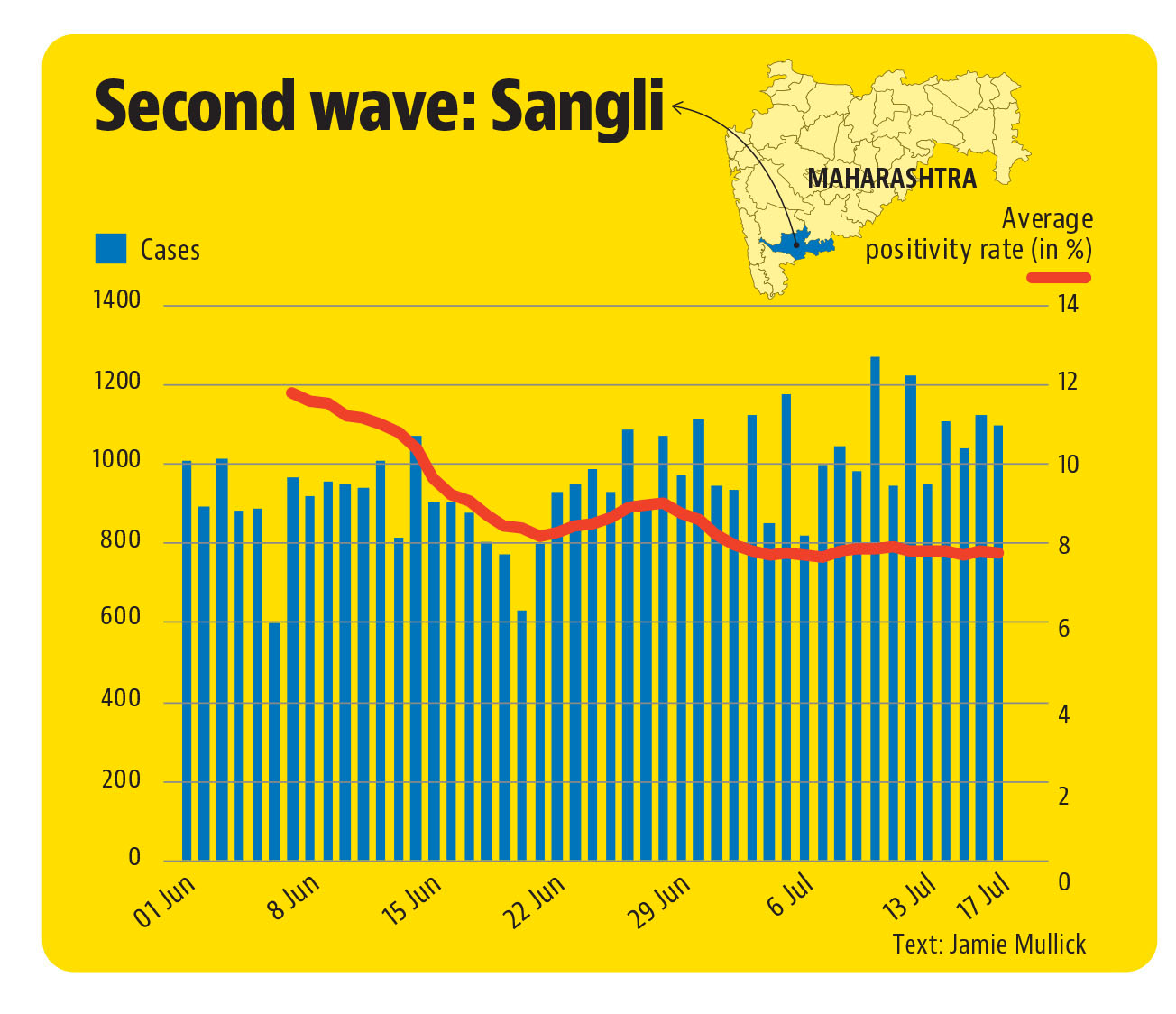
In the past two months, six districts including Sangli have remained constant on the state’s list of districts of concern. Sangli, which lies south of Pune and shares a border with Karnataka, recorded its highest daily caseload of 2,328 cases on May 6. In the weeks starting May 29 to June 4 all the way up till July 10 to 17, its weekly positivity rate -- a function of the number of tests and daily caseload -- came down from 14.02 to 7.81 (the week between May 22 to 28 saw an alarming weekly positivity rate of 20.4).
In Pune, rural areas drove surge
To be sure, the number of tests conducted has steadily increased since June: from 6,944 on June 1 to 13,512 on July 17. This doesn’t indicate a daily increase -- on some days, the number of tests conducted were fewer than the previous day -- but it does indicate a steady rise. What’s more, the daily caseload remains plateaued between 700 and 1100 cases from June 1 to July 17.
This is both a good thing and a bad. Epidemiologists contend that a pandemic is said to be under control if the positivity rate is below 5%. And that can only be found out by upping the testing. As more people get tested, the number of cases that emerge will only increase, and gradually after a point, will begin to dip. However, a plateauing of numbers is only a signal that the testing numbers haven’t gone high enough. There’s another significant factor that might explain the plateauing of cases in Sangli district: the type of test kit used.
On June 18, the Maharashtra government ordered all districts to calculate their weekly positivity rates (WPR) based only on Reverse Transcription Polymerase Chain Reaction (RT-PCR) tests in a bid to ascertain localised unlock plans. Subsequently, several districts reported a rise in WPR -- Sangli which was on a Level 3 restriction went back to Level 4 as its WPR calculated on the basis of RT-PCR tests between June 19 to 25 was 13.09% (by comparison, the WPR based on Rapid Antigen Test kits or RAT, in the same time period, was 7.55%). In the week ending July 17, the WPR based on RT-PCR testing was 8.01% while the WPR based on RAT testing was 7.16%. A district must record a WPR of less than 10% to go down a notch in the lockdown level.
In Kolhapur, young adults await a jab
“In the initial days of the second wave, we were testing 5,000-6,000 persons a day. Now we have increased that three times at least in the past 1.5 months.” Of these, a third of the tests conducted are RT-PCR, said Abhijit Chaudhary, District Collector, Sangli.
Even at the Sangli-Miraj-Kupwad Municipal Corporation (SMKC) labs, the use of RT-PCR kits rose steadily: from a daily average of 200 in April to over a thousand every day starting June-end. The use of RAT kits also rose, and remained higher in proportion.
This reliance on RT-PCR tests is an important one: RAT kits have a success rate of about 50%, which means that a negative result on an RAT could well be a false one. A higher reliance on RAT thus has a deleterious impact in fully understanding the extent of the pandemic’s spread.
“When we think of the second wave in Maharashtra, it started in February. But in districts like Kolhapur and Sangli, the wave started only in the second half of April. So our wave should be considered from then. Yes, the tail of our wave is definitely thick but it’s not correct to say that it’s been going on for the past five months,” Chaudhary said.
Reasons for spread in second wave
There are two reasons for a pandemic to spread, Chaudhary said, when HT met him at his office a day after he met traders seeking the reopening of businesses deemed non-essential by the state. “One is the presence of vulnerable populations. The other is the movement of people.”
To tackle the former, the district follows a plan that was set in place in the first wave itself: test, trace and isolate. The district continues to look for high risk and low risk contacts, and an army of Accredited Social Health Activist (ASHA) workers as well as medical staff at Primary Health Centres (PHCs) and sub-centres have been tasked with implementing this. People are encouraged to remain in home isolation if their homes allow safe distancing between all members as well proper sanitation for the infected person. For those who cannot safely isolate at home, the district has created community centres. Numbers indicate that these measures have achieved a degree of success: by July 17, a total of 8,804 persons were in home isolation, while 1,703 were hospitalised across the district.
Yet, on ground, something seems to have shifted since the first wave. The ASHA workers and PHC staff personnel HT spoke to said that they encountered more resistance from people this time around. Not only were many unwilling to reveal all their contacts to aid in tracing, a general hesitancy to get tested had also set in.
“Earlier, people were serious about the coronavirus, and felt that they needed to stay safe. Now, things are different. We’re doing the best we can, but we need people to support our efforts. People move about, leave out names in contact tracing,” said Sheetal Dabade, a community health officer attached to the Takli village sub centre.
Urmila Patil, an ASHA worker said the bigger problem that she faces in the village she works at is the lack of adherence to Covid-appropriate behaviour. “We tell them to wear masks and only step out when needed. Even then, they don’t listen. What can we do? We just continue to do our jobs,” she said, after testing the blood oxygen level of a Covid positive resident of Surul village during her rounds.
Gathering data, tracking patients
“When the first four cases emerged in Sangli in March last year, we made a containment zone of around five kilometres, and it remained in place for 63 days. We traced 540 contacts of those cases. Now, containment zones are smaller, and we’re not tracing as many contacts as that. Also, last year, there was a lockdown and we tested at checkpoints. This time around, movement is allowed. There were elections that took place in a sugar mill factory. People conducted weddings.
Home isolation of positive patients is permitted by the government, but many people don’t follow the guidelines and wander around. As the health department alone, we can’t control the spread,” said Dr Milind Pore, the district’s health officer.
Pore said that based on the advice of the former Director General of the state, Dr Subhash Salunkhe, they would start to vaccinate on a priority basis those who visit the city daily from rural and periurban parts of the district -- milk deliverymen, construction workers, fruit and vegetable vendors who visit the APMC and sell on carts -- and test them every 15 days between the two doses. “A month ago, we tested such daily commuters in mission mode. But now we must do so every fortnight to catch the breakthrough infections. In community transmission, every third or fourth person is symptomatic. So the more we test, the more numbers we will get,” he said.
Any plan that aims to increase testing, and vaccination, particularly of those most vulnerable to catching the infection -- and spreading it -- is a good one. But the issue of testing hesitancy is a tough one to resolve.
Dadamiya Patel, the fruit commission agent said that many of the vendors who buy from him are unwilling to get tested because they are worried that they would lose their livelihood if they are not permitted to step out of their homes. “Even if they have some symptoms they say it’s probably just a seasonal cold,” said Patil, the ASHA worker in Surul.
“If the person is not willing to disclose his symptoms, seek help in time, or come out as a patient of Covid (that stigma still exists) then that’s a big problem. Last time, private practitioners had kept their practices closed, this time they kept it open and they were aggressive in doing practice. They are treating patients but they did not report to the public health authorities,” said Dr Sanjay Salunkhe, civil surgeon.
“We have heard reports of General Practitioners going to people’s homes and administering steroids. (At least) in DCHCs or DCHs (Dedicated Covid Health Centres and Dedicated Covid Hospitals -- the facilities run by the government), there is a system of checking, and there’s a protocol that we follow,” he said.
It is mandatory for private practitioners to share the names of patients with influenza-like symptoms (ILI) or SARI-like (severe acute respiratory infection) symptoms.
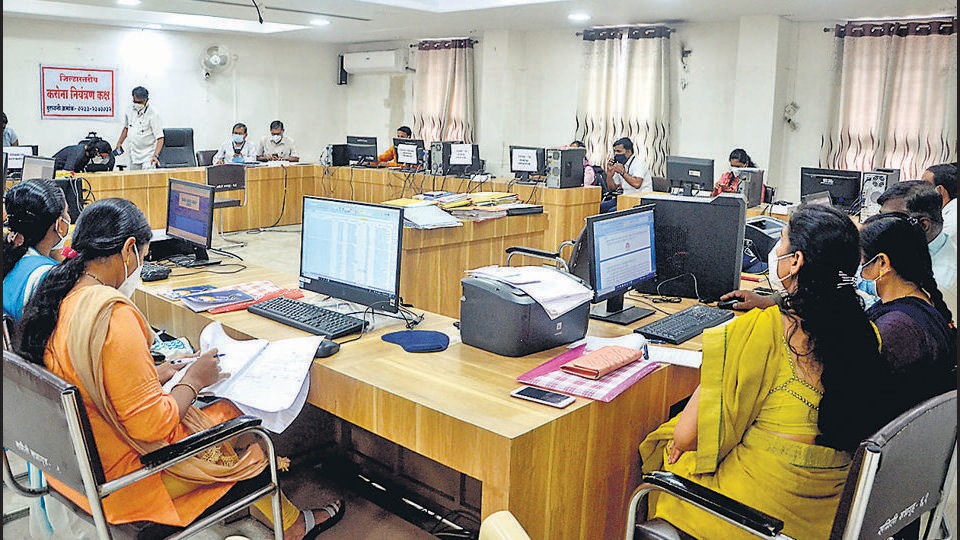
For those who do get themselves tested and turn out to be positive, there is a system that enables the entire district’s health and governance machinery to monitor them. The district and SKMC have separate control rooms where different teams track different things: RAT numbers, RT-PCR numbers, testing numbers from private labs and hospitals, treatment by private practitioners, home isolation, contact tracing, Covid-19 portal updation, bed availability, among others. Lists of patients’ names and their addresses are collected from each taluka and fed back to the respective health centres for monitoring.
Meanwhile, as neighbouring districts like Kolhapur have gone to Level 3 lockdown (opening up non-essential trade), Sangli’s administrators find themselves in a bind: opening up marketplaces, restaurants and permitting free movement will only drive up the number of cases.