
 E-Paper



Make courts inclusive and accessible: CJI
CJI DY Chandrachud on Friday stressed on the need for making courts accessible for all and the role that tribunals can play in making that happen. He was speaking on the occasion of the inauguration of the new Central Administrative Tribunal building in the city


Mumbai: Chief Justice of India (CJI) DY Chandrachud on Friday stressed on the need for making courts accessible for all and the role that tribunals can play in making that happen. He was speaking on the occasion of the inauguration of the new Central Administrative Tribunal building in the city.
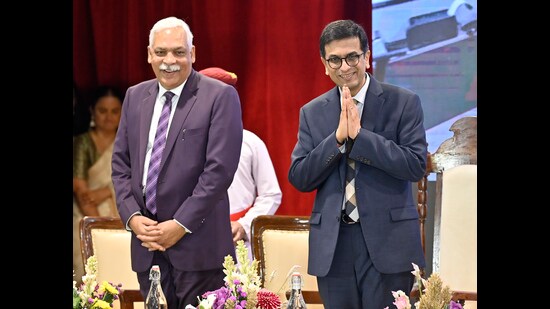
According to the CJI, the tribunals will not only help in offering shorter routes to certain categories of litigants but will also make this journey less onerous for them. “The tribunal has afforded a shorter route to certain categories of litigants. Longer legal battles are bound to become more onerous, perhaps more for one party than the other. The delays in litigation always tend to impact one party more than the other in a dispute, regardless of the individual merit of the case,” the CJI said.
According to the CJI, “A rightful but weary pensioner or a wrongly-terminated single mother may not withstand long and winded litigation or outlast her much more powerful opponent, usually the state. She may continue to have both the substantive right and the right to enforce it. But the prospect of a prohibitively long and costly legal battle may stifle the right at the very outset or overshadow the right in the course of the journey. So the very existence of administrative tribunals is premised on their ability to make this journey less onerous for litigants in matters of public employment, which I believe that they have,” he said.
The CJI also highlighted the importance of infrastructure in addressing the gender disparity in the judiciary. In a society that equates calibre with gender, the impact of delay will be greater for women than for male lawyers, he said. She is not only fighting her immediate opponent in a case, but she is also combating years of gendered perceptions. Therefore, our processes and infrastructure need to be architecturally inclusive to address the challenges as well as the changing composition of the legal profession, he pointed out.
The CJI illustrated this need with a quip from his time as an administrative judge in Kolhapur. “Just a few years ago, when I was an administrative judge in Kolhapur, when I went to inspect the infrastructure, I was told that there was no bathroom in the District Court for women judges. There was a very senior additional district judge who said, ‘Sir, there are women here today who are 28 or 30. They come early in the morning. They can’t go to the only toilet, which is earmarked for women, because they have to pass all the undertrials, who would stare and jeer at them. The next visit to the bathroom is at 6 pm, when they go home. That was the reality of even a developed state, as we call our own state, the state of Maharashtra. So this is something that we really need to look at,” he said.
He also emphasized the need to start a conversation around making courtrooms more accessible for disabled people. According to him, a report by the Supreme Court Center for Policy Research found that only 40% of the courts had dedicated places for persons with disabilities and 30% had infrastructure supporting disabled persons. As institutions founded upon public faith, infrastructure advances must be guided by the objective of accommodating people with diverse needs from different segments of society, he said.
Stay updated with all the Breaking News and Latest News from Mumbai. Click here for comprehensive coverage of top Cities including Bengaluru, Delhi, Hyderabad, and more across India along with Stay informed on the latest happenings in World News.


