
 E-Paper



'Those spreading hatred against Muslims are fooling the majority': Jamiat's Mahmood Madani
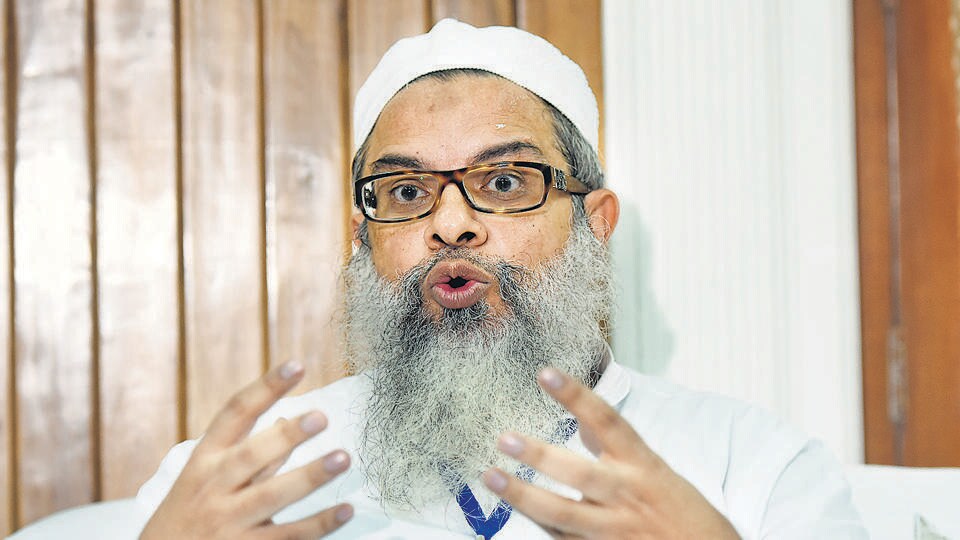
Maulana Mahmood Madani talked about the mood of his community and how his organisation handles the current situation in the country.

 Prefer HTon Google


Maulana Mahmood Madani, head of one of the two factions of the Jamiat Ulama I Hind, was in Mumbai for a discussion on a topic titled ‘Current Situation, Challenges and Solutions’, with activists working on communal harmony. The Jamiat is the largest body of Deobandi ulema in the country. Founded in 1919, the organisation is famous for its participation in the freedom struggle, for which thousands of ulema had to pay with their lives, and its opposition to Partition.
In an interaction with General Pervez Musharraf of Pakistan, at a media conclave held in Delhi in 2009, Madani had told him: “Indian Muslims are capable of solving their problems... We don't need your advice... Don't try to alienate Indian Muslims by your remarks, here or in Pakistan.” The sharp exchange between the Indian Maulana and Pakistan's ex-president is still remembered and has been viewed millions of times on YouTube.
The Jamiat has held numerous conventions against terrorism. In 2008, it flagged off a peace train from Deoband with 8,000 maulanas on it and issued a fatwa against terrorism.
The 59-year-old Maulana, who was featured as ‘Person of the Year 2023’ in the list of ‘The World’s 500 most influential Muslims’ drawn up by the Jordanian Royal Islamic Strategic Studies Centre, spoke to Jyoti Punwani on the mood of his community and how his organisation handles the current situation.
What is the mood of the ordinary Muslim you meet?
It is one of hopelessness, and resulting from that, of anger. When these two emotions combine within a single community, then by and large, there is a danger of the community wanting to go in a third direction. Elements who may constitute even less than 0.1 %, may then take over the community under the garb of offering a “solution”.
Does this mood exist among Muslims in the south too, and in Bengal?
All over India. Not just in India, there’s a concern even in the global Muslim society about what’s happening here. Muslims overseas are increasingly questioning our role, asking us what’s the point of having such a large organisation if we can’t do anything.
On social media, we are called cowards and subjected to all kinds of abuse, especially by the youth.
How do you deal with this mood and abuse?
We are constantly being asked why we don’t react. Our reply is -- there’s a need for a response, not a reaction. It’s difficult to explain the difference to people. However, we keep trying to go to the people and talk to them, both those who are educated, as well as the common Muslim, who may not be well-educated.
Our first aim is to arouse hope among them; to tell them that the ground reality is not what it appears to be, what those in the government or their supporters are portraying it as. We have found that a dialogue helps; people do understand.
What’s your opinion of the way political parties have responded to what’s happening with Muslims today?
I’m very disappointed, perhaps more disappointed with them than with anybody else. They haven’t fulfilled their responsibility. This is not just a minority issue. It concerns the country; it concerns those who constitute the majority.
There’s a famous saying going around these days. We got azadi of all kinds, political freedom, freedom of religion, everything. But it seems we also got the freedom to be fools.
The majority community is being made a fool of by those spreading hatred against Muslims.
What expectations do you have from the INDIA Alliance?
None. I’d rather not say anything more.
RSS chief Mohan Bhagwat keeps making seemingly conciliatory statements such as “there’s no need to look for a shivling in every mosque". Have you engaged in a dialogue with him?
No. But we have supported those who have done so. If we oppose a dialogue, we’ll be faulted for being unwilling to talk. We say the options of a dialogue should always be open, with everyone.
Recently, one of the petitioners in the Gyanvapi Masjid matter asked for a settlement between both sides; the other petitioners however rejected this. Are you open to a settlement?
No comment.
But you just said ‘the options of a dialogue should always be open'.
No comment. Whatever I say will be used as a tool by others; it’s better that I stay silent.
In February, the Jamiat passed a resolution against the UCC. But the government hasn’t even presented a draft. Shouldn’t you have waited for them to do so before opposing it?
Our statement does say, please bring a draft.
Then why oppose it even before that is done? This is the kind of reaction the BJP wants from you.
I agree, that was their agenda.
You were among the most vociferous critics of the Supreme Court’s triple talaq judgment. Do you regret that now?
No. There are reasons for the stand we took. The way the government projected the judgment, as if it was its own achievement, sent the message to people that the custom of triple talaq was as common among Muslims as untouchability is among Hindus. But the 2011 Census showed that the incidence of divorce is less among Muslims than it is among Hindus. (This figure has been disputed – editor.) In a community where the procedure is so easy, the incidence is less; and where the procedure is cumbersome, the incidence is more. Given this, the way PM Modi projected the issue was wrong.
We are not supporters of triple talaq. It should never happen. We believe that efforts must be made to keep the relationship intact till the very end, because of the effect of divorce on children. But the option of talaq must remain only to be used as a last resort. We have to educate the community that this is the worst form of divorce and must be avoided. But that is the community’s job, not the government’s.
The All India Muslim Personal Law Board has been promising to educate the community on the rights of married Muslim women from the time of the Shah Bano issue; we’re still waiting for it to do so.
Isn’t it the Board’s success that the incidence of talaq is going down compared to other communities? But I agree, we didn’t do as much as we should have. And we have been punished for that.
Are you as disappointed with Hindus as you are with political parties?
No. Our experience with Hindus has been magnificent. Not just high society Hindus, but those I meet on the street, in trains, at the airport. All the time, people come and greet me, they tell me they watch my debates. These reactions comfort me like a cool breeze.


