
 E-Paper



Pavement dwellers of decades evicted from Ballard Estate
Around 20 families in Mumbai's Ballard Estate, who have lived on the streets for over 40 years, had their makeshift houses demolished last week without notice. The families are now left on the streets, subsisting on borrowed water and public toilets. Many of them have documents proving their claim to the land, but they are now being told to find alternative accommodation. The families are questioning where they should go now.


MUMBAI: A temporary shack on a footpath can also be home. Testament to this are around 20 families who have lived on four streets in Mumbai’s Ballard Estate for over 40 years now. Many of them were born, grew up, studied, got married, had kids and lost family all on the cobblestones. But that was until last week.
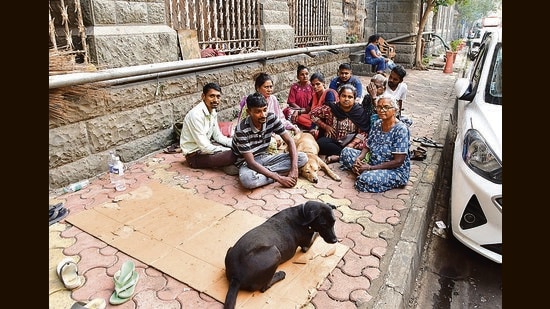
Last Wednesday, the BMC and the police, armed with JCBs and excavators, marched to the four streets—Cochin Street, Calicut Street, Adi Marzban Path and Kumtha Street—and demolished the makeshift houses without any notice. Their tarpaulin-roofed shacks held up with bamboo poles, were all torn apart, many with the pavement dwellers’ belongings. “They shouted at us to get out of our shacks or we’d get hurt,” said Mangala Prasad. “We couldn’t even take our stuff, and some of us lost important documents in the chaos.”
The families, comprising little children, college-going students, patients, senior citizens and adopted stray dogs have all been left on the open streets. Sitting and sleeping on mats and cardboard with only a few of their belongings left with them, they are now subsisting on vada pav, borrowed water and a public toilet some distance away. “The police come repeatedly and don’t allow us to sit or sleep here anymore. We then run off and hide somewhere till it’s safe to emerge,” said Muthu Naidu. The authorities have even placed plant pots on some of the footpaths to prevent them from using the space.
For decades, the pavement-dwellers have lived makeshift lives, subsisting on leftover water from tankers that brought water to the offices around and cooking food on stoves with tiny gas cylinders. Their earnings went into their children’s education, food, on the upkeep of their houses, illnesses, and the occasional new clothes for kids during festivals. But the paltry shelters they had are now all gone, leaving them exposed to the elements.
“We’re partially at fault,” said Mangala. “Some of our men drink out in the open and that leads the high-end restaurant owners around here to complain, as their wealthy clientele doesn’t like seeing us. But we were already here when they decided to set up shop, and anyway they can’t tar us all with the same brush.”
Mangala’s two daughters are in their third year of college. After years of staying at hostels, they are now forced to live in uncomfortable and vulnerable conditions. “I was born here,” said Mangala, who works as a housekeeper. “My father died of a heart attack and my mother passed away soon after. My husband got tuberculosis and died drinking alcohol, so I sent my children off to hostels to get a good education. This is their last year. How will they study if they’re constantly being shooed off?”
A majority of the residents possess documents that prove their claim to the land since 1995, entitling them to alternative accommodation if evicted. But, as one resident Seema Gaikwad explained, a few of them came to their current spots when evicted from Bombay Port Trust land, and so their addresses are those of their previous residence.
“Around 20 years ago, the Port Trust asked us to move away from where we used to stay, so we came here,” said Gaikwad. “But that was the address on our voting and ration cards, which my mother didn’t change because she isn’t educated and wasn’t aware of the need to do so.”
The pavement dwellers said that their MLA Rahul Narwekar had repeatedly asked them for their documents and promised to look into their case, but nothing had moved. Faced now with the government’s diktat to leave and find a house on rent, the impossibility of affording a deposit and rent stares them in the face apart from the fact that the uprooting will take them further away from their schools, colleges and workplaces.
“We’re being told that we’re illegal residents,” said Gaikwad. “So why give us all this hope and lead us on for so many years? We vote. We have all our documents. We’ve been allowed to live here for a lifetime. Where do we go now?”

Stay updated with all the Breaking News and Latest News from Mumbai. Click here for comprehensive coverage of top Cities including Bengaluru, Delhi, Hyderabad, and more across India along with Stay informed on the latest happenings in World News.


