
 E-Paper



State’s skilled labour poised to go global
The Ministry of Skill Development and Entrepreneurship has signed 18 MoUs with countries in Europe, UAE and Japan; the latest with Germany


Mumbai: The state is set to start exporting skilled manpower to the third largest German state for trade. Last Sunday, the Maharashtra government signed a memorandum of understanding (MoU) with Baden-Wurttemberg, in southwest Germany, to provide skilled individuals to the German state in sectors such as science, technology, engineering, construction, healthcare and hospitality, among others. People with technical skills from Maharashtra will undergo specialised training, including proficiency in the German language, to meet specific needs identified by Baden- Wurttemberg.
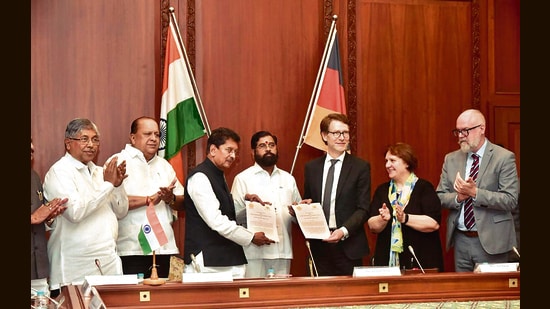
Achim Fabig, consul general of the Federal Republic of Germany in Mumbai, said their country has benefitted from India’s talent pool in the past especially in fields of mathematics, informatics, natural sciences and technology. Fabig added, “Some crafts that are sometimes neglected in India are held in very high esteem in Germany and therefore offer a wide range of opportunities not only for the skilled labourer but also for her or his family.”
Maharashtra currently has a potential workforce of around 7.47 lakh engaged in professions in varied technical fields. While it is going to take a while for the first batch of skilled labour to fly the nest, youth have been making inroads into Germany and reaping the fruits of their labour.
Naigaon resident Vivek Karande, 20, has been working in a house building and electronic firm in Flensburg for the last six months. Son of a Mumbai cop, he applied for the Indo-German Programme for Vocational Education and Training (IGVET-II) after clearing the Class 12 in the science stream. The programme offers dual apprenticeships and workplace-based skill development.
He learnt about the prospect from his brother who was pursuing a course in Industrial Training Institute (ITI). “After completing basic German language course at an Andheri-based institute, I was selected for this unique three-year programme,” said Karande, who works for three weeks in the firm and spends one week at the college for theoretical classes. Under this scheme, 100% fees (€1500 or ₹1,34,888 per year) are paid by the employer apart from earning a monthly stipend of €1,154 ( ₹1,03,774).
Like Karande, four students from Maharashtra went to Germany in September 2023 and were placed in organisations like Dimar and Schulz and Eggers Group. With several opportunities in the global market after completing 10+2 or equivalent courses (Class 12 examination or two-year vocational training or ITI after Class 10) and language training, the number is set to increase, after the latest partnership.
Till now, the Ministry of Skill Development and Entrepreneurship has signed 18 Government to Government (G2G) MoUs with Australia, Belarus, China, Denmark, France, Germany, Japan, Qatar, Switzerland, United Arab Emirates (UAE) and United Kingdom (UK) in the field of skill development and vocational education.
While the country is focusing on providing 10,000 labourers for construction work in Israel and thousands of staff nurses to UK, Finland and Japan, the state aims to send 3,500 skilled workers to the global market in 2024.
Every year, after Class 10, around 2.25 lakh students across Maharashtra enrol in 994 government and private ITIs. In two years, students get trained in more than 100 skills including turners, fitters, computer application, artificial intelligence and machine learning. After completing ITI, the majority pursue a two-year polytechnic diploma of which about 10% go on to earn engineering degrees.
In a bid to facilitate placements, the state has not only opened doors for its youth to gain international exposure but also global exchange of knowledge and expertise, fostering economic growth through remittances. To that end, in September 2023, the first batch of 58 students from Maharashtra received job offers from employers based in Germany, Japan, UK and Finland. Six students have reached their respective destinations, while others are undergoing language training.
“We have been sending our students overseas for a very long time, but the numbers are now increasing with intergovernmental programmes like Technical Intern Training Programme (TITP) with Japan, and others designed for ITI students by the National Skill Development Corporation (NSDC). And yet, we are far behind compared to other developing countries,” said Purshottam Wagh, former principal of Mulund ITI.
Harsh Patil, for instance, never imagined he would work in Japan. Son of a farmer from Raigad district, the 21-year-old is currently employed as Computer Numerical Control operator at the Sankei Giken Kogyo Co. Ltd., in Isesaki; the company manufactures and sells automobile and motorcycle parts.
Seven months ago, he secured the job under TITP, which involves on-job training for three to four years after which candidates return to India. Students earn 90,000 to 1,30,000 yen ( ₹50,000 to ₹72,000) monthly. “While completing training at Industrial Training Institute (ITI) Panvel in Machinist branch in 2019, I learnt about TITP, and I applied for it in 2022,” said Patil.
With a six-month basic course in Japanese language, good working conditions, and having adapted to the climate, food and culture, Patil has now applied for Specified Skill Worker (SSW) – a new residency status introduced by the Japanese government in April 2019.
To cater to the global demand of skilled labour and provide better opportunities to students passing from ITIs, the Ministry of Skills, Employment, Entrepreneurship and Innovation under the Maharashtra government has established an international placement centre called Maharashtra International.
Through the centre, the state government aims to facilitate easy passage of local talent overseas, through training, support for documentation providing helplines for students relocating and to raise awareness about foreign cultures.
Maharashtra skill development minister Mangal Prabhat Lodha said plans are on to establish five international employment centres in the state, “through which over 3,500 students are expected to be employed”.
“India will also collaborate with 27 countries to create new job opportunities for our youth. Since employment is a worldwide issue, I request foreign diplomats in Maharashtra to support these efforts,” said Lodha.
Maharashtra International plans to establish laboratories in additive manufacturing, mechanic electric vehicle, industrial robotics, advanced welding, computerized embroidery and designing, among others. A language laboratory will also be set up at an ITI in Govandi. Apart from this, the state government has also established 511 skill centres in 350 talukas across the state that will train youth in sectors such as construction, electronics, agriculture, food industry, tourism and hospitality. A minimum 30% of women will be provided skill development training, and approximately 50,000 young men and women will gain employment annually. Education provided in these centres will be relevant for the PM Vishwakarma Scheme to provide end-to-end support in 18 trades such as carpentry, tailoring, pottery etc.
Commenting on the state’s approach to promote skilled manpower in the global market, Chandrakant Salunkhe, president of SME Chamber of India and the Maharashtra Industry Development Association, said, “While we are happy that the government is addressing problems of skilled manpower, it must also address issues of skilled manpower shortage faced by local small and medium enterprises (SME). Despite several communications, there has been no response from the government.” Salunkhe added, “As industries are going through a phase of automation, we are unable to get good engineers who can work in rural parts of the state. At present, SMEs are hiring most ITI holders. In view of this, the state while promoting ‘Skill India’ should also focus on local employment along with global employment.”
In its last published ‘Global Skill Gap Report’ in April 2020, the National Skill Development Corporation (NSDC) predicted 26.34 lakh jobs for Indians, with the maximum jobs in the construction sector (11.70 lakh) followed by wholesale and retail trade, repair of motor vehicles and motorcycles (4.23 lakh), real estate, rental and business services (2.83 lakh). Ved Mani Tiwari, chief executive officer, NSDC, stressed the need for cultivating future-driven skillsets to effectively navigate through the integration of machines and humans.
“NSDC candidates from tier 2 and 3 cities are willing to relocate abroad for better opportunities. Since pay scale in Gulf countries is low owing to labour supply from Pakistan and Bangladesh, we are now focusing on European countries and Japan,” said Tiwari. “We are spreading our network to 15 countries and aim to soon reach 30 countries. Though demand is not an issue, we are focusing on trained skilled labour.”

Stay updated with all the Breaking News and Latest News from Mumbai. Click here for comprehensive coverage of top Cities including Bengaluru, Delhi, Hyderabad, and more across India along with Stay informed on the latest happenings in World News.


