
 E-Paper



Steep fee hikes, rule violations taking medical education beyond middle class reach
Private medical colleges are charging exorbitant amounts towards hostel and mess fees and other charges

 Prefer HTon Google


Mumbai: When Sachin Kamble (name changed), a 19-year-old medical aspirant from Repanpalli, a remote village in Gadchiroli district in eastern Maharashtra, failed to secure admission in a government medical college in early November, he was dejected.

“Since I come from a poor, Scheduled Caste (SC) household, I would have got a full fee waiver had I secured admission in a government college,” Kamble told Hindustan Times. “But my score in the National Eligibility-cum-Entrance Test (NEET) was slightly lower than the cut-off, which forced me to consider private colleges.”
Kamble’s family was too poor to afford the steep fees charged by private medical colleges near big cities like Nagpur, Mumbai and Pune. So he zeroed in on the Sindhudurg Shikshan Prasarak Mandal’s medical college in Sindhudurg district, where the tuition fees was ₹50,000 per year, as per details mentioned on its website.
Kamble arranged for ₹50,000 by borrowing from relatives and made a demand draft in favour of the college. But when he visited the institution to get enrolled, officials allegedly demanded an additional ₹9 lakh towards hostel and mess facilities.
“I did not even opt for hostel and mess facilities while seeking admission, but the authorities were insistent. They said I would be given a seat only if I paid the full fees,” he said. “When I refused, I was pressured to send an email claiming I had no complaint against the college before I was allowed to leave the campus.”
The dean, Dr Vandana Gaopande, told HT that the college only demands fees approved by the Fee Regulatory Authority (FRA) under the Maharashtra University of Health Sciences (MUHS).
“We follow all rules notified by the FRA, ARA (admission regulatory authority), the Directorate of Medical Education (DMER), and the CET (common entrance test) cell. No applicant is forced to send any emails,” she said.
Kamble, however, filed a complaint with the ARA, which oversees admission to MUHS-affiliated private colleges. After a hearing, the ARA allowed him to participate in the stray vacancy round, which is conducted after candidates chosen via regular counselling rounds do not report for admission or withdraw their enrolment from allotted colleges.
On Monday, Kamble was relieved as he was granted admission at the Topiwala National Medical College & BYL Nair Charitable Hospital in Mumbai.
Activists welcomed the development, but decried the lack of any punitive action against the Sindhudurg college. Kamble’s case, they said, is emblematic of how private medical colleges charge exorbitant amounts towards hostel and mess fees and other charges that are outside the purview of the FRA, which only regulates tuition fees and development charges. Colleges affiliated with private deemed universities are worse off than colleges under the MUHS, they said, as the annual fee in such institutions often touches ₹1 crore.
“Even middle class families are finding it almost impossible to afford private medical education for their children as fees have increased by nearly 50% in the past five years,” said Dr Ketan Deshmukh, a Pune-based doctor and activist who guides students from poor backgrounds seeking admission in medical colleges.
“There should be a CET cell representative present in every private college during admissions. Only then will fee-related practices be transparent,” he said.
Steep fee hikes
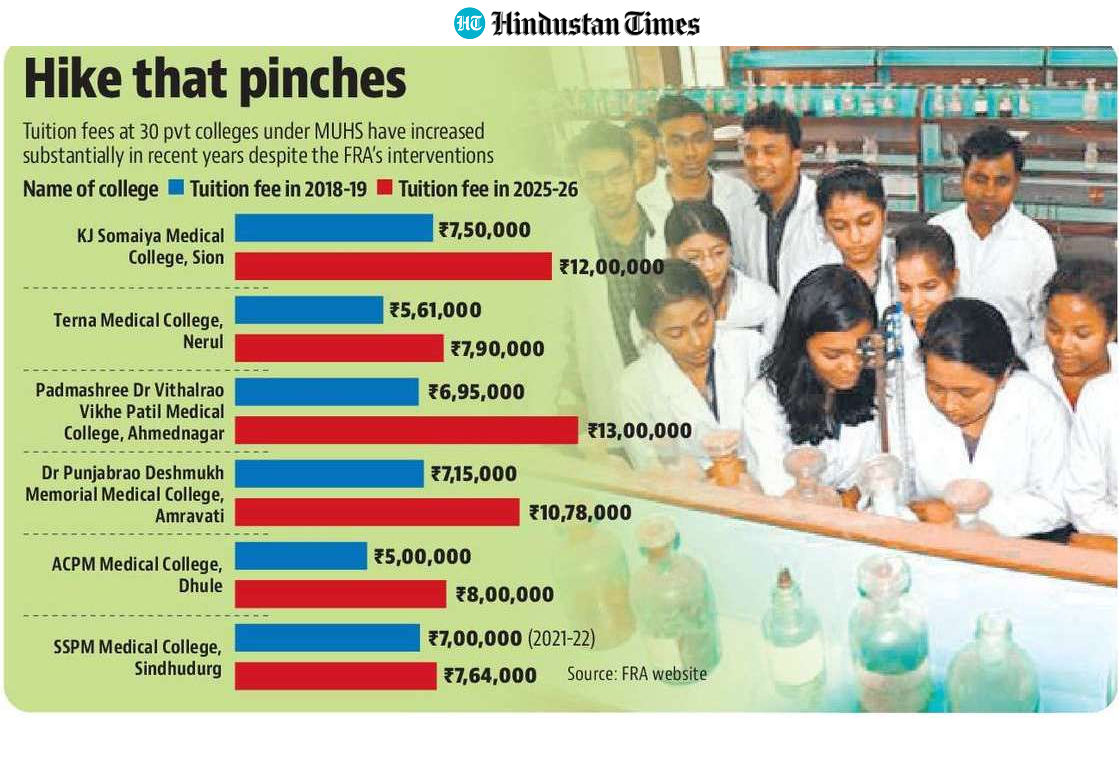
The tuition fee at 30 private colleges under the MUHS have increased substantially in recent years despite the FRA’s interventions, several medical aspirants, doctors and officials told HT. But hostel and mess fees, which are decided by individual colleges, have shot up far more sharply, taking the annual fee to ₹12-14 lakh and the total fee for a five-year MBBS course to ₹60-70 lakh, which is outside the reach of most aspirants, they said.
The situation is more grim at the 14 medical colleges affiliated with nine deemed universities in the state. These colleges do not come under the purview of the FRA and are free to charge any amount they deem fit. The total cost of education at such colleges is often more than ₹1.25 crore for the five year period.
For instance, the Pravara Institute of Medical Sciences at Ahilyanagar, charges ₹19 lakh per year for tuition, and ₹1.2 lakh per year towards hostel and mess charges, taking the total fee over five years to around ₹1 crore. Another deemed university, the DY Patil Medical College in Navi Mumbai, charges ₹27 lakh per year as tuition fee, in addition to ₹3.5 lakh per year towards hostel charges and ₹2.84 lakh as a one-time registration fee.
Pervasive violations
The problem is not just limited to students pursuing MBBS courses, but also affects those enrolled in courses such as BAMS (ayurveda), BHMS (homeopathy), and BUMS (unani) as well as those selected for government scholarships.
For instance, when Kandivali resident Sanjana Kori secured admission to the BAMS course in an Alibag college during the first round of counselling, she was asked to submit a cheque of ₹1.08 lakh to “secure her seat” even though she had a full government scholarship.
“When I refused, they said they couldn’t confirm my admission,” Kori said. “Finally, I gave in when they said I might lose the seat in later rounds.”
Later, Kori wanted to opt for a college in Virar, which too demanded the full fees upfront to confirm her admission. The college granted her admission after she filed complaints with the CET cell, ARA, and the Ayush commissioner.
“Though the college did not charge any fees, they made her sign an undertaking saying if the government failed to release the scholarship sum, I would have to pay the fees myself. It was exhausting,” Kori said.
Delays in releasing scholarship money for female students and those under the social justice department cause further suffering, several parents told HT. Nagpada resident Mohammed Yunus Shaikh, parent of a BAMS aspirant, said he was asked to pay ₹4.5 lakh as tuition fee although his daughter had secured full scholarship. When he questioned authorities at the college, they claimed they hadn’t received the scholarship amount from the state.
“They cannot run the college without collecting fees from students, they said,” Shaikh told HT.
‘Unrealistic cap’
HT reached out to Kamal Kishore Kadam, president of the Association of Management of Unaided Private Medical and Dental Colleges, regarding the steep fee hikes and alleged rule violations, but he was unavailable for a comment. An official from DMER said they carefully scrutinise every complaint and take action after hearing both sides.
Dr Praveen Shingare, former DMER director, said though the number of seats at government medical colleges had increased from 4,000 in 2018 to 7,000 now, there was stiff competition even in private colleges that charged steep fees.
“When the state government spends ₹30 lakh per year per student, how does the FRA expect private colleges to charge only ₹12 lakh,” he said, criticising the “major gap” between the FRA mandated fee and what colleges actually need.
To run a medical college with 100 seats, a college must appoint at least 100 teachers as per National Medical Commission rules. “To maintain facilities, colleges try to collect funds from other sources,” he said.
Though deemed medical colleges charge around ₹25 lakh per year, seats are always filled, he noted. “This is because the quality of education is good and those who can afford it pay for it,” he said.

Stay updated with all the Breaking News and Latest News from Mumbai. Click here for comprehensive coverage of top Cities including Bengaluru, Delhi, Hyderabad, and more across India along with Stay informed on the latest happenings in World News.


