
 E-Paper



The Gathering: Where food and fabric blend to celebrate a cross-border culinary culture
It’s collabs and curated spaces such as these that are at the heart of The Gathering, a unique three-day festival that intertwines food, design, art, crafts, music and more to present the city with multi-sensorial treats


MUMBAI: How would Maharashtra’s Paithani sari taste or Kerala’s white and gold Kasavu fabric flood the mouth with flavours? Sari and textile fanatic chef Niyati Rao re-visted her mother and grandmother’s wardrobes, sat and felt each fabric and mulled over these questions to design a special meal menu focussed on the diverse weaving heritage of India. It consists of Pachadi, caramelised chocolate, served on a bed of mogras inspired by Kasavu; Koshimbir gel, modak gelato, Bombay sandwich sorbet, kokum gel in a Bombay-sandwich-meets-the-pride-of-Paithan vibe, etc.
The food will be served in a temporary restaurant conceptualised by designers David Abraham and Rakesh Thakore. “It will function as the theatre of the space for Niyati’s food,” says Abraham. Swatches of black and white fabrics of varied textiles will fill the space, celebrating the gathering of the warp and the weft, the two threads that bring a fabric together, and the creative exchange and synergy between a chef and a designer.
It’s collabs and curated spaces such as these that are at the heart of The Gathering, a unique three-day festival that intertwines food, design, art, crafts, music and more to present the city with multi-sensorial treats. As the festival concludes today at the Mukesh Mills in Colaba, its line-up offers visitors five pop-up restaurants such as Rao’s, a workshop space where discussions and talks around food and art can be held, a music arena, a speakeasy, a few bars and more food stations. “The idea is for people to be able to spend an entire day at the venue, participating in different activities,” says Susmita Sarmah, the brain behind The Gathering, which was first held in Delhi last year. “Also, it’s with food that people can become analogues in this digital world, find time with oneself and listen to interesting stories. That’s what these experiences aim to do,” she adds.
Abraham participated in one such meal experience at The Gathering’s first edition in Delhi last year. “I signed up for a North Eastern meal and was completely captivated with what was served and how it was served,” he says. So, this year, he and Thakore, known for their textile-focused designs, got on board as participating artists. “Collaborations and exchanges such as these broaden the playground for creative people, and give us a chance to do something different and push our imagination,” says Rao.
This time, chef Bawmra Jap and photographer Pablo Bartholomew also presented Highland Crossroads, which maps the unique identity of the Kachin people, ethnic communities across Northern Burma, Northeast India, and Yunnan in China, celebrating a cross-border culinary culture and the landscape of the region. While Jap served Shan tofu, Manali Ferns, Perilla leaf tempura and other food items, Bartholomew brought alive the Kachin land through his photographs of the North East and Burma, which were projected on the walls of the space, and also printed on long canvas and georgette scrolls.
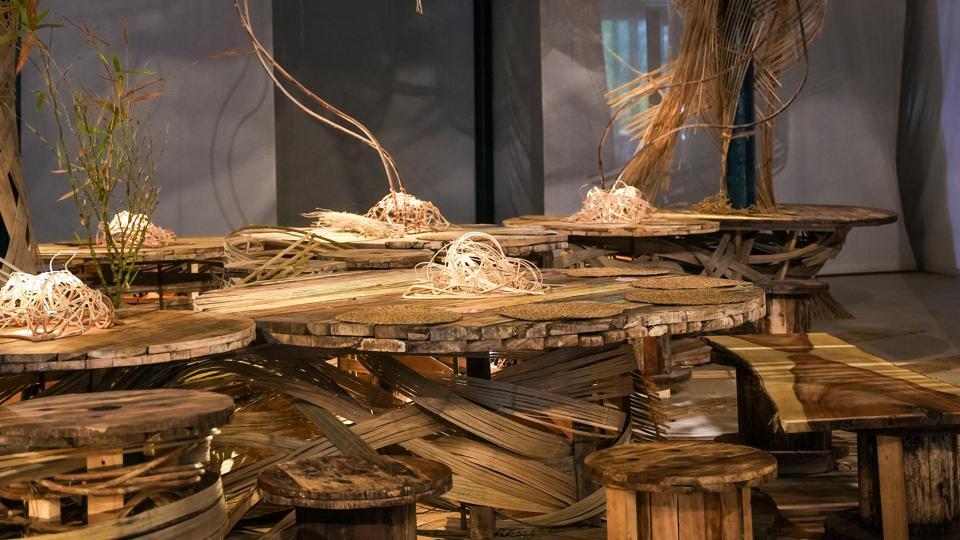
Chefs Doma Wang, Sachiko Seth and architect and designer Udit Mittal’s The Noodle Factory created a space that resembles the humble noodle outlet in Kalimpong, West Bengal, where Wang’s story was shaped by hand-mixed dough and bamboo poles hung with noodles. Mittal interprets the culinary artist’s memories through a dreamlike landscape of unfurling bamboo and gentle light while Wang serves dishes made with tender coconut, rice with vinegar, green herb oil, cured scallops and more.
The festival serves as a platform for not only meals but even important discussions around food. During the festival, at the Salon, food historian Kurush Dalal presented a talk titled The Parsis and Their Cuisine: Adaptability over Adversity. Theatre actor, writer and director Vamsi Matta, food chronicler Shahu Patole and artist Rajyashri Goody discussed the politics of food and caste. Goody also conducted a workshop Referencing Dalit Food and Literature. “I am trying to ask why there are very few or virtually no Dalit cookbooks whereas Dalit literature has lots of food,” said Goody, an artist who belongs to the Dalit community. She has been researching the interplay between cooking, communities, food and violence for the last eight years. “The workshop is not aimed at having Dalit food served in restaurants, I am just looking forward to engaging with people who are willing to listen and learn,” she adds.
Listening, learning, seeing, tasting, and feeling is what the festival was designed for, and to engage with Mumbai and explore the possibilities of creative collaborations.
For more information, log on to gathering.in
Stay updated with all the Breaking News and Latest News from Mumbai. Click here for comprehensive coverage of top Cities including Bengaluru, Delhi, Hyderabad, and more across India along with Stay informed on the latest happenings in World News.


