
 E-Paper



With 306 AQI, Mumbaiites breathe ‘very poor’ air again
Experts have suggested that the limited number of stations monitoring AQI in the city is not enough and that the AQI monitoring network should be dense to understand the pollution trends better. Mumbai has only 17 active monitoring stations including the one in Vasai


Mumbai: Due to an increase in pollution levels, the city’s Air Quality Index (AQI) on Thursday dropped to the ‘very poor’ category at 306, with Mazgaon recording the worst air quality at 358, according to the System of Air Quality Forecasting and Research (SAFAR).
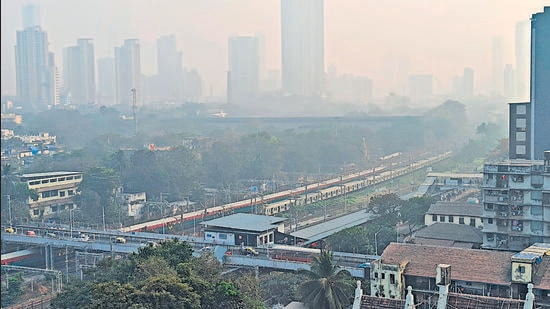
The last time Mumbai’s AQI dipped to ‘very poor’ category was on December 28 with 303.
According to the daily 4pm bulletin by the Central Pollution Control Board (CPCB) the prominent pollutants in the city were PM2.5 and PM10.
Besides Mazgaon, AQI of Chembur, Malad and Andheri were also in the ‘very poor’ category with levels of 343, 311 and 306 respectively.
According to the data provided by Maharashtra Pollution Control Board (MPCB), the PM2.5 levels and PM10 levels in Mulund stood at 406 and 500 respectively around 6pm on Thursday.
Experts have suggested that the limited number of stations monitoring AQI in the city is not enough and that the AQI monitoring network should be dense to understand the pollution trends better. Mumbai has only 17 active monitoring stations including the one in Vasai.
Ronak Sutaria, the founder of Respirer Living Sciences, which operates an independent network of 1000 air quality monitors across the country, said, “The air quality trend across every single 21 monitoring sites in Mumbai (IITM & MPCB sites combined) has reported an increasing (aka worsening air quality trend), other than Kurla. The worst increase is seen in Bandra-Kurla Complex where the air quality has worsened by 2x levels - from 100 ug/m3 on December 4 to nearly 200 ug/m3 on Thursday up to 7pm.”
Sutaria added the rising levels across the city is a significant cause of concern and require timely advisories to be made to all vulnerable segments (people with respiratory illness) to take precautionary measures like wearing masks and staying away from polluted neighbourhoods. “The current levels being seen across the city are nearly 1.5x to 2x the safe limits as prescribed by CPCB. Surat Municipal Corporation and other cities like Lucknow, Jaipur and Guwahati have started deploying dense air quality networks of a few hundred monitors across the city. These kinds of large networks allow for a better scientific understanding of the long-term pollution trends and help build more science-based policies for mitigation actions. These steps are essential if we want to have clean air for our next generation,” said Sutaria.
The AQI of Colaba, Bhandup and BKC fell in the poor category with an AQI of 297, 211 and 211 respectively. Only Worli and Borivali were in Moderate category with an AQI of 156 and 132 respectively.
Doctors have suggested that people should avoid polluted areas and wear masks while venturing out.
“Since the past few weeks, we have been observing a steady inflow of patients complaining of throat irritation, running nose, sneezing and persistent cough. Since the symptoms are pollutant-induced, decongestant and anti-inflammatory medications are unable to alleviate the symptoms immediately. Hence individuals should avoid polluted areas and wear a mask while venturing out. Senior citizens should avoid morning walks in the season due to the heavy smog. Regular steam inhalation, which humidifies the airway, can be effective. Individuals with allergies and asthma should keep their inhalers on themselves at all times” said Dr Salil Bendre, head and senior consultant, of pulmonology, at Nanavati Max Super Specialty Hospital.
Stay updated with all the Breaking News and Latest News from Mumbai. Click here for comprehensive coverage of top Cities including Bengaluru, Delhi, Hyderabad, and more across India along with Stay informed on the latest happenings in World News.


