
 E-Paper



Gzb’s 17km priority section to provide learning benchmark for other RRTS corridors
Trains on the 17km priority section of the Regional Rapid Transit System (RRTS) in India will start running on Saturday. The system will connect Delhi, Ghaziabad, and Meerut and is expected to cut travel time between Delhi and Meerut to an hour. The RRTS is built at a cost of ₹30,000 crore and is set to cater to around 8 lakh passengers when fully operational. This section will serve as a benchmark for other phases of the corridor and other proposed RRTS routes.


With all arrangements in place, trains on the 17km priority section of the Regional Rapid Transit System (RRTS) will start running on Saturday, officials aware of the matter said on Friday, after the project was inaugurated by Prime Minister Narendra Modi in Ghaziabad.
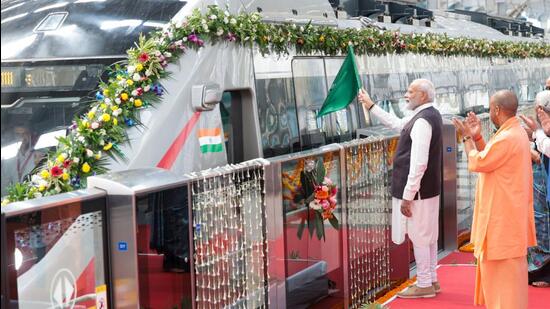
The first of the 10 Namo Bharat trains will leave simultaneously from Sahibabad station and Duhai Depot stations at 6am, the officials said. The RRTS priority corridor comprises three other stations -- Ghaziabad, Guldhar, and Duhai.
The initial frequency of the Namo Bharat trains will be 15 minutes, with a stoppage time of 30 seconds at each of the five stations.
“All the facilities and resources have been put in place and the first train will leave simultaneously from the Sahibabad station and the Duhai Depot station at 6am. We have also deployed more than 50% of women staff for operations and maintenance and this will give better feel to women commuters,” a spokesperson from National Capital Region Transport Corporation, which has developed the RRTS, said.
The priority section is a part of an 82km corridor that will connect Delhi, Ghaziabad and Meerut, and is slated to open in 2025. Built at a cost of ₹30,000 crore, RRTS is expected to cut the travel time between Delhi and Meerut to an hour, using trains that can zip at a top speed of 180kmph, and will likely cater to about 8 lakh passengers when fully operational.
The start of priority section will provide a benchmark for other phases of the corridor, and also for other proposed prioritised RRTS routes such as Delhi-Alwar and Delhi-Panipat, NCRTC officials said.
“The priority section opening is more to gather learning and experiences about the new RRTS system. The learnings from the priority section will provide us benchmark about operations, maintenance, construction, integration of different systems, and these learnings will be taken to other phases of the 82km project and to other proposed corridors in NCR. This section will also help passengers to experience the RRTS trains and system. This section will now start passenger operations from October 21. We have 10 Namo Bharat trains available with us for the start of operations,” said Puneet Vats, chief public relations officer of NCRTC.
PM Modi too on Friday said that the ongoing RRTS projects will catapult the NCR areas in UP, Delhi, Haryana and Rajasthan to new level of commuting.
“...Trinity of Amrit Bharat (redevelopment of railway stations), Vande Bharat and Namo Bharat will become a symbol of modern railways by the end of this decade,” the PM said in his public address in Ghaziabad on Friday, and added that the Namo Bharat trains will also be considered for other parts of the country.
A total of eight RRTS corridors have been identified to be to be developed in NCR, out of which three corridors have been prioritised to be implemented in Phase-I, including the Delhi – Ghaziabad – Meerut Corridor; Delhi – Gurugram – SNB – Alwar Corridor, and Delhi – Panipat Corridor.
NCRTC officials said that the work on the two other corridors is yet to commence. They added that the first part of the Delhi-SNB of Delhi-Panipat RRTS corridor is “awaiting some financial commitment, post which it will be considered for approval by the Government of India.”
“Haryana has given approval for DPR of Delhi-Panipat project and it is awaited from government of NCT, Delhi. The detailed project report is prepared for both the corridors,” an official aware of the matter said, asking not to be named.
NCRTC now intends to complete the other 25km section from Duhai Depot in Ghaziabad to Meerut (South) in the first quarter of 2024.
“After this, the Delhi section of about 14km, also having an underground corridor, is likely to be completed by the end of 2024. The last phase comprising of stretch from Meerut (South) to Modipuram in Meerut along with a local metro module in Meerut is likely to get complete. We are progressing fast and expecting that the last phase gets complete before the project deadline,” a spokesperson from NCRTC, said.
The deadline for the Delhi-Ghaziabad-Meerut corridor is June 2025. NCRTC said it has already completed the civil construction of underground sections in Delhi as well as in Meerut.

Stay updated with all the Breaking News and Latest News from Mumbai. Click here for comprehensive coverage of top Cities including Bengaluru, Delhi, Hyderabad, and more across India along with Stay informed on the latest happenings in World News.


