
 E-Paper



Noida most polluted for second day in a row, no respite in sight
There seems to be no respite from ‘severe’ air for Ghaziabad, Greater Noida and Noida as pollution levels spiked for the second time this season starting from Friday--the first being around the time of Diwali (November 4)--and led to a rise in PM10 and PM2


There seems to be no respite from ‘severe’ air for Ghaziabad, Greater Noida and Noida as pollution levels spiked for the second time this season starting from Friday--the first being around the time of Diwali (November 4)--and led to a rise in PM10 and PM2.5 concentrations.
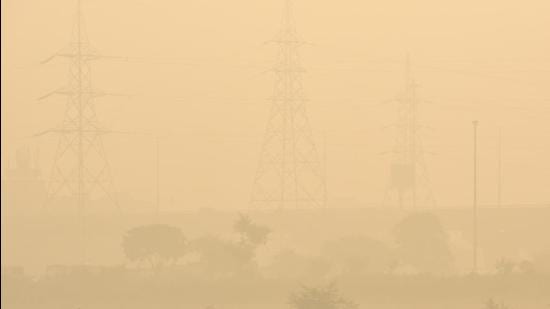
The air quality index (AQI) bulletin of the Central Pollution Control Board (CPCB) indicated that with an AQI of 464, Noida was the most polluted city in the country for the second consecutive day on Saturday. While Ghaziabad recorded an AQI of 441, the AQI of Greater Noida showed a marginal improvement and was at the lower end of the ‘severe’ category at 408 compared to 478 on Friday.
An AQI reading between zero and 50 is considered “good”, 51 and 100 “satisfactory”, 101 and 200 “moderate”, 201 and 300 “poor”, 301 and 400 “very poor”, and 401 and 500 “severe”.
Ghaziabad has been reeling under ‘severe’ pollution levels for 10 days since November 4, the day Diwali was celebrated. Noida too has been under the ‘severe’ category for all days, barring November 10.
The four monitoring stations in Ghaziabad and two in Greater Noida recorded PM2.5 as the primary pollutant while all the four stations in Noida had PM10 and PM2.5 as the primary pollutants.
There has been a major spike in PM10 and PM2.5 levels in Noida and Ghaziabad. According to CPCB data, the first spike in pollution levels lasted from November 4 to 6 and the second spike started on Friday (November 12) and is continuing.
According to official figures of the CPCB, the PM2.5 levels ranged between 297.45 micrograms per cubic metre (mpcm) to 691.18 mpcm in Ghaziabad between November 10 to 12. Likewise, the PM10 levels stood in the range of 511.74 mpcm to 840.68mpcm during the period.
The standard limit for PM10 is 100 micrograms per cubic metre (mpcm) while that for PM2.5 is 60 mpcm.
Likewise in Noida, the PM2.5 ranged from 223.09 mpcm to 585.17mpcm while the PM10 levels were between 394.49 mpcm and 920.95 mpcm.
According to official figures of the CPCB, Delhi NCR this season had the worst PM10 levels as the concentration peaked to as high as 551.2 mpcm between November 5 to 6. The PM 2.5 concentration spiked to 424 mpcm .
During the second spike in pollution levels, the PM10 concentrations have shot beyond the permissible limit of 500 mpcm and spiked to 574.1 mpcm while the PM2.5 concentration spiked to 372.2 mpcm.
“There is spike in PM concentration levels and it is due to the unfavourable meteorological conditions, which also includes slow wind speed. The Ghaziabad/Noida region is still under ’severe’ category as the pollutants are trapped and will disperse only if the wind speed increases or if there is rainfall,” said Utsav Sharma, regional officer of Uttar Pradesh Pollution Control Board.
Experts said there is no likelihood of rain till November 19, which would help wash away the trapped pollutants.
“The wind speed has marginally increased from 7kmph to 9kmph since Friday. On Saturday, the scenario was more or less to what it was on November 10 and 11. The visibility has also improved in the range of 1500-1800 metres, while it was about 500 meters on Friday. Overall, there is a marginal improvement but conditions will remain more or less same for the next couple of days,” said an officer from the Indian Meteorological Department.
“The pollution levels are in the ‘severe’ category in most places in NCR. It is also due to the impact of stubble burning and accumulation of local pollutants. A depression over Odisha and Chattisgarh was present with easterly winds blocking the north-westerly winds. Since the depression has moved out, it is likely that the wind speed in NCR will pick up in the next two to three days and is expected to be in the range of 10-15kmph,” said Mahesh Palawat, vice-president, meteorology and climate change, Skymet.
“The rise in PM concentrations indicates the collective failure of agencies in mitigating the local sources of pollution, which is a contributing factor to the deteriorating air quality, besides external factors such as stubble burning and meteorological conditions,” said Akash Vashishtha, a city-based environmentalist.
The forecast by System of air quality and weather forecasting and research (Safar) said on Saturday that the AQI is likely to improve for the next two days as winds at transport level (925 mb) are slowing down, resulting in lesser intrusion of pollutants from farm fires into Delhi.
“However, as local winds are becoming calm and minimum temperature is decreasing further, preventing efficient dispersion of pollutants leading to improvement of air quality to upper end of very poor category or lower end of severe category,” said the Safar forecast.
As a result of the deteriorating air quality and the prevailing weather conditions, residents staying in the flats on the higher floors of buildings are complaining of different complications.
“I stay on the 10th floor and have to keep my doors and windows closed and also ensure my children are indoors. There is poor visibility in the morning. Hardly any measures are being taken at the ground level to control local sources of pollution,” said Sanjeev Sethi, a resident of Sector 107 in Noida.
“I stay on the 18th floor. The high pollution levels have triggered burning sensation in my eyes and allergic reactions in the respiratory tract. There is a thick blanket of pollutants, which can be easily seen in the morning hours,” said Kamiya Arora, a resident of Crossings Republik Township.
The sub-committee of the Commission for Air Quality Management (CAQM), after a meeting on November 12, directed the concerned states and implementing agencies to be ready to implement measures listed under the “emergency’ category of the Graded Response Action Plan (Grap).

Stay updated with all the Breaking News and Latest News from Mumbai. Click here for comprehensive coverage of top Cities including Bengaluru, Delhi, Hyderabad, and more across India along with Stay informed on the latest happenings in World News.


