
 E-Paper



RRTS project: NCRTC successfully conducts test run of new signal system
NCRTC officials said that the test was conducted at the Duhai depot in Ghaziabad and the new signalling system will provide the backbone for operation of high-speed RRTS trains, automatic train operation, automatic train protection, communication of the control centre with the trains and also with other control centres for a seamless and smooth train operation

 Prefer HTon Google


The National Capital Region Transport Corporation (NCRTC), which is developing the 82-kilometre- long Regional Rapid Transit System (RRTS) project to connect Delhi, Ghaziabad and Meerut, has successfully initiated a test run of the trainset with the European Train Control System (ETCS level-2) signalling over the LTE communication network.
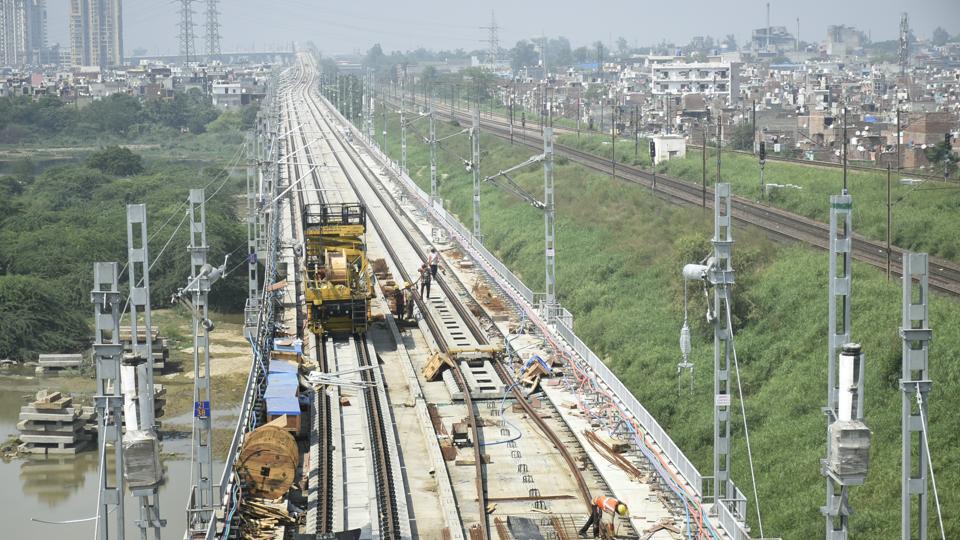
NCRTC officials said that the test was conducted at the Duhai depot in Ghaziabad and the new signalling system will provide the backbone for operation of high-speed RRTS trains, automatic train operation, automatic train protection, communication of the control centre with the trains and also with other control centres for a seamless and smooth train operation.
Officials said that the RRTS trains will have a design speed of 180 kilometres per hour (kmph) and an operation speed of 160kmph, while the average running speed will be 100kmph.
“This requires a reliable and high-speed network which is critical for train operation. It is for the first time that ETCS level-2 signalling has been tested and synchronised on the LTE network. This will lead to faster operations, smooth communication and efficient service,” said Puneet Vats, chief public relations officer,NCRTC.
The ETCS level-2 is a radio-based system through which the train continuously sends data of its direction and location to the control centre. LTE (long term evolution) is a standard for wireless data transmission and is much faster than technologies such as 3G.
“This technology will be the backbone of the signalling network for the RRTS project and will efficiently facilitate communication between control centre and trains, trains and tracks, tracks and signals, among others,” Vats added.
Officials said that the automatic train operation, in which drivers will have a minimal role, will be controlled by the control centre which has come up at Duhai for the 17-km ‘priority section’, which will commence operations in March 2023.
Two other control centres will come up at Jangpura in Delhi and Modipuram in Meerut, sources said.
“Train speed, directions and other automatic operations will require a high-speed and reliable signalling like the ETCS level-2 on LTE network. Further, different control centres will be able to communicate with each other efficiently. This signalling is also synchronised with the platform screen doors (PSDs). The PSDs will open when the train arrives while the train will move only when all the PSDs have closed down. This will provide efficient and reliable passenger safety,” said an NCTRC officer.
The NCRTC has proposed 30 trains of six coaches each, besides 10 trains with three coaches each that will serve as a local transit module in Meerut.
The RRTS project is pegged at ₹30,274 crore.
The department of telecommunication (DoT) has temporarily allocated a spectrum in the 900MHz band for the commissioning of the LTE network for the priority section of Delhi-Meerut RRTS, officials said.
“This is for the first time in the world that a combination of the latest ETCS level-2, having automatic train operation over LTE radio is being deployed. I am happy that despite this technological challenge and serious supply-chain constraints posed by the Covid-19 pandemic, NCRTC successfully procured the ETCS level-2 signalling system under the ‘Make in India’ scheme and implemented it within the stipulated timeline,” said NCRTC managing director Vinay Kumar Singh.


