
 E-Paper



UPPCB’s survey to identify bad roads in Ghaziabad; to penalise erring agencies
Ghaziabad has been reeling under ‘severe’ air pollution with the daily air quality index (AQI), recorded by the Central Pollution Control Board (CPCB), oscillating between ‘very poor’ and ‘severe’ categories since October 31 this year.

 Prefer HTon Google


With the extended deadline for completing road repair works ending on November 15, the officials of the Uttar Pradesh Pollution Control Board (UPPCB) said on Tuesday that they have started a survey to identify the stretches where work is pending and to levy an environment compensation cost (ECC) from the errant agencies.
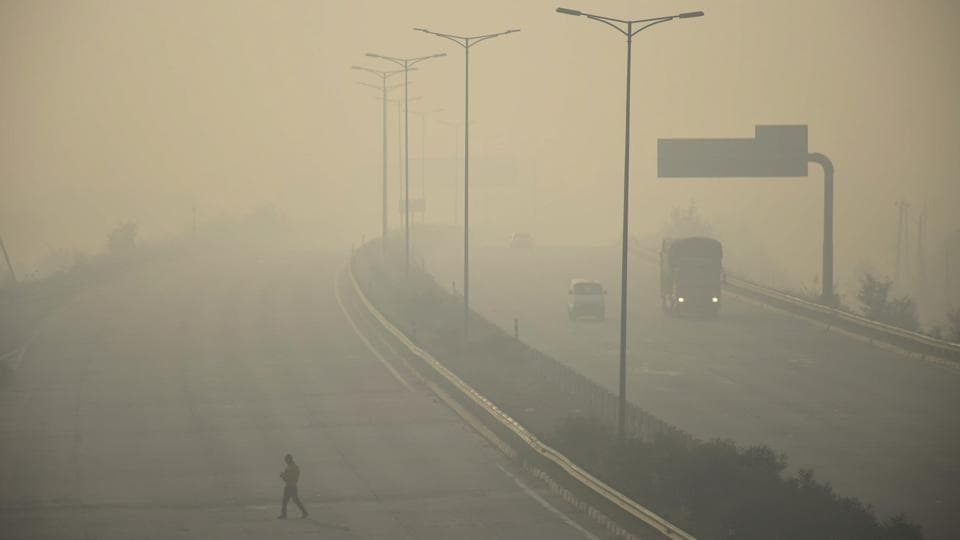
The Ghaziabad city has been reeling under severe air pollution with the daily air quality index (AQI), recorded by the Central Pollution Control Board (CPCB), oscillating between “very poor” and “severe” categories since October 31.
The city on Tuesday recorded an AQI of 356 while neighbouring Greater Noida and Noida recorded an AQI of 361 and 397, respectively, all figures falling in the “very poor” category.
An AQI between zero and 50 is considered “good”, 51 and 100 “satisfactory”, 101 and 200 “moderate”, 201 and 300 “poor”, 301 and 400 “very poor”, and 401 and 500 “severe”.
The officials of the UPPCB said bad roads also contribute to pollution and were to be repaired by November 15. “As the extended deadline — the original one was October 31 — has also expired, we have started a survey to identify the bad roads that are left to be repaired and levy an ECC from the errant agencies. The sub-committee of the Commission for Air Quality Management has also directed us to identify dusty roads,” said Utsav Sharma, regional officer, UPPCB.
When Hindustan Times made a cursory tour of the city, the team found bad stretches in Govindpuram, Patel Nagar 2, GT Road, Vijay Nagar link road, and BS Road industrial area, among others. The roads in all these parts are maintained by different agencies.
The sub-committee, in its latest directions, issued on November 13, has reiterated that states and agencies must increase the frequency of mechanised road cleaning and sprinkling of water, besides identification of road stretches having high dust generation.
“Bad road patches are a common feature in Ghaziabad and they cause high levels of dust emission, besides leading to snarls and posing a risk to commuters. Such patches lead to an increase in PM10 pollutant and also indirectly cause an increase in PM2.5 level — they cause snarls which lead to more vehicular emissions. The repair work should have been taken up on war footing before the start of the winter,” said Akash Vashishtha, a city-based environmentalist.
PM10 is particulate matter with a diameter of 10 micrometers or less and is inhalable into the lungs. PM2.5 is finer particles which can even enter the bloodstream.
The officials of agencies such as the Ghaziabad municipal corporation and public works department (PWD) said they have completed a majority of the work, but some portions remain.
“We have completed 98.2% of repair work but the work of resurfacing roads is left and it is estimated that about 20 to 22 roads are yet to be resurfaced. Since there is a ban on the operation of hot mix plants at present, we are unable to complete the work. Further, the extended monsoon and festival season also hampered the work progress,” said NK Chaudhary, chief engineer, Ghaziabad municipal corporation.
The sub-committee in their latest directions had also called for the closure of all hot mix plants and stone crushers in Delhi-NCR.
The officials of the PWD also said they have completed about 80% of the work on the roads maintained by them and the remaining work is being held up by the ban on hot mix plants.
“We need some more days to complete the work as there is a ban on hot mix plants and these works can be taken up only when the ban is lifted. We have also come to know that the deadline of November 15 is likely to be extended by another 15 days. But we are waiting for the written orders from the state officials. There were a lot of factors which affected the works and the UPPCB should consider these before levying any fine from us,” said Vimal Kumar, executive engineer, PWD.
On November 9, the pollution control board had taken cognisance of the under-construction CISF Road in Indirapuram and levied a cost of ₹25 lakh on UP Jal Nigam for not completing the work, while giving the agency the liberty to recover the cost from its contractor.


