
 E-Paper



Affluent pockets have high caseload, more hot spots
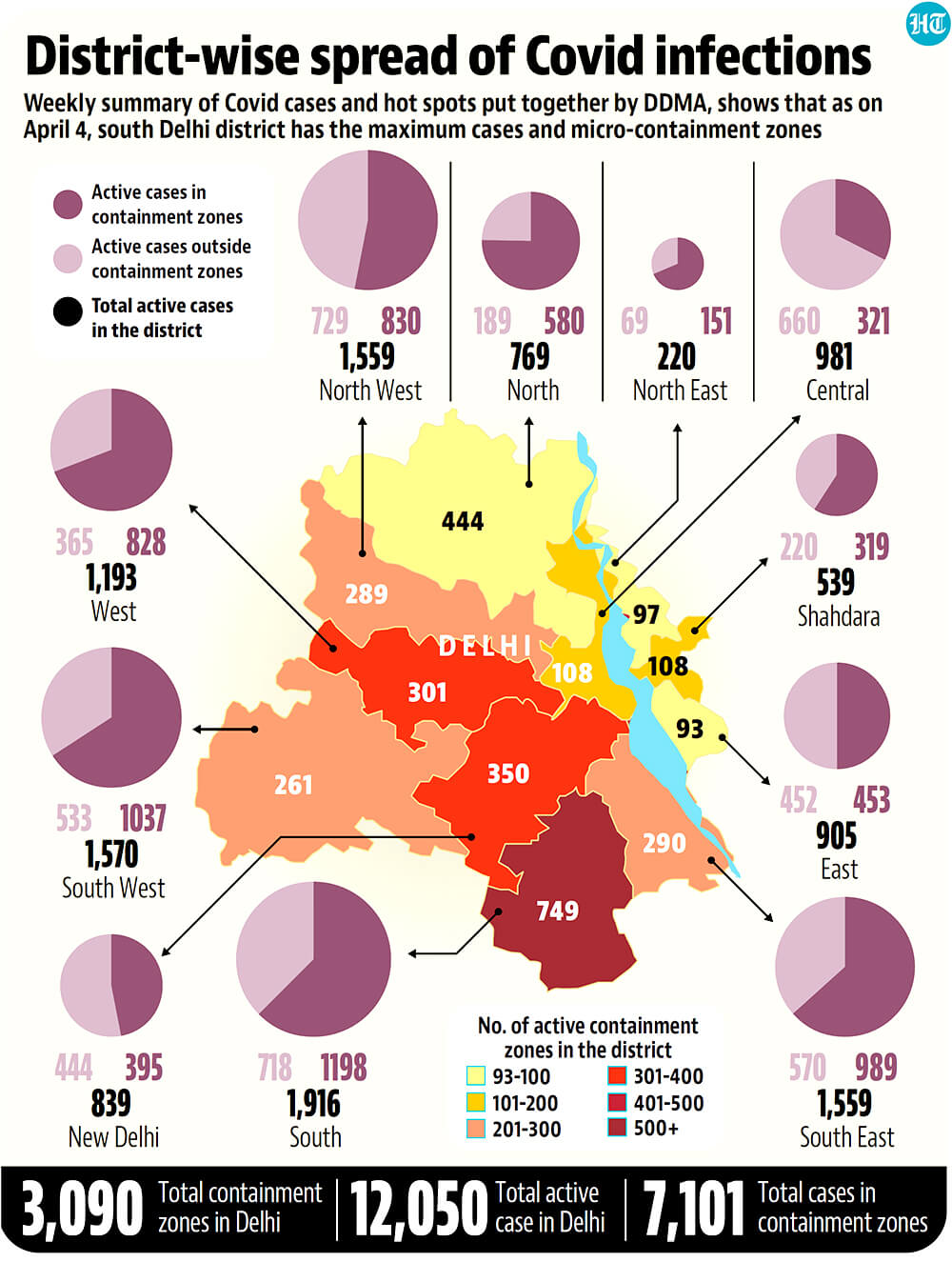
Of the 12,050 total Covid-19 active cases as on April 4 evening, 1,916 were in south Delhi, followed by 1,570 in south-west Delhi and 1,559 each in south-east and north-west districts in the city.


New Delhi: South Delhi district has the highest number of active Covid-19 cases and micro-containment zones as on April 4, a weekly summary of the cases of the viral infection and the hot spots in the national capital prepared by the Delhi Disaster Management Authority (DDMA) shows.

Of the 12,050 total Covid-19 active cases as on April 4 evening, 1,916 were in south Delhi, followed by 1,570 in south-west Delhi and 1,559 each in south-east and north-west districts in the city. The lowest number of cases are in neighbouring districts of northeast Delhi (220) and Shahdara (539), the DDMA report showed.
Also, as on April 4 evening, the report showed, of the 3,090 containment zones in the city, 749 were in south Delhi – the highest among the 11 revenue districts.
According to Delhi government’s daily bulletin, the total active cases in the capital on Tuesday stood at 17,332. The city reported 5,100 fresh cases on Tuesday -- the highest this year -- which came on the back of 103,453 tests -- the maximum ever.
As the Capital faces what experts call a fourth wave of Covid infections, the total number of active cases rose to 17,332 and total number of containment zones to 3,291 on Tuesday, the government’s daily health bulletin said. On Tuesday, the city recorded 5,100 new cases -- the highest daily spike in cases this year.
Senior officials in the revenue and health departments said that at this particular juncture, several affluent colonies in the city have a disproportionately high caseload, which also reflects in the high number of micro-containment zones created in these areas
Districts such as south Delhi, south-east Delhi, south-west Delhi and north-west Delhi – which top the list in terms of caseload – have relatively high number of planned colonies, gated communities and high-income localities, compared to districts such as north-east Delhi and Shahdara, which mostly have densely populated low-income group colonies and unplanned neighbourhoods.
Some of the localities that have been identified by the DDMA as high caseload areas include Vasant Kunj, Pitampura, Greater Kailash I & II, Dwarka, Rohini, Paschim Vihar, Vasant Vihar, Mukherjee Nagar, RK Puram and Lajpat Nagar, senior officials said, adding that each of these areas have 30 to 70 containment zones.
Delhi’s health minister Satyendar Jain said the government has scaled up testing and micro-containment efforts in these areas. “Experts have told us that in the previous waves of Covid-19 in the city, the densely populated areas witnessed extremely high caseload. So, the antibody prevalence is likely to be higher in those areas. That is one reason why in this particular wave so far, affluent colonies are witnessing high number of cases.”
Rajiv Kakria, member of the residents’ welfare group in Greater Kailash-1, said they were helping the government in efforts to curb the spread of the infection.“In colonies with a high number of cases, resident groups are helping with organising test camps, ensuring delivery of essential goods to doorsteps of home isolated patients, making separate arrangements for garbage collection from residences of patients and conducting awareness camps to boost the vaccination drive.”
Dr Lalit Kant, former head of the division of epidemiology and communicable diseases in the Indian Council of Medical Research (ICMR), said, “The government’s assessment makes sense in this regard. In the previous surge in cases recorded in last November, which was the worst so far, we have seen the virus rage through densely populated neighbourhoods, with disproportionately higher cases emerging in slums, unauthorised colonies and low-income localities. So, at this point of time, the antibody prevalence is likely to be high in such areas. That means, affluent colonies are likely to witness relatively high cases.”
More than 56% of the 28,000 people sampled during Delhi’s fifth serological survey in late-January this year were found to have developed antibodies against the Sars-CoV-2 virus.
In 2020, Delhi witnessed three distinct phases of severe spikes in Covid-19 cases – in June, September and November. At its worst, the Capital recorded 8,593 new cases in a day on November 11.

Stay updated with all top Cities including, Bengaluru, Delhi, Mumbai and more across India. Stay informed on the latest happenings in World News along with Delhi Election 2025 and Delhi Election Result 2025 Live, New Delhi Election Result Live, Kalkaji Election Result Live at Hindustan Times.


