
 E-Paper



After ‘exodus,’ Kairana wants growth song on playlist now
Kairana is the birthplace of Ustad Abdul Karim Khan, a doyen of Hindustani classical music, who founded famous Kairana Gharana with his brother Ustad Abdul Wahid Khan.

 Prefer HTon Google


Once famous for the soothing sound of classical music, Kairana lapsed into notoriety as the talk of exodus struck discordant notes and now it yearns to be in tune with the developmental momentum seen across Uttar Pradesh.
Kairana is the birthplace of Ustad Abdul Karim Khan, a doyen of Hindustani classical music, who founded famous Kairana Gharana with his brother Ustad Abdul Wahid Khan.
The issue of exodus reared its head when the then BJP MP Hukum Singh turned the spotlight on the alleged mass migration from the town in 2016-17 when the Samajwadi Party was in power in Uttar Pradesh. Soon, it became a national issue.
Many seasons later, with a change of regime bringing the BJP to the helm, Kairana has moved on and exodus is no longer a reality here but memories of the controversy remain.
Anil Chauhan,60, a BJP leader with family ties to the late Hukum Singh, said exodus is no longer prevalent after the BJP came to power in the state.
He admitted, “Palayan (exodus) brought a bad name to Kairana and had an adverse affect on its development. It was not a political issue but the fallout of a bad law and order situation.”
Good governance, infrastructure development, business growth, and a better future for the next generation are the key aspirations of the 17,14,758 voters of this constituency.
“We want to regain our past glory and erase the blot,” said Vipul Jain, president of UP Udyog Vyapaar Pratinidhi Mandal in Kairana.
He also claimed “palayan’ was a political agenda, which gave a bad name to the city and inflicted a heavy toll on its growth and development.”
Shamli Industrial Estate Manufacturing Association president Ankit Goel said, “The palayan issue affected the industrial growth of the area as industrialists chose to establish their new projects elsewhere.”
The association that Goel heads here represents over 250 industrial units.
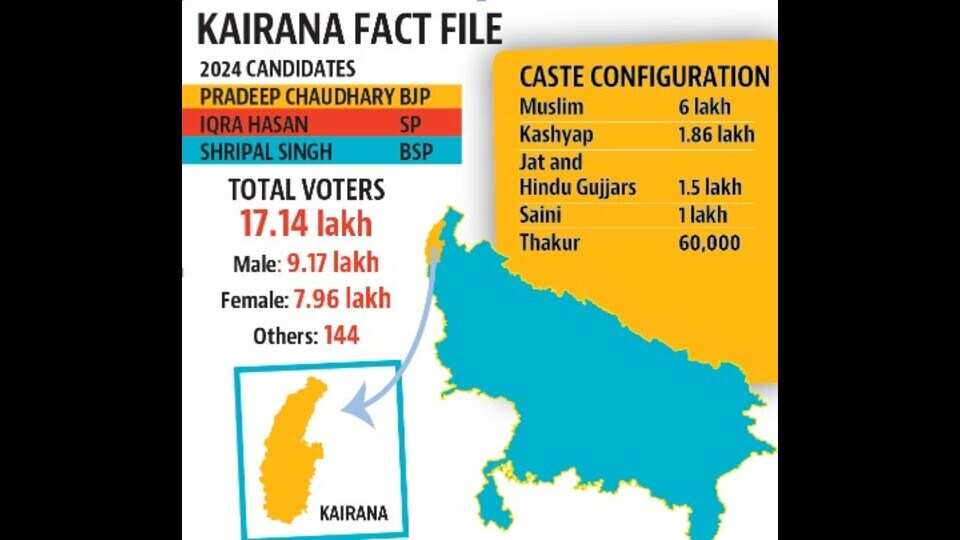
The sitting BJP MP Pradeep Chaudhary is seeking a second term from Kairana. Samajwadi Party candidate Iqra Hasan and Bahujan Samaj Party’s Shripal Singh are his main challengers.
About exodus, Iqra Hasan claimed, “There was no such issue. A few families moved out in search of jobs and to do business and (for) fear of a few goons. But, it was twisted and made a political issue.”
Pradeep Chaudhary and the late Hukum Singh’s daughter, BJP leader Mrigank Singh were not available for comment on the issue as they were busy on the campaign trail.
Kairana has five assembly constituencies with 9.17 lakh male and 7.96 lakh female voters and 144 others.
It is a Muslim community-dominated constituency with 6 lakh Muslims, including Muslim Gujjars, 1.86 lakh Kashyaps, 1.5 lakh Jat and Hindu Gujjars, one lakh Sainis and about 60,000 Thakurs.
Hindustan Times spoke to a cross-section of people in this constituency, including farmers of various communities, business representatives and the general public, to assess the possible voting pattern in the first phase of Lok Sabha election scheduled on April 19.
Ashok Sharma, a farmer and former pradhan of Ramsahaywala village said, “Farmers’ issues inflation, unemployment are among the people’s concerns.”
Satish Jain, president of the Indian Industries Association (IIA) of Kairana, said, “Law and order has improved, but corruption still needs to be curbed at the lower level.”
IIA is an apex representative body of micro, small and medium enterprises (MSME) with a strong membership base of about 9919 units with a total turnover of over ₹500 crore annually.
Satish Jain said this industrial cluster employs more than 18,000 people in various industries, such as rural multi-utility vehicles like tractors, matchboxes, garbage management units, paper mills, disposable items and utensils.
Ankit Goel said 80% employees are locals, a majority of them Muslims. They are now skilled hands contributing to the development and growth of the area.


