E-Paper



Gyanvapi survey continues, ASI gets extension to submit report
A 41-member ASI team, led by the agency’s additional director general Prof Alok Tripahi, began the survey at 8am and it lasted till 5pm. The process was stopped at 12.30pm for two hours to allow Muslim devotees to pray at the 17th-century mosque

 Prefer HTon Google


The Archaeological Survey of India (ASI) on Saturday continued the scientific survey of the Gyanvapi mosque premises, abutting the Kashi Vishwanath temple, for a second consecutive day amid tight security, even as the Varanasi district court granted the Union government agency an additional four weeks to submit its report by September 2.
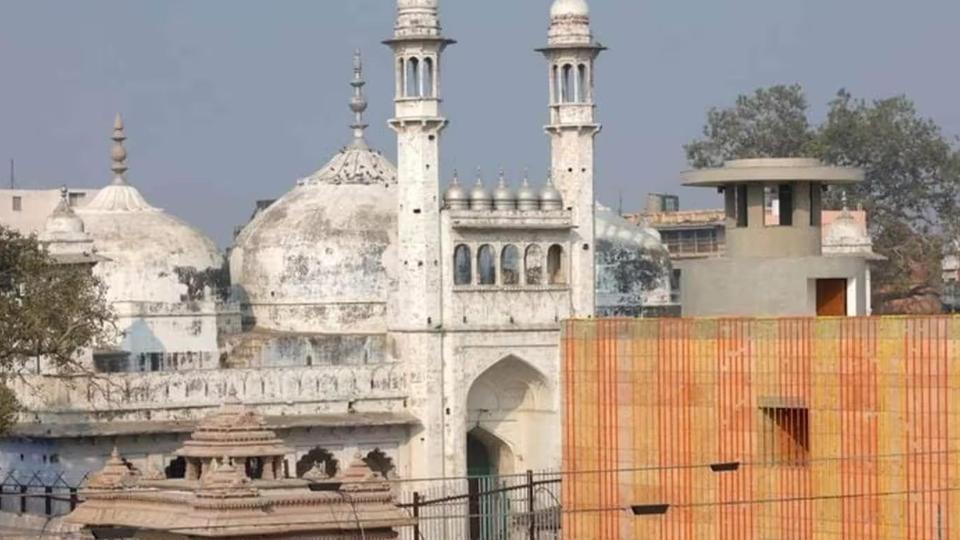
A 41-member ASI team, led by the agency’s additional director general Prof Alok Tripahi, began the survey at 8am and it lasted till 5pm. The process was stopped at 12.30pm for two hours to allow Muslim devotees to pray at the 17th-century mosque. The ASI team resumed the survey at 2.30pm.
For the first time, representatives of the Muslim side also took part in the survey process. Mumtaz Ahmad and Akhlaque Ahmad, counsel for Anjuman Intezamia Masjid Committee, which manages the Gyanvapi mosque, also accompanied the survey team. The Muslim side did not participate in the survey on Friday.
Counsel for the Hindu plaintiffs said that remains of idols were found in the basement of the mosque during the ASI survey on Saturday, a claim rejected by the Muslim side.
“The south basement was dirty. It was cleaned at the behest of ASI. The team did 3-D imaging of the basement as well as mapping of the entire hall. The ASI team also minutely surveyed the pillars and frame (of the door),” Anupam Dwivedi, counsel for a Hindu plaintiff, said. “The Muslim side fully cooperated in the survey on Saturday.”
Also Read: Findings of day 2 survey at Gyanvapi mosque
Sudhir Tripathi, another counsel for Hindu plaintiffs, said, “The ASI team started the survey at 8am. This survey is comprehensive and everything is happening in a scientific manner.”
Tripathi claimed that remains of Hindu idols were found in the basement near the statue of Nandi bull.
Akhlaque Ahmad, however, refuted the claim. “No remains of idols have been found in the south basement. No signs were found there. I was present in the survey. My senior colleague, advocate Mumtaz Ahmad, was also there,” Ahmad said. “The ASI team is doing its work in a scientific manner. We fully cooperated in the survey.”
Muslim devotees offered namaz (prayer) on Gyanvapi premises in the afternoon, he said, adding they will participate in the survey on Sunday as well.
“Do not pay any attention to the rumours, keep ignoring the statements of the people, this is for the good of all,” SM Yasin, the joint secretary of Intezamia committee, appealed in a letter on Friday. “Let us hold fast to the mantra of peace-restraint-harmony.”
Meanwhile, the Varanasi district court granted an additional four weeks to the ASI to complete the survey and file a report by September 2. District judge Ajaya Krishna Vishvesha passed the order on an application for extension filed by the ASI on Friday, which was the earlier deadline for completion of survey process.
“On Saturday, the court granted four weeks’ time and ordered the ASI to submit a report of the scientific survey of Gyanvapi by September 2,” said Amit Kumar Srivastava, standing counsel for the Union government.
Srivastava submitted before the court that the ASI could not conduct the survey citing a stay on the process till August 3.
“We urged the court to give four weeks’ time to the ASI for submitting report in terms of the order dated July 21, which has been affirmed by the order of the Allahabad high court dated August 3,” Srivastava said. “The court accepted our prayer.”
The survey restarted on Friday after the Allahabad high court cleared the decks for it the previous day, holding that scientific investigation was necessary in the interest of justice and would benefit both parties.
On July 21, the Varanasi court ordered the scientific survey of the Gyanvapi mosque to determine whether it was constructed over a pre-existing structure of a Hindu temple.
Following the order, the ASI conducted a survey on July 24 before the Supreme Court on the same day halted the exercise till 5pm on July 26 while allowing the Muslim side to approach the Allahabad high court against the lower court’s order. On August 3, the high court dismissed its petition and allowed the survey. The Muslim side then approached the Supreme Court, which refused to stay the high court order on the ASI survey on Friday.
The top court bench of chief justice of India (CJI) Dhananjaya Y Chandrachud and justices JB Pardiwala and Manoj Misra, however, asked the ASI not to carry out any invasive act during the survey. The order came hours after an ASI team already resumed the detailed survey as ordered by the district court.
The ASI team conducting the survey of Gyanvapi mosque also included experts from Lucknow, Agra, Jhansi and Patna.
Advocates representing the Hindu side, Vishnu Shankar Jain and Subhash Nandan Chaturvedi, along with women plaintiffs Rekha Pathak, Sita Sahoo and Manju Vyas, also participated in the survey.
“Mapping, imaging and measurements of the building of Gyanvapi, excluding its sealed area, is being done by ASI, and every inch of the building is being studied deeply,” said Jain, counsel for four Hindu women plaintiffs.
On Friday, the ASI team took measurements of the barricaded area and created a map. Thereafter, it collected soil samples, Chaturvedi said.