
 E-Paper



Businesses honk for help as e-rickshaws stall streets and sales
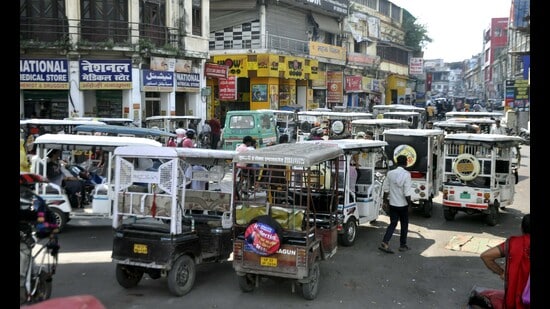
In bustling market areas like Aminabad, Latouche Road, and Hewett Road, e-rickshaws have become a common sight, often utilised for transporting goods rather than passengers.


LUCKNOW For years, small business owners and shopkeepers across Lucknow have been grappling with the challenges posed by the unchecked proliferation of e-rickshaws. From encroachments outside their establishments to safety hazards caused by reckless driving, trade and business associations are increasingly frustrated with the growing presence of these three-wheelers.
E-Rickshaws: The Market Menace
In bustling market areas like Aminabad, Latouche Road, and Hewett Road, e-rickshaws have become a common sight, often utilised for transporting goods rather than passengers. Gopal Dixit, president of Shivaji Marg Lucknow Vyapar Mandal, lamented, “The entire Hewett Road (Shivaji Marg) is a commercial area, and the e-rickshaws have become a major nuisance here. They occupy parking spaces outside every shop, causing congestion throughout the day.”
Similar concerns echo from other trade associations, such as those covering Talkatora Road and Alambagh crossing. E-rickshaws and autos without permits frequently clog left lanes, despite the absence of designated three-wheeler stands, exacerbating the scarcity of space on the streets. Amarnath Mishr, Chairman of Lucknow Udyog Vyapar Mandal, pointed out, “While the police conduct anti-encroachment campaigns, e-rickshaws return within days due to insufficient vigilance.”
He added, “Businesses in areas like Chowk, Mahanagar, Munshipulia, and Indiranagar are severely affected, especially during mornings. While the police readily fine common citizens for traffic violations, they have failed to control e-rickshaw encroachments. We don’t expect drastic measures against the drivers, but we do need better administrative checks and balances.”
Traffic Woes Persist On Banned Routes
Vinod Punjabi, President of the Hazratganj Traders’ Association, highlighted that Hazratganj, despite being one of the 11 banned routes for e-rickshaws, still witnesses their unauthorised entry through narrow alleys. “This disrupts the flow of traffic in an area with approximately 120 shops, inconveniencing both shoppers and shop owners,” he said.
“Additionally, it poses a safety hazard for senior citizens.” Regarding the enforcement of the ban, Punjabi noted, “Though the number of e-rickshaws has reduced since the ban, there are still more of them than the traffic police can handle.”
Bottlenecks At Crossings
The traders’ association of Munshipulia faces similar issues. In a letter to the Joint Commissioner of Police, signatories Santosh Tripathi, Nitin Jain, and Yashpal Singh expressed concerns about e-rickshaws causing massive traffic jams at the Munshipulia crossing and engaging in confrontations when asked to drive or park responsibly.
Mishr of Lucknow Udyog Vyapar Mandal emphasised, “The lack of designated pick and drop spots for e-rickshaws leads to their clustering at intersections, resulting in major traffic jams.”
Using Passenger E-Rickshaws As Load Carriers
An excessive number of load-carrying e-rickshaws are frequently parked in market areas, further limiting space for business owners and shoppers.
Md Alam, the regional transport officer (enforcement), said, “E-rickshaws are supposed to be categorised as either passenger vehicles or load-bearing vehicles at the time of registration.” He added, “Of the e-rickshaws active in Lucknow, approximately 90% are registered as passenger vehicles, and the remainder as load-carrying vehicles.”
The deputy commissioner of police (traffic), in a letter to the JCP (law and order), noted that the city’s e-rickshaw population far exceeds its operable capacity. With a lack of official parking spaces and e-rickshaw stands, managing their numbers and movements has become an even more challenging task.


