
 E-Paper



Civil society, police discuss Gurugram-based issues
The issues were discussed at HT Gurugram’s First Dialogue, a civic platform created to shift the discourse on the city from merely identifying problems to solving them through coordinated engagement among residents, experts and authorities.


The enforcement of traffic rules will be strengthened in hot spots and black spots, senior police officers said on Saturday, as police and experts came together to discuss public issues of key importance at HT Gurugram’s First Dialogue, a civic platform created to shift the discourse on the city from merely identifying problems to solving them through coordinated engagement among residents, experts and authorities.
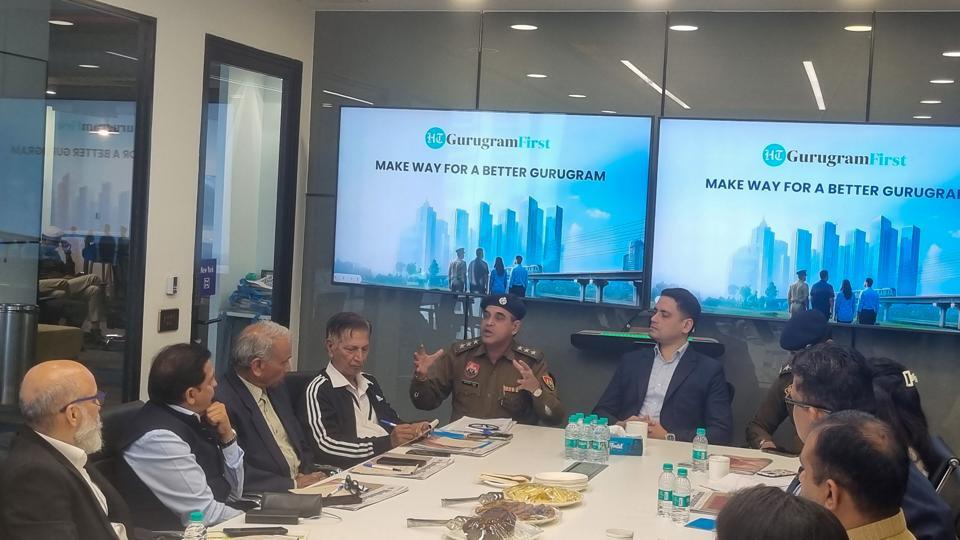
In the first iteration, residents’ welfare associations (RWAs), road safety experts, members of the Raaghiri Foundation, a citizens’ group, and senior police officers discussed public issues and the way forward.
Karan Goel, deputy commissioner of police (west), said the police welcomed such platforms because they bridge gaps between enforcement and lived experience. “Our priority is to listen and understand what residents are facing on the ground. When RWAs share issues collectively, it helps us respond faster and more effectively,” he said.
Traffic safety dominated much of the discussion, with RWAs flagging speeding, wrong-side driving, illegal parking and unsafe pedestrian stretches across neighbourhoods. The sessions will be held every month,to follow-up on issues, track progress and brainstorm ideas.
Additional commissioner of police (traffic) Satyapal Yadavassured residents that enforcement would intensify in hot spot zones. “We are mapping every choke point shared today. There will be targeted action, more marshals on the ground and stricter checks on wrong-side driving,” he said.
Cybercrime emerged as a major worry, with several RWAs reporting sharp increase in fraud cases.
ACP (Cybercrime) Priyanshu Dewan said the nature of scams had evolved rapidly. “Most victims are losing money within minutes. Awareness and quick reporting to 1930 is critical. We will conduct sector-wise workshops to strengthen digital safety,” he said.
Participants emphasised that consistent engagement, not one-off meetings, was key to building trust.
Bhawna Jha, representing the Raahgiri Foundation, said, “Safety and mobility improve only when residents and authorities work together. Platforms like this create the momentum needed to shift behaviour on the streets.”
“Gurugram is becoming increasingly car-centric, driven by residents’ purchasing power. Instead, the focus should be on promoting public transport, which can ease mobility for everyone. Strong public transportation could easily resolve at least half of the city’s traffic problems and chaos,” Jha said.
“Many of the residences face serious hyper-local civic issues, which are rarely discussed in mainstream media. Through this opportunity and platform provided by HT, we were able to voice our concerns to senior most officials and cops in the city who can help us in resolving them,” said Anil Kumar, representative of Tulip Violet’s RWA in Sector 69.
Mukul Aggrawal, general secretary of the DLF Phase 1 RWA, said such monthly meetings provide residents with a valuable platform to raise their issues.


