Delhi Police have written to the Central Reserve Police Force (CRPF) seeking details on the anti-riot measures used, the number of tear gas shells fired, and the types of pellets used, if any, during the sprawling student protests last month that eventually forced the resignation of the Union education minister.
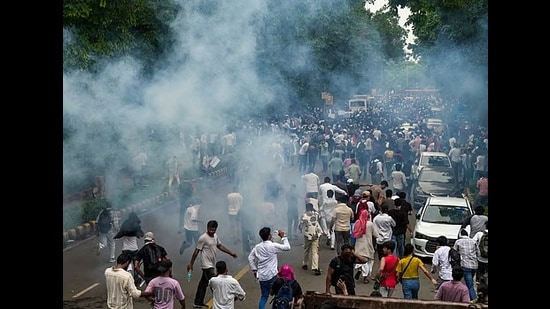
The letter – confirmed by a senior CRPF officer and two Delhi Police officers – comes amid a controversy over allegations of excessive force and pellet gun usage during the July 20 protest that left over a hundred agitators injured. The Supreme Court is hearing a batch of petitions on the issue, including one demanding a ban on pellet guns.
HT has reported that five people – Sheikh Irshad Mansuri, a 25-year-old employee with a private firm, Nootan Toppo, a 32-year-old woman from Gurugram, a 28-year-old reporter, Prashant Singh, a 25-year-old Bihar resident, and 19-year-old Sahil Lochab, a student aspiring to join the police force – have alleged (in Lochab’s case the allegations were made by the family) that they were hit with pellets on July 20.
Last week, Union minister Jitendra Singh told Parliament that no bullets were fired during the protest.
{{/usCountry}}Last week, Union minister Jitendra Singh told Parliament that no bullets were fired during the protest.
{{/usCountry}}Also read: Pellet guns allowed 'in exceptional cases', says Supreme Court; CJP reacts with 'disgusting'
Police seek details of crowd-control measures
Two senior police officers in the Delhi Police confirmed that a letter was sent last week to get details from the Rapid Action Force’s Delhi unit on all anti-riot measures adopted by the force on July 20 and deployment details for other days. The officials cited above said that police sought details of all measures in order of the sequence that was adopted. RAF’s anti-riot measures have different gradients (levels) according to the standard operating protocol.
“It’s a regular inquiry. We have asked them what all anti riot measures were used, if pellet guns were used and what kind of pellets were used, fully metal or partially metal. We are also compiling details of other measures including lathi charge, use of tear gas and details of injured persons, since we are also investigating what all measures had to be used to control huge crowds,” said one of the police officers cited above.
Also read: Supreme Court opens door for withdrawal of FIRs against student protestors
A senior CRPF official confirmed the letter and is preparing a report. It is unclear whether they will submit the report to the government or to the Delhi police.
Police said they asked for deployment numbers, types of weapons used and carried by RAF, said the second police officer cited above.
“The RAF control room has collected information from their personnel on all measures that were adopted. The details are as specific as the number of tear gas shells, grenades and the timing of lathi charge. It must have been submitted to the New Delhi district police by now. The RAF control room headquarters sought this report last week from the battalion that was deployed in Jantar Mantar,” an officer in CRPF said.
The CRPF spokesperson did not comment on the development.
CRPF prepares detailed report
Another CRPF officer, who asked not to be named, said, “It is not unusual to send a small report on the course of action adopted by central armed police forces during their deployment. But this is usually a small one-page report — regular paperwork. This time it looks like a detailed report on the type of measures and the specific details, including the type and number of anti-riot measures adopted that day. The CAPFs also collect what is known as COI(Card of Information) that is signed by either a magistrate in case of states or DCPs in case of police commissionerates like Delhi. The COI contains details of who authorised the use of what force. This COI is submitted to the RAF control room.
Pellet gun allegations under scrutiny
The controversy over the conduct of security forces during the July 20 protest has only escalated after the student stir at Jantar Mantar was called off last week following the resignation of Pradhan. At least two rounds of pellets were used on July 20 on the orders of a deputy superintendent of the Delhi Police, according to the statement of a RAF deputy commander recorded in a general diary entry at the Parliament Street police station.
The diary entry – filed at 1.24am on July 22 by a Delhi Police sub-inspector and seen by HT – was the first document that showed the usage of pellets on July 20.
It is unclear if the forces used metallic or plastic pellets – both of which are available in the inventory. RAF is a specialised unit within CRPF deployed to handle riots and other public disturbances across the country. CRPF has already instituted an inquiry into the allegations.
Also read: SC to examine Centre’s SOPs on pellet gun use amid row over alleged use on student protesters
Internal enquiry
HT has previously reported that a RAF internal enquiry noted several deviations from SOP — such as personnel being caught on tape tripping students to make them fall, using unnecessary force, removing name tags, and giving interviews to social media influencers.
But CRPF chief GP Singh – who has not publicly commented on the allegations of pellet gun use – has defended the force, saying that he took responsibility for decisions and actions “carried out in bonafide discharge of their duties.”