
 E-Paper



Supreme Court opens door for withdrawal of FIRs against student protestors
Supreme Court clarifies eligibility for withdrawal of criminal cases against student protesters, allowing states to close FIRs without serious offenses.

 Prefer HTon Google


The Supreme Court on Monday said it was willing to facilitate the withdrawal of criminal cases against student protesters, clarifying that its previous order did not stand in the way of governments closing or withdrawing FIRs against eligible students and that only those with “grave and heinous” criminal antecedents would fall outside the protective umbrella granted last week.
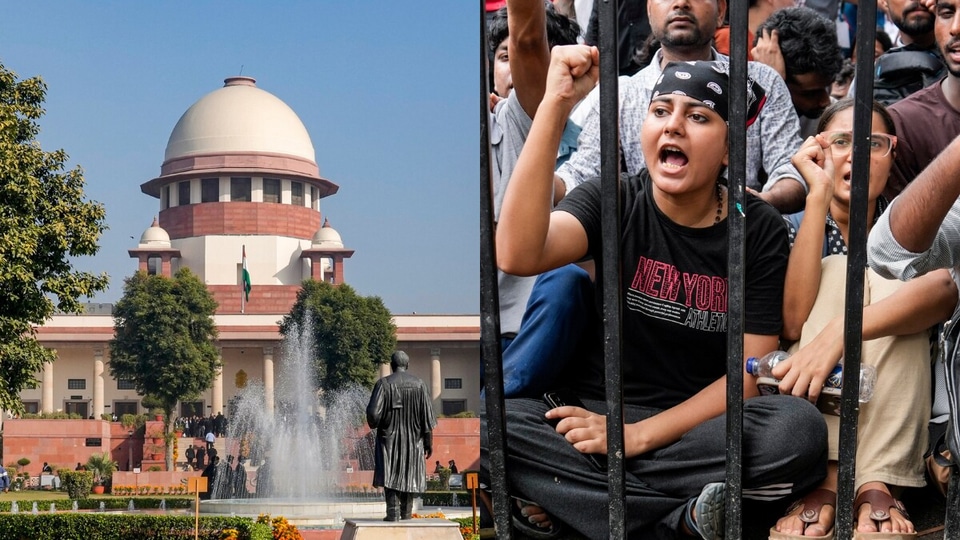
The court’s clarification was welcomed by the Cockroach Janta Party, and its spokesperson Saurav Das said: “Another major victory was achieved for the youth. The Supreme Court clarified that the states that wish to withdraw the FIRs will have the liberty to do so, and the Supreme Court’s [earlier] order will not interfere with that.”
The court’s comment came after Solicitor General Tushar Mehta, representing the Centre and the Delhi police, reiterated the Centre’s commitment to withdrawing cases against eligible protesters, saying the issue was now one of legal procedure rather than intent.
Also Read | Can students be punished for protesting? Here's what the Constitution says
That was likely a reference to the court’s direction on July 28. Senior advocate Gopal Sankaranarayanan submitted that this previous direction permitting investigation to continue was being construed as an impediment to the withdrawal of FIRs, while senior advocate Abhishek Manu Singhvi pointed out that the phrase “criminal antecedents”, again used in that direction, could cover even trivial offences.
Bench considers wider probe into protest violence
In response, a bench, comprising Chief Justice of India Surya Kant and justices Joymalya Bagchi and V Mohana, clarified its July 28 interim order to state that Delhi and all other states would be “at liberty to close/withdraw cases in accordance with law”, and that the expression “criminal antecedents” used in the earlier order referred only to grave and heinous offences.
The bench repeatedly emphasised that it did not want criminal cases to continue hanging over the future of students.
“If both of you agree on, we can facilitate the process so that FIRs do not keep hanging on the heads of the students,” it observed during the hearing after Mehta said: “The government is serious about its assurance on the withdrawal of FIRs...It may be a matter of following a process and semantics.” He added that those leading the protests were already in dialogue with the government.
Pellet gun use under judicial scrutiny
Appearing for former Intelligence Bureau special director Yashovardhan Azad and two pellet gun victims, advocate Vrinda Grover said the petitioners had been engaging with the government and stressed that the protesters were young people whose lives should not be permanently affected by pending criminal proceedings.
“These protesters are youth and they have their life ahead. Youth have to move on,” said Grover, while expressing concern that the statutory process for withdrawal of prosecutions could prove cumbersome.
The bench suggested that both sides work together to identify cases that could either be withdrawn by the public prosecutor or closed through appropriate police reports.
“Withdrawal within the legal framework is permissible,” observed the bench, urging the parties to “forge a convenient way”.
Also Read | No more protests at Jantar Mantar? Supreme Court to hear plea against suitability of Delhi site
At the same time, the court clarified that it was not directing withdrawal in every case.
“We are not asking you to withdraw the FIRs against murderers,” remarked the bench after the solicitor general informed the court that 2,738 persons facing charges such as murder, rape, kidnapping and offences under the POCSO Act had been identified among the protestors.
To be sure, it is not clear why the police had not acted against them earlier, or how all of them happened to turn up at the protest site.
The bench also disclosed that it was considering constituting two separate mechanisms -- a special investigation team comprising serving and former senior police officers to examine cases that are not withdrawn or closed, and a committee headed by a former judge to inquire into other issues arising from the nationwide protests.
Addressing concerns raised by petitioners over alleged police excesses, the bench said it wanted to ensure that neither police officials accused of wrongdoing nor persons responsible for violence escaped scrutiny.
“Let no such impression go that the police officials taking the law into their own hands are protected or those creating violence under the garb of protest are protected,” it underlined.
Underscoring the human dimension of the litigation, the court added: “We have to see that children are not dragged into any legal problem...this is also for the parents who with their hard-earned money have funded their education.”
The bench also continued its examination of the alleged use of pellet guns during the July 20 “Sansad Chalo” protest. When Grover submitted that no standing order of the Delhi Police authorises their use, the court indicated that it intended to frame comprehensive guidelines governing whether pellet guns may be deployed at all and, if so, under what circumstances.
Also Read | 'Withdraw FIRs now': CJP to BJP after top court clarifies order on protest-linked cases
“We would like to lay down a comprehensive protocol on whether this can be used or not and if so, under which situations,” it said.
Next hearing on August 18
The proceedings arise out of a batch of petitions concerning alleged police excesses during student protests over the NEET examination controversy. In its July 28 order, the Supreme Court had found that the allegations disclosed a prima facie case warranting an independent probe, directed preservation of electronic evidence, restrained coercive action against peaceful student protesters and ordered the release of detained minors without criminal antecedents, while making it clear that protection would not extend to persons with criminal antecedents.
The matter will next be heard on August 18. The protestors called off their campaign on July 25, after Union education minister Dharmendra Pradhan resigned.



