
 E-Paper



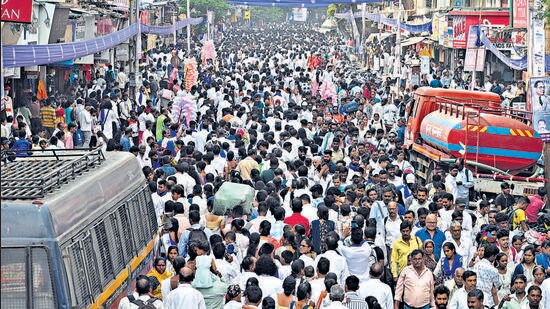
Fired by Ambedkar’s ideals, lakhs throng Chaitya Bhoomi
From waterproof tents to stalls distributing free food, juice, tea and medicines, BMC and NGOs pull out all stops to woo Babasaheb’s followers


MUMBAI: Followers of Dr B R Ambedkar, who came in droves to his memorial Chaitya Bhoomi on Wednesday to pay their tributes on his 67th death anniversary, witnessed something unique there: an initiative called the ‘Ek Vahi Ek Pen Abhiyan’ (One Book, One Pen Movement). Datta Jawale from the Face of Ambedkarite (FAM) movement, the brain behind the enterprise, urged followers to ditch the usual floral offerings and instead donate notebooks and pens to impoverished Adivasi children in 29 zillas of Maharashtra.
“The flowers get dumped as nirmalya into the sea,” said Jawale. “It’s a waste of resources. Babasaheb would have been the first to request that the money invested in flowers be used for a fruitful cause instead.”
Forty thousand notebooks have been collected in the past 10 days, and on Wednesday alone, 5,000 notebooks along with pens were donated by 1 pm. Rajesh Ubale came from Chembur to donate four dozen notebooks when he read about the movement on social media. “Another person donated 2,000 notebooks,” said Jawale. “We will go to the zillas and Adivasi padas within Maharashtra and donate the notebooks and pens on January 3, Savitribai Phule’s birth anniversary.”
In earlier centuries, education was reserved for the upper castes, and the scheduled castes were not allowed into classrooms. This changed after the introduction of the Caste Disabilities Removal Act, signed in 1850 by the British. Theoretically, this was the first step forward towards social equality in India. Since then, the scheduled castes or Dalits have come a long way and laid emphasis on education. “ ‘Shika, sangathit vaha ani sangarsh kara (Get educated, unite and join the struggle),’ was Babasaheb’s core message,” said Sujit Jadhav, an electrical engineer.
Jadhav said that they had seen children in remote areas and orphanages evincing an interest in education but without the resources to fulfil their dreams. “It is difficult for people to even reach out in the interiors due to lack of roads, water and electricity,” he said. “Notebooks and pens are the least we can provide.”
Jadhav emphasied that the books would not be distributed on the basis of caste or religion. “The only thing we take into account is the children’s poverty,” added Sushim Kamble. “This movement is on in 15 districts of Maharashtra today.”
Around four lakh followers turned up at Chaitya Bhoomi this year. “We were expecting three lakh people but four lakh came,” said a senior BMC official. “It could be because the pandemic had deterred them for a couple of years or that social workers had convinced people in the interiors about the facilities provided by the BMC and that visiting Chaitya Bhoomi in great numbers would promote Dalit unity.”
The nearby Shivaji Park, spread over one lakh square feet, had a waterproof tent for Ambedkarites to stay as well as many stalls providing free food, water, juices, tea, books and medicines. They were all set up by the BMC, NGOs and self-help groups from across the state.
Deputy chief minister Ajit Pawar, among the politicians who came to Chaitya Bhoomi, said that the Constitution served to unite a big and diverse country like India. “His research thesis ‘The Problem of The Rupee’ written in the year 1923 has completed 100 years this year,” he said, adding that work on the Ambedkar memorial at Indu Mills was going on apace. The BMC distributed an information booklet ‘Global footprints of Babasaheb Ambedkar’ to the dignitaries.
From a dais at Shivaji Park, senior citizen Sunanada Jadhav from Jalgaon read out the Constitution in Marathi. “I am not educated,” she said. “I can read today courtesy of my grandchildren. I told them that the first book I wanted to read was the Indian Constitution written by Dr Ambedkar. It is because of him that we are even here. He is our ‘sarvasva’ (everything). He is our God.”
*****
Unique service for women
Members of NGO Bhakar Foundation distributed free sanitary napkins at the event at Shivaji Park. Founder Deepak Sonavane said that over one lakh women travelled to Chaitya Bhoomi every year. “Medical stores run out of stocks and in any case poor women cannot afford them,” he said. “While various camps, from eye check-ups to health check-ups are set up, there was no one distributing sanitary napkins. Hence, we decided to do this. A lot of women said our drive really helped them.” Around 15 volunteers distributed more than 2,000 sanitary napkins on Tuesday and Wednesday.
Hawkers lose out
While the BMC distributed free food to Ambedkarites, its license department teams took action against illegal hawkers selling food and other items inside and outside the park. Civic officials said that one van from each ward along with three to four officials were deployed in and around Shivaji Park. Action was taken by the department against more than 30 hawkers as of Wednesday afternoon.
Notes for Coins
The Reserve Bank of India, along with HDFC Bank, set up a counter where people could submit old, torn and damaged notes and get coins in return. Notes worth more than ₹1,50,000 were exchanged.
Wankhede Spotted
Controversial IRS officer Sameer Wankhede and his wife Kranti Redkar-Wankhede were seen at Chaitya Bhoomi, paying their tributes to Ambedkar.


